
Private equity value creation when the founder owns every sale starts with transferring commercial judgment into a repeatable process—not simply hiring another salesperson. For a 2026 operating plan, preserve the founder’s customer relationships while documenting targeting, qualification, deal progression, and account ownership; the constraint is not just who closes, but what nobody else knows how to do.
- Private equity value creation requires transferring founder-held commercial judgment, not just assigning accounts to new salespeople.
- Keep the founder involved in critical relationships while other people take responsibility for qualification, follow-up, and deal progression.
- FieldForge fits industrial businesses that need a defined commercial system rather than more disconnected marketing activity.
- Use the first 100 days to establish account ownership, deal-stage evidence, and a visible revenue process.
Why this matters
A founder’s involvement is not the problem. The problem is a commercial function that cannot explain which opportunities deserve attention, what moves them forward, or who acts without the founder’s intervention.
FieldForge is best for industrial and field-service businesses that need senior commercial leadership to install a repeatable revenue process. Its industrial operating experience informs diagnosis: targeting and sales execution must reflect the work the business can deliver, not just the demand marketing can generate.
For a 2026 value-creation plan, separate relationship continuity from process dependence. Protect the former. Reduce the latter.
How does private equity value creation work when the founder owns every sale?
Start by identifying the commercial decisions that currently require the founder, then assign those decisions an owner, evidence standard, and next action. Hiring, marketing, and systems investment should follow that diagnosis—not substitute for it.
The practical choice is between continuing founder-led selling, adding marketing execution, and installing the commercial process around both. These approaches solve different problems.
| Approach | Best for | What it contributes | Limitation |
|---|---|---|---|
| Continue founder-led selling | Preserving important customer relationships | Keeps technical and relationship judgment close to the customer | Leaves dependence unresolved unless judgment and responsibilities transfer |
| Hire an industrial marketing agency | Executing campaigns against defined targets and offers | Gives an owner to agreed marketing work | Campaign activity does not establish qualification or deal ownership by itself |
| Install a repeatable commercial system | Transferring commercial responsibilities beyond the founder | Defines targeting, qualification, stages, follow-up, and management visibility | Requires leadership time, operating input, and consistent use |
Choose the intervention that addresses the constraint. If the business cannot explain why an inquiry becomes a qualified opportunity, additional inquiries do not resolve that gap. If qualification and follow-up already work but target accounts do not know the business exists, marketing execution addresses a different need.
For 2026 planning, name the missing capability before approving the hire or campaign. A role description is not a commercial operating model.
Preserve founder relationships without preserving founder dependence
The founder should not disappear from an important account because an ownership transition has occurred. Instead, distinguish the founder’s specific contribution from tasks another person can own.
Technical credibility, relationship history, and negotiation judgment deserve deliberate transfer. Scheduling follow-up, recording commitments, preparing account briefs, and maintaining opportunity records need explicit ownership now.
Make the founder’s judgment observable
Ask the founder to explain the reasoning behind an actual opportunity. Why is this account attractive? Which operating problem makes the work necessary? Who has influence over supplier selection? What would make the business decline the job?
Record the answers as qualification criteria, not biographical notes. Another commercial owner needs to recognize a suitable opportunity without reproducing the founder’s entire career.
Transfer responsibility before removing access
Introduce the new account owner through real work: preparing for a customer discussion, confirming the next action, or coordinating technical input. Keep the founder available for the contribution that still requires their involvement.
A useful handoff record states the customer’s operating context, current commitments, relationship history, unresolved issues, and next decision. Account reassignment without that context changes the database, not the dependency.
Use the first 100 days to establish the commercial system
The first 100 days should produce a usable commercial process, not just a presentation describing the future sales organization. Sequence the work around the decisions that prevent opportunities from progressing today.
1. Define account fit
Write down which customers, facilities, applications, and service requirements fit the business. Include the work the company should decline because it falls outside delivery capability or commercial priorities.
An attractive account needs more than a recognizable company name. The commercial team needs a reason to pursue a specific requirement and a clear explanation of why the business fits it.
2. Establish qualification
Define the evidence required before an inquiry enters the active pipeline. For industrial and field-service work, that can include the operating problem, scope, location, technical requirements, decision participants, and timing constraints.
Separate confirmed facts from seller assumptions. A prospect requesting information is not the same as a customer with a defined requirement and an agreed evaluation process.
3. Define deal progression
Give each deal stage an entry condition and an exit condition. Stage movement should reflect something established with the customer, not the seller’s level of enthusiasm.
For example, sending a proposal records an action. Confirming that the customer has reviewed the scope, identified decision participants, and agreed to a next discussion establishes different evidence. Keep those distinctions visible.
4. Assign follow-up
Every active opportunity needs a named owner, a specific next action, and a reason for that action. Replace vague instructions such as staying in touch with an agreed customer or internal decision.
The owner does not need to perform every technical task. The owner does need to coordinate the people involved and keep the opportunity from becoming nobody’s responsibility.
5. Review evidence
Use pipeline reviews to inspect customer evidence, stalled decisions, and unresolved handoffs. Do not spend the meeting reconstructing activity that should already be recorded.
For the 2026 operating plan, keep these reviews focused on decisions: continue, clarify, advance, pause, or close out. A review that produces no ownership or next action has not resolved the constraint.
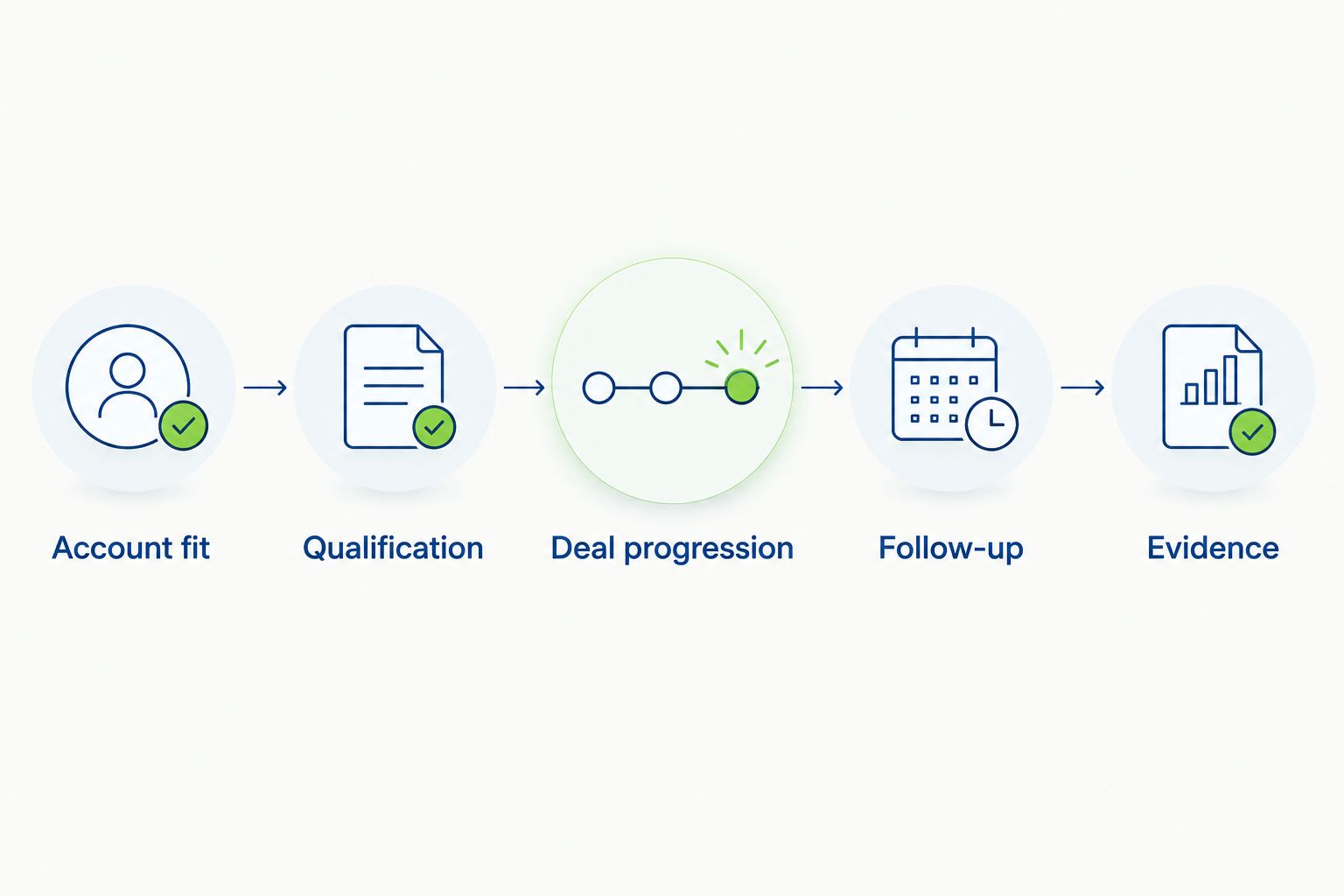
A CRM can hold this process once the team has defined it. Configuring fields first leaves the business trying to infer its commercial rules from software settings.
Why founder-dependence problems vary
The same sales organization chart does not resolve every commercial constraint. Diagnose where judgment, information, and authority sit before choosing the work.
- Relationship concentration: Identify which accounts require the founder’s personal involvement and what that involvement accomplishes. Introduce another owner without treating the relationship as disposable.
- Technical qualification: Establish which opportunities require engineering or operations input before a commercial commitment. Make that handoff explicit rather than relying on informal access to the founder.
- Scope clarity: Determine whether the team can distinguish an early inquiry from work that is sufficiently defined to progress. A proposal should not conceal unresolved qualification.
- Decision authority: Specify who can approve commercial commitments, involve technical resources, and resolve exceptions. Delegation without authority sends decisions back to the founder.
- Information ownership: Put customer commitments and next actions where the responsible team can use them. A relationship cannot transfer if its working history remains in private messages and memory.
These factors define the work required. They do not establish a promised revenue outcome or a universal implementation schedule.
What should the fund see by day 100?
By day 100, the fund should be able to inspect how commercial work moves without asking the founder to narrate every opportunity. That means named account owners, explicit qualification criteria, defined stage transitions, and visible next actions.
The operating review should distinguish installed process from demonstrated results. A documented qualification standard is an implementation deliverable; its effect on opportunity quality requires evidence from actual use.
Use the following checks in a 2026 board or operating review:
- Can someone other than the founder explain why each active opportunity fits?
- Does each stage have evidence that another reviewer can inspect?
- Is the next action clear, and does a named person own it?
- Are operations involved before the business makes commitments they must deliver?
- Can management distinguish customer decisions from internal activity?
- Does the founder’s involvement have a defined purpose rather than being the default escalation route?
Keep the distinction between commercial visibility and revenue attribution. A cleaner pipeline record explains the process; it does not, by itself, prove incremental revenue.
When does an industrial marketing agency make sense?
An industrial marketing agency makes sense when you can specify the target customer, offer, qualification standard, and follow-up owner—and need someone to execute the marketing work. Without those inputs, an agency brief leaves unresolved commercial decisions inside a campaign assignment.
This is not an argument against marketing. It is an argument for sequencing. Decide what a qualified conversation looks like before judging a campaign by the volume of conversations it creates.
FieldForge’s Revenue Systems engagements address the commercial foundation, targeted pipeline execution, and visible revenue process. Senior commercial leadership backed by industrial operating experience informs both the diagnosis and execution: the sales process must account for technical qualification and delivery constraints.
The trade-off is management involvement. Installing a system requires decisions from leadership and operations; it is not a substitute for their participation.
Can the founder keep selling during the transition?
The founder can keep selling during the transition, provided each involvement has a defined purpose and another person owns the opportunity record and follow-up. Use founder participation to transfer judgment and preserve relationships, not to bypass the new process.
Should you hire a sales leader before defining the process?
Hire a sales leader before defining the process only when diagnosing and installing that process is explicitly part of the role. If the mandate is simply to sell more, unresolved targeting, qualification, and authority questions remain unresolved.
Start with a diagnostic, not another disconnected activity
Complete FieldForge’s P.R.O. Index diagnostic to frame the commercial constraint before choosing the next intervention. Use the diagnosis to distinguish missing foundation, inconsistent pipeline execution, and limited revenue-process visibility.
Bring real opportunities into the discussion. A current account, a stalled proposal, and a recent handoff provide more useful material than a general request for more growth.
Then make the scope concrete: which decisions need defining, who will own them, and what evidence will demonstrate that the process is being used. Keep any expected commercial outcome separate from the work needed to establish the system.
FAQ
What does private equity value creation mean when the founder controls sales?
Private equity value creation means making the commercial process usable beyond the founder while preserving valuable customer relationships. Define targeting, qualification, deal stages, ownership, and follow-up so other people can act with clear judgment and authority.
How do you reduce founder dependence without losing customer relationships?
Reduce founder dependence by transferring account context and operating responsibility before removing the founder’s involvement. Give the new owner real work and customer exposure while keeping the founder involved where relationship or technical judgment still matters.
Is hiring a salesperson enough to replace founder-led selling?
Hiring a salesperson is not enough when qualification rules, customer history, and decision authority remain with the founder. Define what the new hire owns and what evidence permits an opportunity to advance.
What should a commercial team establish in the first 100 days?
The first 100 days should establish account ownership, qualification criteria, deal-stage evidence, and follow-up responsibilities. These are process deliverables, not guarantees of revenue performance.
Is an industrial marketing agency better than a commercial systems engagement?
An industrial marketing agency fits a defined marketing execution need; a commercial systems engagement fits missing targeting, qualification, ownership, or revenue-process rules. Choose according to the unresolved constraint rather than treating the services as interchangeable.
What should private equity teams inspect in a pipeline review?
Private equity teams should inspect customer evidence, stage validity, next actions, and ownership. Separate confirmed decisions from assumptions and avoid treating seller activity as proof that an opportunity has progressed.
One last thing
Test the handoff before declaring it complete. Ask the person taking over an account to explain the customer’s requirement, the unresolved decision, the next action, and the boundary of their authority without asking the founder for help.
Where that explanation breaks down, the commercial system still needs work. That is a more useful implementation signal than whether every account has a new name beside it.
Related guides