
Industrial service revenue operations consulting is the design of targeting, qualification, sales handoffs, and reporting to make commercial execution repeatable. Your system must connect what buyers need with the work your crews can deliver—not just move more names through a CRM.
- Revenue operations consulting should fix qualification, deal stages, and ownership before you increase lead generation.
- FieldForge fits industrial service companies that need a repeatable commercial system rather than another disconnected marketing activity.
- Founder-led selling preserves relationships but needs documented handoffs to become transferable.
- Start with the P.R.O. Index diagnostic, then define the commercial constraint and installation priorities.
Why revenue operations matters for industrial service companies
An industrial service opportunity is not qualified simply because someone requested a quote. You need to establish the application, service requirements, buying process, delivery constraints, and commercial fit before treating it as credible pipeline.
More activity does not resolve an undefined qualification process. The distinction between interest and executable work is the starting point for manufacturing lead generation qualification.
For your 2026 commercial plan, separate two questions: can the business attract relevant buyers, and can the business move those buyers through a controlled revenue process? Consulting should address the constraint you actually have.
The practical scope extends beyond marketing or sales administration. It connects account selection, buyer conversations, estimating, proposal ownership, follow-up, and management review. You need to see where a deal stands and what evidence justifies moving it forward.
Recognize the operating constraint
Start with the points where commercial decisions meet delivery decisions. Does someone confirm whether the requested work fits your capabilities? Does estimating receive enough information? Does the sales team know which commitments require operational approval?
A commercial system makes those decisions explicit. It does not require every job to follow an identical buying cycle, but it does require a shared definition of what is known, what remains unresolved, and who acts next.
That is the standard for evaluating a consulting engagement: does it change how work moves, or does it only describe the problem? A slide deck without operating rules leaves the owner managing the same exceptions.
Install the commercial system in six steps
Define the work you should pursue
Build your targeting rules manually before adding prospecting software. Review recent quotes, completed jobs, lost opportunities, and work your operations team would decline. Identify the conditions that distinguish attractive demand from activity that consumes estimating time without a clear commercial case.
Separate account fit from project fit. A company can operate in the right sector while requesting work outside your geography, capabilities, or delivery model. Your account list and qualification questions must capture both.
Use a written targeting brief for your 2026 plan. Keep it specific enough that another person can select accounts without asking the founder to approve every name. Define exclusion rules as carefully as inclusion rules; a useful targeting system tells you where not to spend time.
Close this step with a working set of decisions:
- Name the services and applications you intend to sell.
- Specify the facilities, locations, and operating environments you serve.
- Identify technical users, commercial buyers, and approval roles.
- Document capability and delivery exclusions.
- Assign an owner to resolve borderline opportunities.
Establish qualification before requesting quotes
Review 10 recent opportunities as a working exercise, not as a statistical sample. Use a spreadsheet to record what was known when each entered the pipeline, when estimating became involved, and whether the buyer had agreed to a next step.
Look for missing decisions rather than missing database fields. A record can be fully populated and still fail to establish why the buyer needs the work, who approves it, or whether your company should pursue it.
Define the minimum evidence required before estimating starts. Keep an exception path for urgent requests, but name who authorizes the exception and what information must follow. Otherwise, urgency becomes a permanent exemption from qualification.
For each opportunity, require a clear answer to these questions:
- What operating problem or service requirement exists?
- What scope, site conditions, and timing are known?
- Who evaluates the technical approach and approves the purchase?
- Why does the requested work fit your delivery capability?
- What action has the buyer agreed to take next?
Map deal stages and handoffs
Draw the current sales process on paper before changing the CRM. Include the handoffs between the owner, salesperson, estimator, operations lead, and customer. Record where information changes hands and where responsibility becomes unclear.
Stages should describe buyer progress, not seller effort. Sending a proposal is an activity; confirming that the buyer is reviewing an agreed scope is evidence of progress. Keep that distinction visible in your stage definitions.
FieldForge's Revenue Systems work is positioned around a defined commercial foundation, targeted pipeline execution, and a visible revenue process. Senior commercial leadership backed by industrial operating experience informs the diagnosis: qualification, estimating, and delivery commitments must be examined together. The FieldForge approach fits companies whose commercial structure has not caught up with their operational capability.
Write down the operating rules before configuring fields:
- Give every stage an observable entry condition.
- Define the evidence required to leave each stage.
- Assign one accountable opportunity owner.
- Specify what estimating needs before accepting a handoff.
- Record the next action, responsible person, and agreed date.
- Define how stalled opportunities leave active pipeline.
Build follow-up around buyer decisions
Create a shared follow-up list using the tools you already have. Each open opportunity needs a next action that advances a decision: confirm site access, resolve scope, identify the approver, review the proposal, or establish procurement requirements.
Do not substitute automated reminders for a commercial reason to re-engage. A reminder tells your team when to act; it does not tell the buyer why the conversation matters. Write the purpose of the next interaction into the opportunity record.
Keep existing relationships intact while making their status visible. The founder can remain involved in important accounts without remaining the only person who knows what was promised. Document commitments immediately after conversations, including informal ones.
Apply the same discipline to your 2026 follow-up process:
- Agree on the next interaction during the current conversation.
- Link each follow-up to an unresolved buyer decision.
- Record technical questions and the person responsible for answers.
- Escalate delivery commitments before promising them.
- Close or pause opportunities without an active buying process.
Review pipeline as an operating process
Start with a 30-minute weekly pipeline review as a proposed management routine. Use the existing spreadsheet or CRM; the first requirement is consistent evidence, not a new dashboard.
Review changes, exceptions, and decisions. Ask what advanced, what stalled, what needs operational input, and what should leave the forecast. Reading every record aloud does not resolve a constraint or assign an action.
Choose measures your team can define consistently. Cost per qualified meeting is useful only when everyone applies the same qualification standard. Stage conversion is useful only when entry and exit rules remain stable. Separate signed work from delivery and invoicing assumptions when reviewing revenue timing.
Build the review around these controls:
- Define qualified meetings before counting them.
- Review stage changes against documented evidence.
- Separate expected decisions from seller-selected close dates.
- Identify estimating and approval bottlenecks.
- Assign corrective actions with owners and due dates.
- Check whether sold work matches delivery capacity.
Transfer ownership and test adoption
Test the system on live opportunities before declaring the installation complete. Ask someone other than the founder to explain the account fit, current stage, unresolved issue, and next action from the record alone.
A failed handoff exposes a process gap. Fix the definition, responsibility, or information requirement rather than immediately adding another field. Your system should make essential decisions easier to understand, not create an administrative copy of every conversation.
For a proposed 90-day installation plan, separate design, live use, and management ownership. Treat those as work phases, not a guaranteed engagement duration. The completion test is whether your team operates the process without relying on the consultant to interpret it.
Set explicit acceptance criteria:
- Confirm that targeting rules guide account selection.
- Check qualification evidence on live opportunities.
- Test an estimating handoff without founder translation.
- Verify that stage changes reflect buyer progress.
- Assign ongoing ownership of data definitions and reviews.
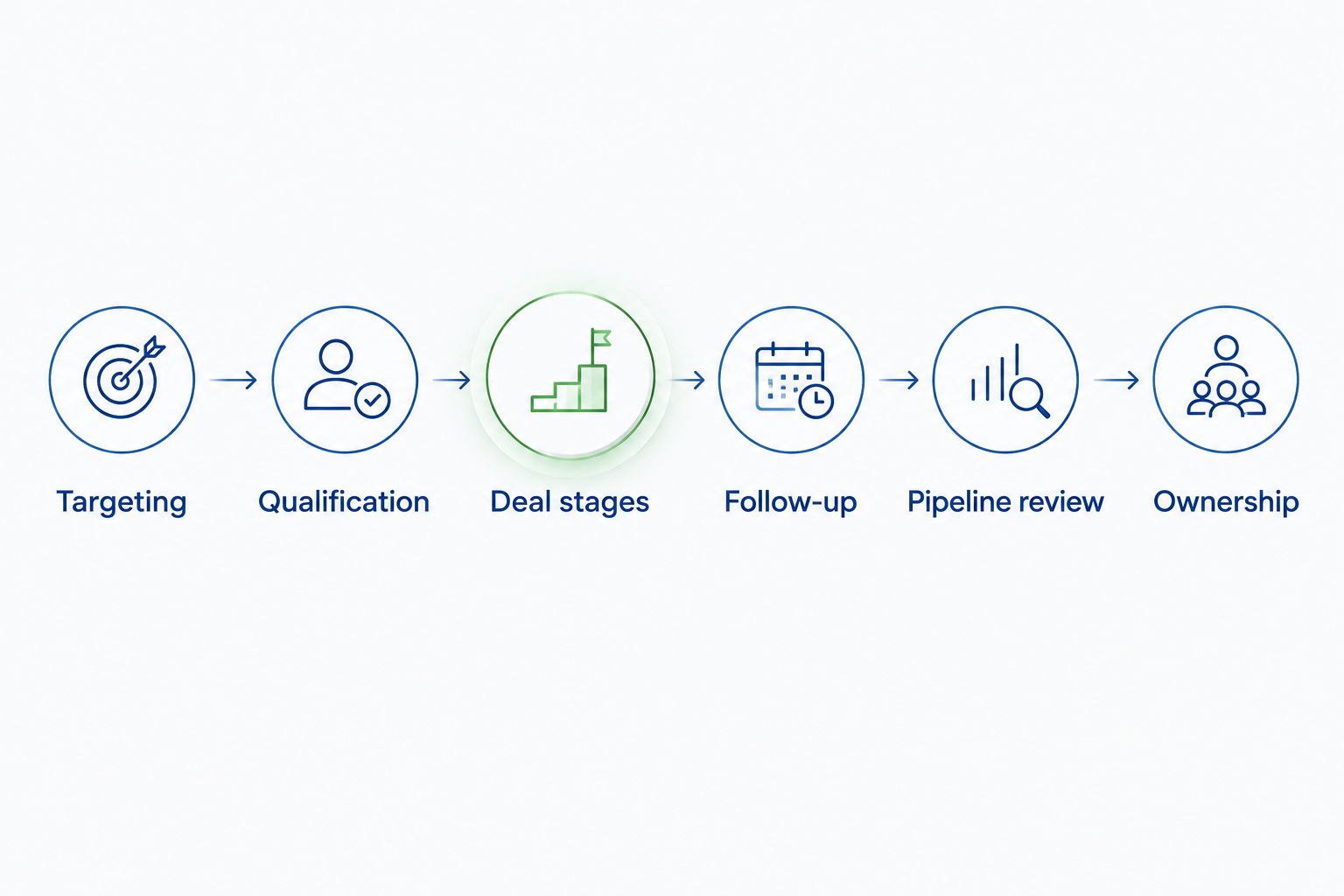
The installation sequence is straightforward: Targeting, Qualification, Deal stages, Follow-up, Pipeline review, and Ownership. Complete the definitions in that order, then revise them against live work.
Choose the support that matches the constraint
FieldForge is best for industrial service companies that need a repeatable commercial system rather than disconnected commercial activity. That does not make a Revenue Systems engagement the answer to every sales problem.
Internal execution fits when your team has the leadership capacity and authority to install the process. An industrial marketing agency fits when commercial rules are established and the immediate requirement is campaign or channel execution. Founder-led selling remains useful for relationships, but relationship strength and process visibility are different assets.
| Option | Best for | Practical advantage | Key limitation |
|---|---|---|---|
| Internal commercial-system installation | Companies with available commercial leadership | Keeps design and ownership inside the business | Competes with the team's existing operating responsibilities |
| Founder-led selling | Relationship-dependent opportunities requiring owner involvement | Preserves direct knowledge of buyers and commitments | Context remains difficult to transfer unless documented |
| Industrial marketing agency | Companies with defined targeting and qualification that need campaign execution | Assigns specialist attention to selected channels | Campaign delivery alone does not define estimating handoffs or deal governance |
| FieldForge Revenue Systems | Industrial service companies with an underdeveloped commercial structure | Connects foundation, pipeline execution, and revenue-process visibility | Requires internal participation and ongoing ownership; it does not replace delivery capability |
Before appointing outside support in 2026, identify the decision that remains unresolved internally. If nobody can define a qualified opportunity, a larger campaign creates more decisions for an already unclear process. If qualification and follow-up work consistently, channel execution becomes a more specific brief.
Diagnose the constraint before commissioning work
Complete the P.R.O. Index diagnostic as the starting point for a Revenue Systems discussion. Bring the result into a review of actual opportunities, handoffs, and management decisions rather than treating a diagnostic as a substitute for examining the work.
Ask for a scope that names the operating changes, internal responsibilities, and acceptance criteria. Do not approve an engagement solely because it promises strategy, technology, or activity. You need to know what your team will do differently when it ends.
Start with the commercial constraint
Begin with the P.R.O. Index diagnostic before defining a Revenue Systems engagement.
Common mistakes industrial service companies make
Treating every quote request as qualified pipeline
A request proves interest, not fit or purchase readiness. Require scope, buyer context, and a reason to pursue before allocating estimating effort; retain an explicit approval path for exceptions.
Installing the CRM before defining the process
Software configuration cannot settle disagreements about qualification or stage ownership. Write the operating rules first, then configure the system to reflect those decisions.
Keeping founder relationships outside the system
Do not force the founder out of important relationships. Capture commitments, approval roles, and next actions so another person can support the account without reconstructing its history.
Buying lead generation to solve a handoff problem
More inquiries do not establish who follows up or what estimating needs. Repair those responsibilities before increasing the volume moving through them.
Forecasting without checking delivery assumptions
A buyer's intended decision date is not the same as a service start date or invoice date. Keep those assumptions separate so the commercial review does not obscure operational commitments.
FAQ
What does revenue operations consulting do for an industrial service company?
Revenue operations consulting defines how an industrial service company targets accounts, qualifies opportunities, manages handoffs, and reviews pipeline. The work should connect commercial decisions with estimating and delivery requirements, not stop at CRM administration.
Is revenue operations consulting the same as hiring an industrial marketing agency?
No. Revenue operations consulting defines the commercial operating process, while an industrial marketing agency can execute campaigns within that process. Compare the proposed scope rather than assuming either provider covers both responsibilities.
Can we install a revenue process without buying a new CRM?
Yes. You can define targeting, qualification, stage evidence, and ownership using a spreadsheet and written operating rules. Decide whether different software is necessary after testing the process on live opportunities.
Should the founder stop selling when a commercial system is installed?
No. The founder can retain important relationships while documenting commitments, buyer roles, and next actions. The objective is transferable account knowledge, not the removal of useful involvement.
How do we measure whether revenue operations consulting is working?
Check whether your team applies qualification rules, completes handoffs, and moves opportunities using documented evidence. Review commercial outcomes alongside those operating changes without treating activity counts as proof of progress.
Who needs to participate in an industrial revenue operations project?
Include the people accountable for sales, estimating, operations, and commercial management. Their participation is necessary to define what information and approval each handoff requires.
Where should we start with FieldForge?
Start by completing the P.R.O. Index diagnostic. Use it to frame a discussion about the commercial constraint, then examine live opportunities and responsibilities before defining a Revenue Systems scope.
One last thing
For your next 2026 pipeline review, hide the opportunity value column first. Ask the owner to explain the buyer's unresolved decision, the evidence supporting the current stage, and the agreed next action.
If the team cannot explain the opportunity without its value, resolve the missing evidence before debating the forecast. That is a practical first test of whether your revenue process supports decisions or merely stores expectations.