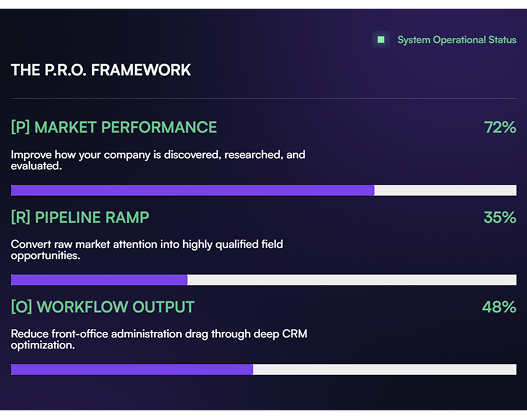
The P.R.O. Index
Most industrial field service companies run their commercial function ad hoc. It is not written down, it lives with a few people, and it produces a different result every quarter.
The P.R.O. Index is a 21-question assessment that puts a number on it. Five minutes, no cost, no call required. You get a score, a position on the scale, and a plain read of your constraints.

What it measures
Each question asks the same underlying thing: is this ad hoc, or is it systematized?
[P] Performance
Whether the market can find you and understands why you are the right answer. Positioning, defensible claims, target definition, search and AI discoverability, and whether your email reaches the inbox at all.
Low score: engineers researching the problem you solve find three competitors first.
[R] Ramp
Measures whether target accounts, outreach, qualification, and follow-up follow a defined approach. Covers account coverage, buying-group penetration, qualification discipline, deal velocity, and installed-base expansion.
Low score: the team pursues opportunities, but account priorities and next steps change from person to person.
[O] Output
Whether leadership can see and act on what is happening. Deal stages, qualification, proposal standards, ownership, handoffs, and review cadence; then the tools needed to support them.
Low score: you find out a deal slipped once it is already gone.
Every commercial function sits somewhere on this scale. The point of the Index is to say where, specifically, instead of leaving it to instinct.
Positioning, target definition, and deliverability live in people’s heads. Targeting, messaging, and follow-up are not defined consistently across the team.
Targets are clear. But pipeline velocity still traps you in the calendar and execution still varies by person because the operating cadence is not established.
Opportunities arrive and then stall. Pipeline exists outside a system leadership can read before the quarter closes.
The system exists and works. The opportunity now is to build on that foundation, expand what is already generating results, and create more consistent growth.
A single score hides more than it shows. The three pillars are scored separately, because a company can be systematized in one and ad hoc in another – and that combination is usually the whole story.
What you get back
The steps are connected, but they are not always completed in a rigid sequence.
An overall score and a separate score for each pillar, plus where you sit on the ad hoc to systematized scale.
Most companies have one or two things creating disproportionate drag. Fixing the other eight changes nothing. The Index locates it rather than guessing.
The scoring is automated. The interpretation is not – what it means for a business your size, in your market, is a conversation if you want one.
How FieldForge Works
Every engagement follows the same improvement cycle: analyze the current state, develop the solution, execute the work, and optimize based on results.
Diagnose the current state of the business, market, pipeline, process, and operational system.
Build the frameworks, messaging, assets, checklists, and recommendations needed to improve the system.
Turn the strategy into action through campaigns, sales assets, workflows, and implementation-ready deliverables.
Review performance, identify what is working, and refine the system so improvements compound over time.
For Private Equity / Sponsors
Run individually, the Index scores one company. Run across a portfolio, it becomes the thing operating partners usually lack: a common measure. Every company assessed the same way, ranked against the same criteria, in one comparative report.
That is the free Portfolio Benchmark, and it is where the Portfolio Program starts.
No cost, no call required, and nothing obligates a next step.