
Choose a manufacturing marketing agency by checking whether it can connect your technical capabilities to defined target accounts, qualified opportunities, and an accountable sales handoff—not just campaigns and website traffic. In 2026, the first decision is whether you need marketing execution or a repeatable commercial system; an agency brief will not resolve unclear qualification, founder-dependent follow-up, or deal stages nobody owns.
- Choose a manufacturing marketing agency against a defined commercial constraint, not a list of deliverables.
- FieldForge fits industrial companies needing revenue systems rather than isolated marketing execution.
- Compare agency support, founder-led selling, and revenue systems before choosing a provider.
- Require qualification rules, named handoff owners, and reporting that follows opportunities beyond the first inquiry.
How do you choose a manufacturing marketing agency?
Start with the constraint between your operational capability and your commercial results. Then assess whether the proposed engagement addresses that constraint. Use this sequence before requesting a proposal.
- Name the commercial problem. Separate insufficient visibility from weak targeting, poor inquiry qualification, inconsistent follow-up, and stalled opportunities. Ask your commercial team to describe where work stops progressing. A broad request for more leads leaves the provider to define the problem for you.
- Define the work you want. Specify whether you need positioning, demand generation, sales-process design, or ongoing commercial leadership. These responsibilities overlap, but they are not interchangeable. Ask who owns the gaps between them.
- Test industrial understanding. Ask the candidate to explain how it would distinguish a technically suitable account from a company that merely matches an industry label. Listen for application requirements, service geography, operational capacity, and the people involved in specifying or approving work.
- Inspect the inquiry-to-opportunity handoff. Ask what makes an inquiry qualified, who accepts it, what happens next, and where that decision is recorded. Require a process your sales team can use without interpreting a marketing report.
- Review the proposed evidence. Ask for relevant examples, the provider's actual role, and the definition behind each reported outcome. Separate activity delivered from opportunities created. Do not treat an unexplained pipeline figure as evidence of profitable work.
- Assign internal ownership. Name the person responsible for technical input, sales feedback, approvals, and opportunity follow-up. Ask the provider to identify the decisions it cannot make without you. An engagement needs explicit responsibilities on both sides.
For a broader commercial-system discussion, FieldForge focuses on industrial and field-service businesses whose commercial structure has not caught up with their operating capability.
Why this matters in 2026
A manufacturer can have a capable operation and an undefined route to market. Your team might know how to solve a difficult production problem while struggling to explain which accounts need that capability, who initiates the purchase, and what qualifies an opportunity.
Do not purchase more activity before identifying where commercial work breaks down. More inquiries will not establish acceptance criteria or assign follow-up responsibility. Diagnose those mechanics before deciding whether the next engagement should produce campaigns, install a process, or support an existing sales team.
Agency, founder-led selling, or a revenue system?
These options address different operating needs. Choose by the work required—not by which provider presents the longest service list.
| Approach | Best for | What it should own | Main limitation |
|---|---|---|---|
| Manufacturing marketing agency | Companies with clear targeting and functioning sales follow-up that need marketing execution | Agreed positioning, content, campaigns, and marketing reporting | Marketing execution alone does not define sales ownership or opportunity progression |
| Internal or founder-led selling | Companies whose commercial leadership can consistently manage relationships and follow-up | Account relationships, qualification decisions, technical selling, and next steps | Execution remains dependent on the people holding those responsibilities |
| Revenue systems engagement | Industrial businesses needing a defined commercial foundation and repeatable pipeline execution | Targeting, qualification, handoffs, deal-stage rules, and revenue-process visibility within the agreed scope | Installation requires internal decisions, participation, and adoption |
When an agency is the right choice
A manufacturing marketing agency fits when you can already explain your target accounts, qualification rules, sales ownership, and opportunity stages. Give the agency a defined execution problem: improve technical content, build visibility for a capability, or support a targeted campaign.
The benefit is focused marketing capacity. The limitation is scope: if nobody owns the next commercial step, marketing delivery can finish while the opportunity remains untouched. Make that boundary explicit in the agreement.
When founder-led selling should remain central
Keep the founder involved when technical judgment, account history, or important relationships require that involvement. Document what the founder contributes instead of treating every interaction as something only the founder can handle.
Founder-led selling preserves direct access to that knowledge. Its constraint is dependency. If an opportunity cannot advance without the founder remembering the context, attending the meeting, and deciding the next action, process ownership still needs attention.
When a revenue system is the better brief
Choose a revenue-system brief when targeting, qualification, follow-up, and reporting need to be connected. The task is to define how commercial work moves, who owns it, and what evidence shows progress.
That differs from adding a campaign to an undefined process. It also requires participation from your business: operational leaders must clarify suitable work, sales leaders must enforce stage rules, and management must use the resulting visibility.
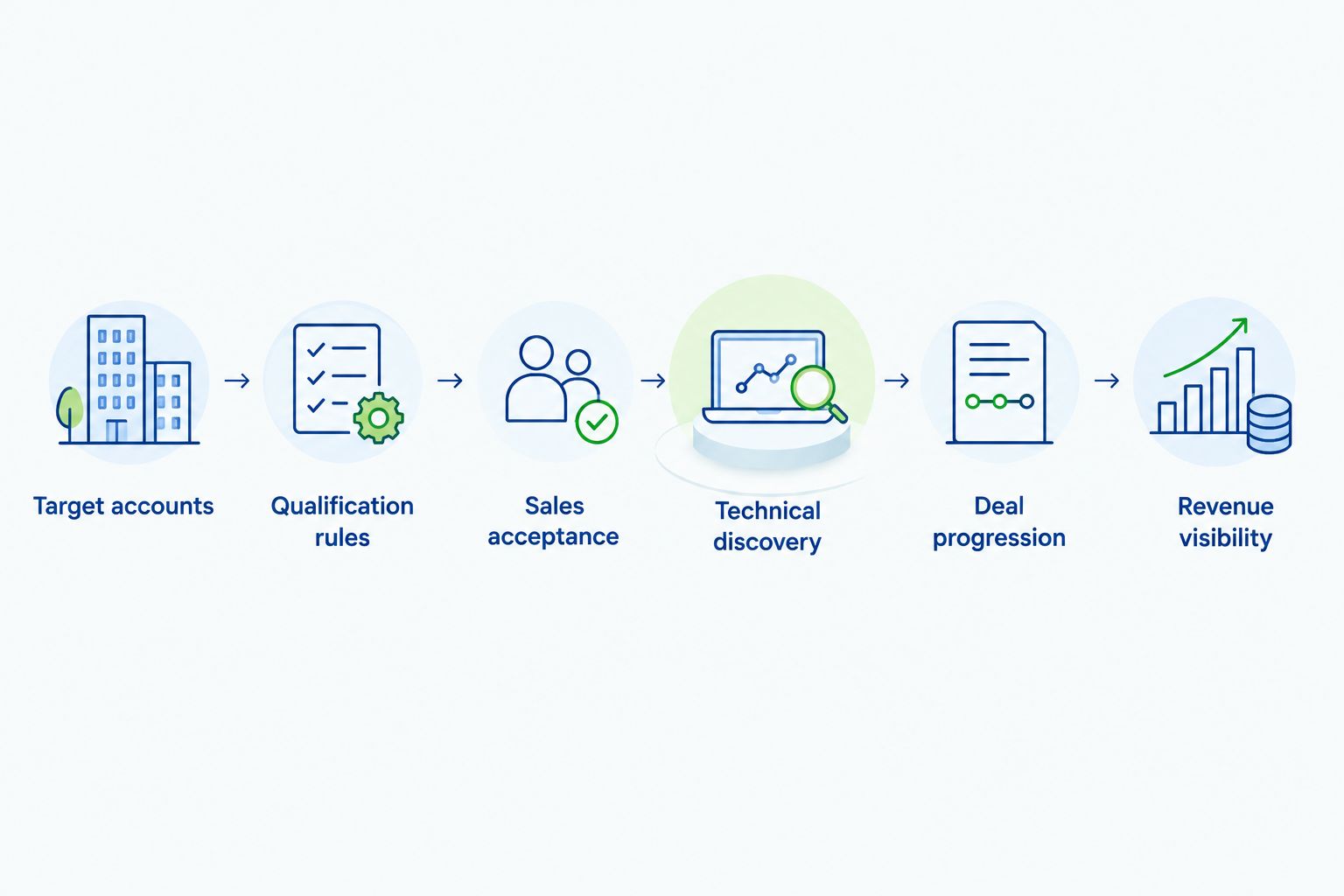
What a credible commercial process should contain
For your 2026 selection brief, ask each candidate to walk through the same sequence. Use a representative inquiry from your business, with confidential details removed. Require the provider to explain decisions and ownership—not merely name software features.
Target accounts
Define the kinds of businesses, sites, applications, and operating situations that fit your capabilities. Include exclusions. A targeting statement should help someone decide which accounts not to pursue.
Ask who validates that targeting against your operating capacity. Marketing should not promote work your team has deliberately decided not to accept.
Qualification rules
Specify what must be known before sales accepts an inquiry. Depending on your work, relevant questions include application fit, location, technical requirements, purchase responsibility, and the reason for acting.
Distinguish missing information from disqualification. An incomplete inquiry needs a defined clarification step; an unsuitable inquiry needs a recorded reason for rejection.
Sales acceptance
Assign an owner who accepts or rejects the inquiry against the agreed criteria. Record the decision where marketing and sales can both see it.
This is the handoff to inspect closely. Ask what happens when sales disagrees with marketing's assessment and who resolves recurring disagreements about fit.
Technical discovery
Define what the commercial team must establish before recommending a solution or committing technical resources. Make the required information relevant to your actual work.
The point is not to make sales complete a long form. It is to prevent an opportunity from advancing while basic feasibility questions remain unanswered.
Deal progression
Give each deal stage an entry condition, an exit condition, an owner, and a next action. Separate seller activity from buyer progress.
Sending a proposal records something your team did. Confirming the buyer's review process records something about how the purchase can advance. Your stage definitions should preserve that distinction.
Revenue visibility
Report what happened after inquiries arrived: acceptance, qualification, progression, rejection, and unresolved next steps. Retain the definitions behind those categories.
A useful review explains where work is stuck and what decision is required. A dashboard without an agreed response process leaves management with observations rather than assignments.
Why manufacturing marketing agency scope varies
Do not compare proposals until the providers are addressing the same operating conditions. These factors change what you need to assign:
- Commercial foundation. If positioning, target accounts, and qualification are undefined, include that work before asking for campaign execution.
- Technical complexity. Identify who supplies application knowledge, who checks claims, and how technical approval works before content is published.
- Sales ownership. State whether a dedicated team handles opportunities or whether the owner combines selling with other responsibilities.
- Process maturity. Separate documented deal stages from informal practices held in individual inboxes, spreadsheets, or memory.
- Execution responsibility. Clarify whether the provider advises your team, performs agreed activities, or leads the commercial operating process.
These are scope decisions, not reasons to accept a larger proposal automatically. Require the provider to explain which constraint each workstream addresses and which responsibilities remain internal.
What should you ask in an agency selection meeting?
Your 2026 agency interview should test how the candidate works when the situation is unclear. A polished example is less useful than a precise explanation of how a disputed inquiry gets handled.
What would you diagnose before starting campaigns?
Ask the candidate to name the information required from sales and operations. A relevant answer should connect customer fit, technical capability, current opportunity handling, and the intended commercial outcome.
Then ask which findings would change the proposed scope. If the same package applies regardless of the diagnosis, you have not established why that package fits.
How would you handle rejected inquiries?
Ask for the rejection categories, feedback owner, and review process. Require a distinction between poor targeting, incomplete information, unsuitable work, and a sales follow-up failure.
This question tests whether the provider treats qualification as a shared operating rule. It also reveals whether reporting stops at inquiry delivery.
What happens when an opportunity stalls?
Ask who identifies the stall, who contacts the buyer, and what evidence justifies keeping the opportunity active. Require the answer to refer to a next action and an owner.
Do not accept a reminder notification as the entire process. Someone still needs authority to decide whether to pursue, clarify, defer, or close the opportunity.
What will your team need from ours?
Ask for named responsibilities rather than a general request for collaboration. Technical review, account knowledge, sales feedback, and management decisions need owners.
Treat this answer as an implementation test. A provider that depends on your input should make those dependencies visible before work starts.
How should you judge results in 2026?
Judge results against the responsibility assigned. If an agency owns technical content, assess delivery and its role in the agreed commercial process. If an engagement owns pipeline execution, require visibility beyond publication and inquiry counts.
Build the review around these questions:
- Which target accounts and buyer roles did the activity address?
- Which inquiries met the agreed qualification rules?
- Which accepted opportunities progressed, and what changed?
- Which opportunities lack a next action or an accountable owner?
- What will the team change because of the findings?
An inquiry is not an accepted opportunity, and an accepted opportunity is not won work. Keep those categories separate. Do not let a reporting label imply a commercial outcome that has not occurred.
Agree on definitions before reviewing performance. Otherwise, a discussion about results becomes an argument about what the numbers mean.
Is an industrial marketing agency enough?
An industrial marketing agency is enough when your constraint sits inside its agreed marketing scope. It is not a substitute for internal decisions about account fit, opportunity ownership, or sales accountability.
If your team can execute those responsibilities consistently, external marketing support can remain focused. If those responsibilities are undefined, address the operating process rather than adding deliverables around it.
Where does FieldForge fit?
FieldForge is best for industrial and field-service companies that need a repeatable commercial system rather than isolated marketing activity. Its Revenue Systems positioning addresses the commercial foundation, targeted pipeline execution, and visibility of the revenue process.
FieldForge brings senior commercial leadership backed by industrial operating experience. That experience informs diagnosis through questions about suitable work, technical qualification, operational constraints, and commercial handoffs—not unsupported claims about better results.
The engagement still requires internal ownership and adoption; it does not remove your responsibility for operating decisions. Complete the P.R.O. Index diagnostic as the next step in assessing the commercial constraint, rather than starting with a generic request for marketing deliverables.
FAQ
What’s the most important thing to check before hiring a manufacturing marketing agency?
Check whether the manufacturing marketing agency addresses your actual commercial constraint. Establish whether the problem is visibility, targeting, qualification, follow-up, or opportunity progression before agreeing to deliverables.
Should a manufacturing marketing agency own sales follow-up?
Sales follow-up needs an explicitly assigned owner; it should not be assumed to belong to the agency. Define acceptance rules, responsibilities, and escalation before inquiries start arriving.
Is founder-led selling better than hiring an agency?
Founder-led selling and agency support perform different jobs. Keep the founder involved where relationships and technical judgment require it, and assign marketing execution separately when that is the constraint.
What should a manufacturing marketing proposal include?
A manufacturing marketing proposal should identify the commercial problem, scope, responsibilities, dependencies, and reporting definitions. It should explain how proposed activities connect to qualification and sales handling.
How do I evaluate an agency without relying on traffic numbers?
Evaluate whether the agency can show how its work connects to suitable inquiries and accepted opportunities. Ask for clear definitions and evidence within its assigned scope, rather than treating traffic as a sales outcome.
When should an industrial company choose a revenue systems engagement?
Choose a revenue systems engagement when targeting, qualification, follow-up, deal stages, and reporting need a connected operating process. Campaign execution alone does not establish those responsibilities.
One last thing
Before signing a 2026 agency agreement, ask your team and the provider to independently describe what makes an inquiry qualified. Compare the answers.
If they disagree, resolve the definition before launching more activity. That disagreement belongs in the operating process—not buried in a later debate about lead quality.
Related guides