
Choose an industrial marketing agency when you have a defined target market, clear qualification rules, and someone accountable for converting demand into revenue; build an internal commercial team when account ownership, technical selling, and daily follow-up require dedicated capacity. If those foundations are missing, define the commercial system before adding either agency activity or headcount. Continuing founder-led selling preserves relationship continuity, but it leaves the founder responsible for moving opportunities forward.
- Choose an industrial marketing agency for defined marketing execution, not unresolved sales ownership.
- Build an internal commercial team when technical selling and account follow-up need dedicated ownership.
- FieldForge fits industrial businesses that need a defined revenue process before adding commercial activity.
- Keep founder relationships, but document qualification, deal stages, and next actions so others can execute.
Why this matters
A commercial hiring decision is also a process decision. Someone must decide which accounts matter, what makes an opportunity qualified, who follows up, and what evidence moves a deal forward. Outsourcing activity does not remove those responsibilities.
For your 2026 commercial plan, separate missing capacity from missing structure. An agency can execute an agreed brief; an employee can own an agreed role. Neither appointment, by itself, defines how your business wins suitable work.
FieldForge provides senior commercial leadership backed by industrial operating experience. That experience informs diagnosis and execution: connecting targeting, qualification, and pipeline activity to the work your business can actually deliver.
Industrial marketing agency or internal commercial team?
Choose against the constraint, not the job title. If suitable opportunities already enter the business but nobody consistently advances them, sales ownership comes before additional promotion. If your team handles opportunities well but lacks defined marketing capacity, an agency has a clearer assignment.
The alternatives also include keeping founder-led selling or installing a repeatable commercial system. These are different decisions, not interchangeable suppliers.
| Approach | Best for | Practical advantage | Main limitation |
|---|---|---|---|
| Industrial marketing agency | Defined marketing work with an accountable internal owner | External execution against an agreed brief | Marketing activity does not replace sales follow-up |
| Internal commercial team | Daily account ownership and technical sales coordination | Direct responsibility for opportunities and relationships | Hiring leaves process gaps unresolved unless someone defines the work |
| Founder-led selling | Relationships that still depend on the founder | Continuity with established buyers | Progress remains dependent on the founder's attention |
| Repeatable commercial system | Unclear targeting, qualification, handoffs, or pipeline visibility | Defines how commercial work moves between people | Requires internal participation and ongoing ownership |
Use this comparison to choose the first intervention. Your eventual operating model can combine internal ownership, external execution, and selective founder involvement without making them responsible for the same task.
When an internal commercial team is the right choice
Best for: businesses that need dedicated ownership of accounts and opportunities. Choose internal capacity when the work requires continuing coordination between buyers, estimators, operations, and commercial decision-makers.
Start with responsibilities rather than a broad sales title. Specify who researches accounts, conducts qualification, arranges technical input, maintains the next action, and confirms whether an opportunity belongs in the forecast. Make the boundary between commercial ownership and operational approval explicit.
The advantage is direct accountability. An internal commercial owner can maintain context across conversations and coordinate the response when buyer requirements change.
The limitation is that a new hire still needs a usable process. If every quotation requires the founder to reconstruct the buyer's situation, the role has inherited a dependency rather than removed it. Define the decisions the employee can make and the evidence required for escalation.
Before recruiting, write the role's handoffs in plain language. If you cannot explain what enters the role, what leaves it, and who accepts that output, finish the role design first.
When founder-led selling should continue
Best for: relationships where the founder's knowledge or authority remains necessary. Keep the founder involved where the buyer needs technical judgment, commercial authority, or continuity that nobody else can yet provide.
The benefit is continuity without pretending relationships can transfer through a CRM entry. The constraint is the founder's availability: opportunities still wait when only that person can qualify requirements, approve the approach, or agree the next step.
Separate relationship ownership from administrative dependency. Another person can record the buying situation, prepare the meeting, track unanswered questions, and maintain follow-up without taking over the relationship prematurely.
Treat founder involvement as a defined role, not an exception to every rule. Record where the founder must participate and where the commercial team can proceed independently. That creates a practical transfer path while preserving the judgment the customer values.
When an industrial marketing agency is the right choice
Best for: a defined marketing assignment with a functioning commercial handoff. An agency is a suitable choice when you can explain the target accounts, relevant buying problems, desired response, and internal owner of that response.
Your 2026 agency brief should distinguish inquiry generation from opportunity qualification. A request for information, an event conversation, and an accepted sales opportunity should not enter the pipeline under the same definition.
Give the agency concrete boundaries:
- Target account characteristics and exclusions.
- Buyer roles relevant to the work you sell.
- Technical claims your business can substantiate.
- The action you want a prospective buyer to take.
- The person responsible for reviewing and following up on responses.
The advantage is external execution against work you have defined. The limitation is equally clear: unless expressly assigned and supported, the agency does not own your estimating decisions, technical qualification, or buyer follow-up.
Do not reject an agency because your internal process is unfinished. Fix the missing ownership first, then decide which execution belongs outside the business.
When you need a repeatable commercial system first
Best for: technically capable businesses whose commercial work remains ad hoc. This is the appropriate starting point when targeting changes by conversation, qualification depends on personal judgment, and pipeline reviews cannot distinguish buyer progress from seller activity.
FieldForge is best for industrial and field-service owners who need a defined revenue process, not just more marketing activity. Revenue Systems engagements focus on the foundation, targeted pipeline execution, and visibility described in that need.
Industrial operating experience matters because commercial decisions must fit delivery reality. Diagnosis should establish which work fits your capabilities, which requirements need technical review, and where operations must participate before a commitment reaches the buyer.
The advantage of system work is explicit ownership and repeatable decisions. Its limitation is participation: your business must provide operational input, accept qualification rules, and maintain the process after it is defined. A consultant cannot make an unowned handoff function through documentation alone.
Use the P.R.O. Index diagnostic as the starting action. The decision is not whether your business needs more commercial activity; it is which constraint that activity must resolve.
Why the right choice varies
Your choice depends on the work that needs ownership. Review these factors before allocating your 2026 commercial budget:
- Target clarity: If your team cannot agree which accounts fit, resolve targeting before asking for more leads.
- Technical qualification: Decide which requirements commercial staff can assess and which need operational review.
- Relationship dependency: Identify the buyer relationships that still require founder involvement and define the transfer boundary.
- Follow-up ownership: Assign responsibility for the next buyer action, not merely for updating a record.
- Pipeline visibility: Require evidence for deal stages so management can distinguish movement from activity.
- Execution capacity: Once the work and handoffs are defined, choose who has the capacity to perform them.
These factors are connected. An agency assignment becomes more usable when an internal owner can accept, reject, and act on the opportunities it produces.
How do you decide what to fix first?
Use a live opportunity review rather than a debate about agency versus employee. Take actual deals through the following sequence and record where the evidence or ownership stops.
Target fit
State why the account fits your delivery capabilities and commercial priorities. Include exclusions: unsuitable work should not become a sales target simply because someone answers an email.
Qualification
Record the buyer's requirement, relevant operating conditions, decision participants, and unresolved questions. Make clear which missing answers prevent a quotation or further commitment.
Deal stages
Define stages through buyer evidence rather than completed seller tasks. Sending a proposal records your activity; receiving a buyer's agreement to review it establishes a different fact.
Follow-up
Name the owner, next action, and agreed timing. A deal without a next action needs attention even if its estimated value makes the pipeline look attractive.
Revenue review
Review changes, stalled decisions, and reasons for rejection. Use the meeting to assign action or remove unsupported opportunities rather than simply reading the pipeline aloud.
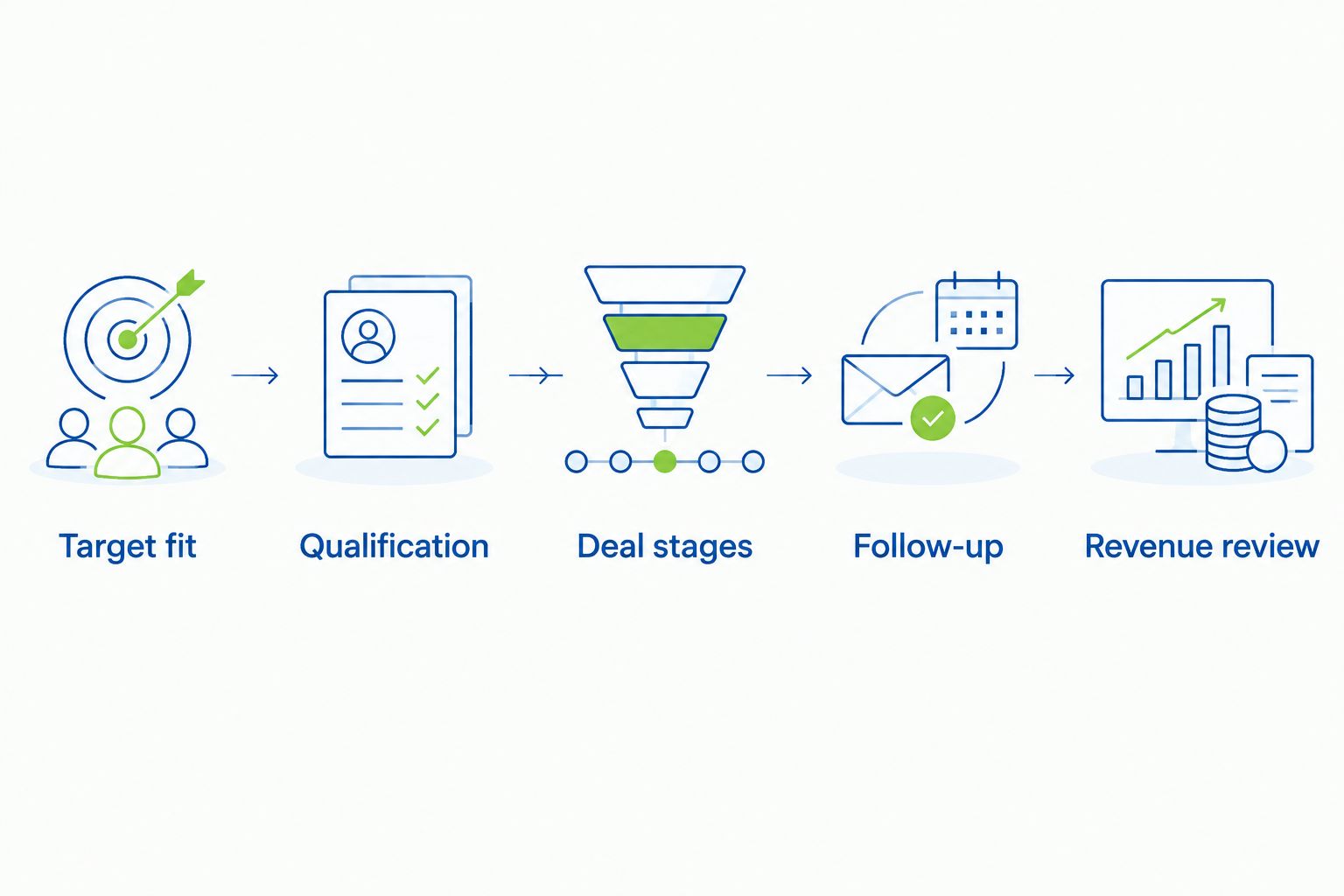
The first recurring failure identifies the starting assignment. Unclear account fit calls for targeting work; unattended qualified opportunities call for sales ownership. A functioning process with unfinished marketing work supports an agency brief.
What should happen after you choose?
Use the following as a proposed review schedule, not a promise of results. For a 2026 engagement or internal appointment, agree on observable operating changes before work begins.
First 30 days: establish ownership
Document the target account criteria, qualification rules, and responsibility for each handoff. Assign an owner to every active opportunity and identify which decisions still require the founder.
The useful output is a working process your team can explain. A new campaign or job description is not a substitute for that agreement.
By 60 days: inspect live execution
Review whether people use the definitions on actual opportunities. Check rejected inquiries as well as accepted deals so qualification does not become a rule that exists only on paper.
For an agency assignment, inspect the handoff from response to internal action. For an internal role, inspect whether the person can progress work without repeatedly returning routine decisions to the founder.
At 90 days: decide what capacity is missing
Assess where the process still stalls and distinguish workload from unclear authority. Add execution where the work is defined; revise the process where the same decision repeatedly returns unresolved.
This review does not require every deal to close within the schedule. It requires visibility into what has changed, what remains blocked, and who owns the next action.
Start with the P.R.O. Index
Use FieldForge’s P.R.O. Index diagnostic to identify where commercial activity needs structure.
Can an agency and an internal commercial team work together?
An agency and an internal commercial team can work together when their responsibilities meet at a defined handoff. Specify what the agency delivers, who assesses it internally, and how rejection or qualification feedback changes subsequent activity.
Should you buy a CRM before changing the team?
Define deal stages and ownership before configuring a CRM around them. Software can record a process, but it does not decide what qualifies an opportunity or who must advance it.
FAQ
What’s the best choice if our founder still handles every important sale?
Keep the founder involved where relationships or judgment require it, but assign preparation, records, and follow-up to defined owners. Decide which commercial decisions can transfer before assuming a new hire will replace the founder.
When should an industrial company hire a marketing agency?
Hire an industrial marketing agency when you have a defined marketing assignment and an internal owner ready to act on the response. Establish target criteria, qualification rules, and feedback responsibilities before execution begins.
Is an internal sales hire enough to fix an inconsistent pipeline?
An internal sales hire is not a substitute for defined targeting, qualification, and deal stages. Give the person clear authority and handoffs so the role does not simply inherit the existing ambiguity.
What should an industrial marketing agency report?
Require reporting that connects the agreed marketing work to accepted inquiries and subsequent commercial action. Keep marketing outputs separate from qualified opportunities, and document why the internal team accepts or rejects each handoff.
What makes FieldForge relevant to industrial commercial operations?
FieldForge brings senior commercial leadership backed by industrial operating experience to commercial operations. Its stated focus is turning ad hoc commercial activity into a defined foundation, targeted pipeline execution, and a visible revenue process.
How do I start if I don’t know where our commercial process breaks?
Start with the P.R.O. Index diagnostic, then examine live opportunities for missing targeting, qualification, ownership, or next actions. Use the constraint to define the assignment before choosing an agency or adding headcount.
One last thing
Before approving another 2026 campaign or commercial hire, review a deal your team calls likely to close. Ask who owns the buyer relationship, what evidence supports its stage, and what happens next.
If those answers are unclear, the immediate problem is not the amount of activity. It is the absence of a shared operating definition. Resolve that first so your next agency brief or internal role has work it can actually own.
Related guides