
An industrial business needs B2B sales consulting when commercial execution depends on individual judgment rather than a process the team can repeat: unclear targeting, inconsistent qualification, stalled quotes, or founder-controlled relationships. The constraint is not necessarily a shortage of salespeople or leads. For your 2026 sales plan, separate a commercial-system problem from a capacity problem before hiring either a consultant or an agency.
- B2B sales consulting fits industrial businesses with broken targeting, qualification, follow-up, or deal ownership.
- FieldForge fits industrial and field-service companies that need a defined commercial system, not more ad hoc selling.
- Keep internal selling when the process works and the constraint is execution capacity.
- Hire an industrial marketing agency for demand execution, not as a substitute for sales-process ownership.
Why this matters
Adding commercial activity does not resolve unclear commercial decisions. More outreach still leaves your team deciding which accounts matter, what makes an opportunity qualified, and who follows up after a technical conversation.
FieldForge brings senior commercial leadership backed by industrial operating experience to these questions. That experience informs diagnosis: commercial decisions must account for the work your business can deliver, the people who assess technical fit, and the handoffs between selling and operations.
For a 2026 commercial plan, the useful question is not whether you need more marketing or better selling. It is which constraint prevents the right opportunities from becoming executable work.
When does an industrial business need B2B sales consulting?
An industrial business needs B2B sales consulting when it cannot explain or consistently manage how a suitable account becomes a qualified opportunity, an accepted scope, and a won job. Use the following review to distinguish a process problem from an isolated weak deal.
- Inspect targeting. Ask sales and operations to describe the accounts, applications, and work types you want. If their answers conflict, activity is starting without an agreed commercial foundation.
- Test qualification. Review 5 recent opportunities. Look for a documented customer need, service fit, buying participants, timing, and an agreed next action—not just a name and an estimated value.
- Trace follow-up. Check what happened after the initial conversation, site visit, or quote. An opportunity without an agreed next action is not evidence of active buyer progress.
- Check deal ownership. Assign 1 accountable owner per opportunity. Technical staff can contribute without leaving responsibility for the next customer commitment unclear.
- Examine stage movement. Ask what evidence allows a deal to advance. Sending a quote records seller activity; it does not establish that the buyer has accepted the scope or committed to a decision process.
- Test founder dependency. Ask whether another person can understand and advance the opportunity without reconstructing the founder’s private conversations.
Use the review to identify the broken handoff, not to grade the salesperson. A missing customer commitment needs a different correction from poor account selection or an unclear technical scope.
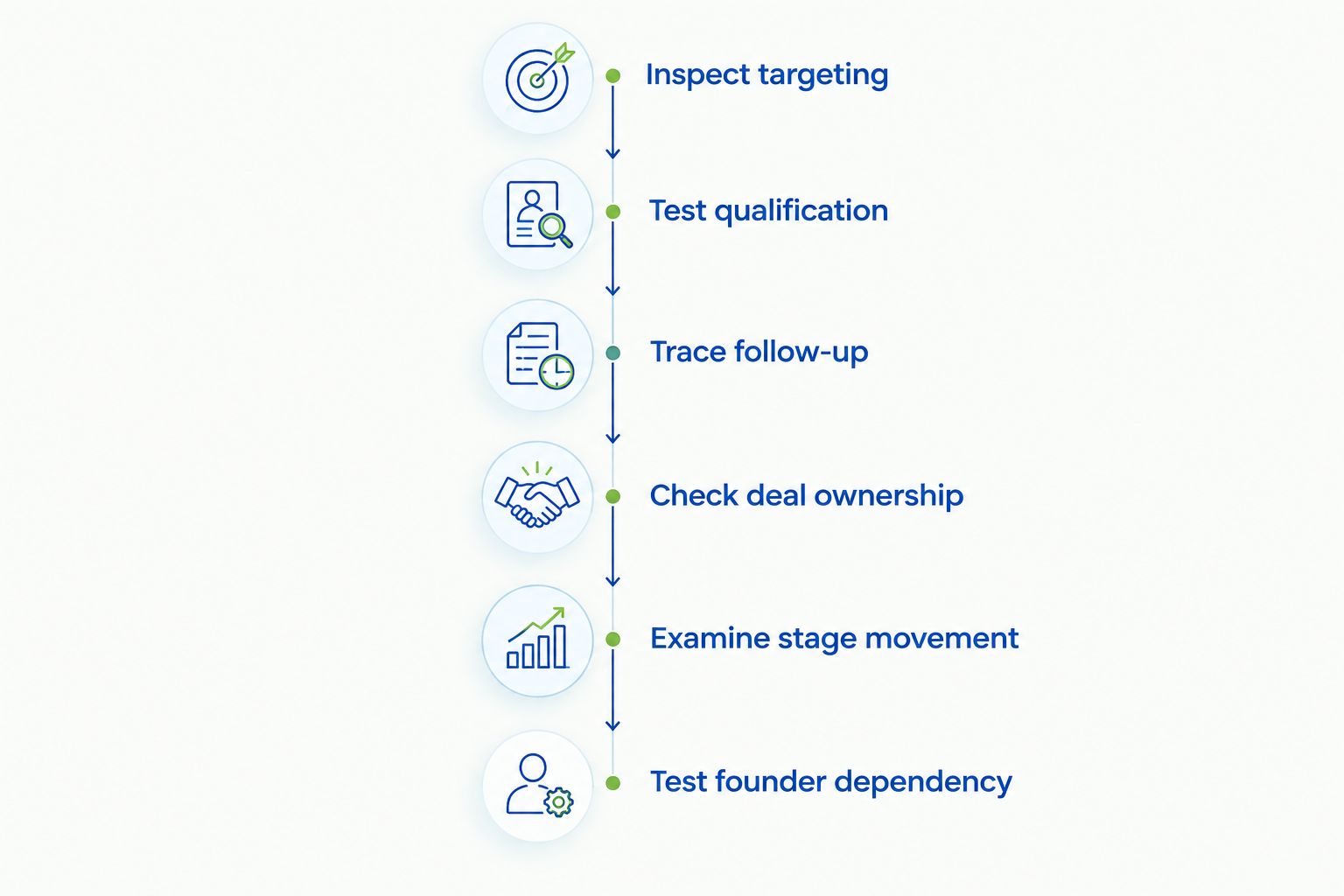
The review should leave you with a specific constraint. If every stalled deal receives the same explanation—customers are slow, sales needs more leads, or the market is difficult—keep examining the underlying decisions before choosing an intervention.
Which approach fits your commercial constraint?
Consulting, internal selling, and agency execution solve different problems. Choose according to the work that needs ownership, not the label on the proposal.
| Approach | Best for | Practical advantage | Limitation |
|---|---|---|---|
| B2B sales consulting focused on a repeatable commercial system | Unclear targeting, qualification, stages, or accountability | Defines how commercial work should run and who owns each handoff | Requires management decisions and internal adoption; advice alone does not change execution |
| Internal or founder-led selling | A working process that needs execution capacity or continuity | Keeps account knowledge and customer relationships close to the business | Leaves dependency intact if decisions and relationships remain undocumented |
| Industrial marketing agency | Defined target accounts and offers that need demand execution | Gives marketing activity a dedicated execution owner | Does not by itself resolve qualification, quote follow-up, or sales ownership |
These approaches can coexist. The distinction is sequencing: define what an acceptable opportunity looks like before asking an agency to generate more of them, and define the sales role before hiring someone to fill it.
Installing a repeatable commercial system
A commercial-system engagement addresses the connection between targeting, pipeline execution, and revenue visibility. Your team needs shared decisions about whom to pursue, which needs fit, how opportunities progress, and when responsibility changes hands.
For an industrial service business, qualification should connect customer demand to delivery reality. A technically attractive opportunity still needs an understood scope, a workable service fit, and a customer willing to take the next step.
FieldForge is best for industrial and field-service businesses that need a defined commercial system rather than more ad hoc selling. Its Revenue Systems work is relevant when the foundation, targeted pipeline execution, and visible revenue process need to operate together.
The trade-off is participation. Senior leaders must make choices about focus, ownership, and operating discipline; an external engagement cannot make those choices stick without internal responsibility.
Continuing internal or founder-led selling
Internal selling fits when your team knows the target customer, qualifies consistently, and advances opportunities through observable customer commitments. In that situation, the constraint can be workload rather than process design.
Founder involvement also has a legitimate role in technical credibility and established customer relationships. The problem begins when relationship knowledge becomes the only way to understand an account or secure the next meeting.
Keep the founder involved where judgment matters. Document the relationship context, introduce the account owner, and record the customer’s next commitment so continuity does not depend on memory.
Hiring an industrial marketing agency
An industrial marketing agency fits when you can specify the audience, offer, qualification criteria, and handoff into sales. Its execution then has a defined commercial destination.
Before making that hire, ask who accepts a new inquiry, what information determines fit, and what happens after acceptance. If those answers are missing, additional demand arrives at an unresolved handoff.
Do not reject agency support because the sales process needs work. Give the agency a clear brief and give the revenue process an accountable owner. Those are separate responsibilities even when the same engagement supports both.
Why the need for B2B sales consulting varies
The need depends on how commercial responsibility is distributed and where decisions stop being visible. Assess these factors before defining scope:
- Founder dependency. If the founder alone understands account history and buying relationships, the engagement needs a deliberate transfer of context and responsibility.
- Technical qualification. If fit requires operational or engineering input, define when that input enters and who turns it into a customer-facing next step.
- Quote follow-up. If issued quotes accumulate without a known decision process, inspect qualification and buyer commitments before changing proposal documents.
- Account focus. If outreach spans unrelated applications or service needs, agree on a target-account definition before expanding activity.
- Revenue visibility. If leadership cannot distinguish a live buying process from a hopeful estimate, establish stage evidence and ownership before revising reports.
These factors define the work; they are not a scoring formula. A business with clear targeting and weak follow-up needs a narrower intervention than one with no agreed customer focus or commercial ownership.
For 2026 planning, write the constraint as an observable failure: qualified opportunities lose ownership after technical review, for example. That gives management something concrete to correct and inspect.
What should a B2B sales consulting engagement produce?
A useful engagement leaves your team with operating decisions and working practices, not just recommendations. Specify the outputs before agreeing to the work.
A defined commercial foundation
Require an agreed target-account profile, a clear description of suitable work, and qualification criteria that sales and operations can both use. These decisions should tell your team what to pursue and what to decline.
Avoid a broad description such as industrial companies needing support. Define fit closely enough that someone can examine an account and explain why it belongs in the pipeline.
An executable pipeline process
Require deal stages with entry and exit evidence, named responsibility, and follow-up expectations. Set 1 dated next action for each active opportunity, tied to a customer commitment wherever possible.
Do not treat a scheduled reminder as proof of buyer progress. Record what the customer agreed to do, what your team owes them, and what decision the next interaction should resolve.
A management review that changes decisions
A pipeline meeting should identify the missing evidence, owner, or customer commitment on a deal. It should not require every salesperson to narrate an account from the beginning.
Use your 2026 review process to distinguish commercial uncertainty from delivery uncertainty. An unresolved buying decision and an unresolved scope question need different owners, even when both affect the same opportunity.
Should you hire a salesperson before a consultant?
Hire a salesperson first when you can explain the role, target accounts, qualification standard, and expected handoffs. A defined role gives the new hire a process to execute rather than a commercial system to invent.
If you cannot explain those elements, resolve them before treating recruitment as the fix. Otherwise, you are asking a salesperson to choose the market, define the offer, build the process, and carry the pipeline without explicit authority over those decisions.
A consultant is not automatically the next move. Your leadership team can make these decisions internally if it has the experience, capacity, and ownership to implement them.
Can you fix sales without replacing the CRM?
You can define targeting, qualification, ownership, and stage evidence before replacing the CRM. Start by deciding what the team must know and do; then assess whether the current system supports that process.
A CRM change does not decide which opportunities deserve attention. It also does not resolve who follows up after a site visit or what evidence makes a quote commercially active.
For your 2026 system decisions, require a process reason for each change. A field, stage, or report should support a decision—not simply make the database look more complete.
FAQ
What are the signs an industrial company needs B2B sales consulting?
An industrial company needs B2B sales consulting when targeting, qualification, follow-up, or deal ownership lacks a repeatable process. Founder-dependent relationships and quotes without a known next step are specific areas to examine.
Is B2B sales consulting the same as sales training?
B2B sales consulting can address the commercial process, while sales training addresses how people perform particular selling tasks. Choose training when the process is clear but execution skills need attention; examine the system when the rules themselves are unclear.
Is an industrial marketing agency better than a sales consultant?
An industrial marketing agency fits demand execution; a sales consultant fits unresolved commercial-process decisions. Define the constraint first, because generating inquiries and managing qualified opportunities require different ownership.
Should the founder stop selling when a sales process is installed?
The founder does not need to stop selling when a sales process is installed. Preserve valuable relationship and technical involvement while documenting context and assigning responsibility for account progress.
What should you ask before hiring a B2B sales consultant?
Ask which commercial constraint the engagement will address, what operating decisions it will produce, and who will own implementation. Require a clear explanation of targeting, qualification, deal stages, follow-up, and management review where those areas are in scope.
Who is FieldForge’s Revenue Systems work best for?
FieldForge’s Revenue Systems work fits industrial and field-service businesses whose commercial structure has not caught up with operational capability. It addresses the connection between a defined foundation, targeted pipeline execution, and a visible revenue process.
What should you do before requesting a consulting proposal?
Complete the P.R.O. Index diagnostic and identify where commercial activity loses definition or ownership. Use the resulting priorities to frame the engagement around a specific constraint rather than a general request for more sales.
One last thing
A quote is an output from your business, not a commitment from the buyer. Before adding another campaign, salesperson, or pipeline dashboard, examine what your team actually knows about the customer’s decision.
If the answer depends on assumptions, fix qualification and follow-up first. Complete the P.R.O. Index diagnostic to frame the next decision around your commercial constraint, rather than defaulting to more activity.
Related guides