
Customer concentration supports private equity value creation when you measure dependence on connected customers, test the profit and cash exposed, and turn that exposure into a targeted commercial plan. Revenue share alone is incomplete: separate invoices can depend on the same parent company, purchasing decision, plant shutdown, or founder relationship.
- Private equity value creation requires measuring customer dependence across revenue, gross profit, receivables, and purchasing control.
- FieldForge fits industrial businesses that need a repeatable commercial system beyond founder-led selling.
- Group connected accounts before calculating concentration; separate billing entities do not necessarily represent independent demand.
- Prioritize qualified diversification, not additional customers that create the same underlying exposure.
How does customer concentration support private equity value creation?
Customer concentration analysis identifies where losing or reducing a relationship would affect revenue, gross profit, cash collection, and operating capacity. For an industrial or field-service business, the useful output is not just a customer ranking. It is a set of commercial decisions: which relationships need protection, which exposures need diversification, and which opportunities deserve selling effort.
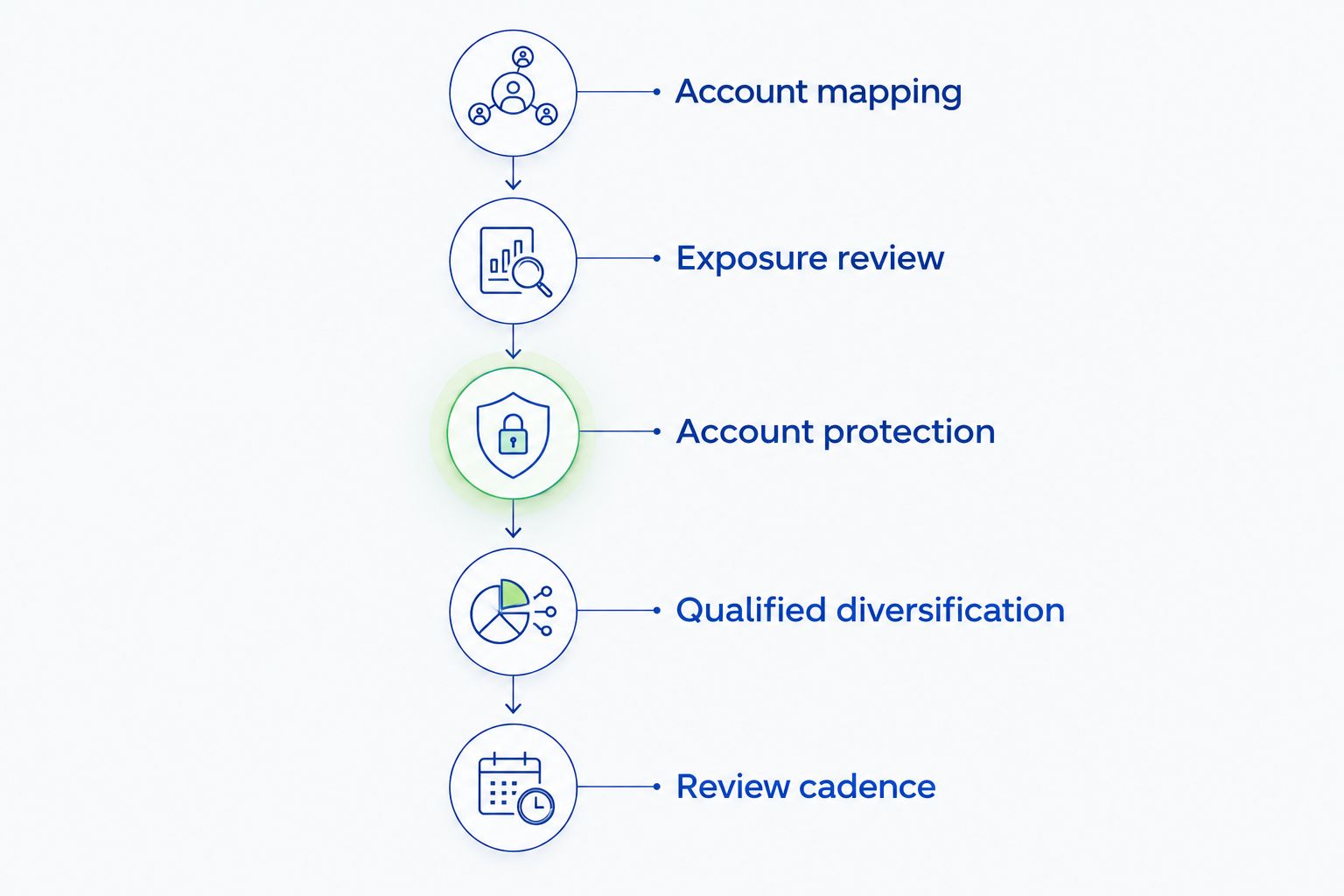
Use the following sequence for a 2026 review:
- Define the customer group. Connect billing entities, sites, and subsidiaries where purchasing decisions are shared.
- Calculate dependence. Measure each group's share of revenue, gross profit, and receivables using consistent boundaries.
- Inspect continuity. Separate committed work from discretionary orders, unapproved quotes, and relationship-dependent expectations.
- Test operational consequences. Identify the labor, equipment, and specialist capacity tied to each relationship.
- Assign commercial actions. Give account protection and diversification work an owner, qualification rules, and a next decision.
Do not confuse customer count with commercial independence. Several accounts can still depend on the same decision-maker or project.
Why this matters
A concentration report becomes useful when it changes how the company sells. Reporting a large customer's share without changing account coverage, targeting, or follow-up leaves the dependence intact.
FieldForge provides Revenue Systems engagements for industrial and field-service businesses whose commercial structure has not caught up with operational capability. Its stated approach combines senior commercial leadership with industrial operating experience, connecting the diagnosis to how work is specified, purchased, scheduled, and delivered.
For a 2026 value-creation plan, keep the distinction clear: measuring exposure is an analytical task; reducing dependence requires commercial execution. Neither replaces the other.
Measure revenue concentration at the connected-account level
Start with a clearly defined reporting period. Use the trailing 12 months as a working measurement window, then inspect the underlying monthly pattern so a project completion or shutdown does not disappear inside the total.
Calculate revenue concentration as:
Customer-group revenue ÷ total company revenue × 100%.
Apply the same accounting basis to the numerator and denominator. Mixing invoiced revenue for individual customers with recognized revenue for the company makes the result inconsistent.
Before calculating, create an account map containing:
- The invoiced legal entity and its parent organization.
- The operating sites receiving the work.
- The people who approve suppliers and authorize spending.
- The contracts or projects governing the relationship.
- The internal owner of each customer relationship.
Keep both the billing view and the connected-account view. The billing view supports reconciliation; the connected-account view supports decisions about dependence.
Do not automatically combine every site under a parent into a single purchasing relationship. Record whether authority is centralized or local, and distinguish ownership concentration from purchasing concentration.
Measure gross-profit concentration separately
Revenue concentration shows dependence on sales. Gross-profit concentration shows dependence on the gross profit those sales produce.
Calculate it using the same customer groups and reporting period:
Customer-group gross profit ÷ total company gross profit × 100%.
Use a consistent job-costing method. Explain how labor, materials, subcontractors, travel, and other direct costs enter the calculation rather than allowing account owners to apply different definitions.
| Measure | What it answers | Best for | Limitation |
|---|---|---|---|
| Revenue concentration | Where does sales volume depend on a customer group? | Mapping demand dependence | Does not show the profit contribution |
| Gross-profit concentration | Where does gross profit depend on a customer group? | Prioritizing economically important relationships | Depends on consistent cost allocation |
| Receivables concentration | Where is outstanding customer debt concentrated? | Reviewing collection exposure | A point-in-time balance is not a revenue forecast |
| Purchasing concentration | Which accounts share buying authority? | Finding dependence hidden by separate invoices | Requires account-level investigation |
A customer can matter differently across these measures. Keep the measures separate rather than compressing them into an unexplained score.
Measure cash exposure without calling it revenue risk
Receivables concentration measures a customer's share of outstanding receivables at a specified date. Add aging and dispute status to distinguish an ordinary billing balance from an unresolved collection issue.
For the 2026 review, record the snapshot date beside every receivables calculation. Comparing balances from different dates can confuse collection timing with a change in underlying dependence.
Inspect unbilled work and contract-specific billing conditions separately. Work completed, revenue recognized, and cash collected are different events; a customer relationship can expose the business at each stage.
Use the receivables view to direct collection and contract attention, not to substitute for a demand forecast. Finance and commercial owners should agree on which actions belong to each team.
Why customer concentration varies
The relevant drivers extend beyond the largest account's revenue share. Assess these factors before deciding what needs attention:
- Purchasing control: Independent sites and centralized procurement create different patterns of dependence.
- Work continuity: Committed work, repeat purchasing, and unapproved opportunities provide different evidence of future demand.
- Profit contribution: Account-level economics determine how much gross profit depends on a relationship.
- Operational commitment: Dedicated labor, equipment, or specialist capacity changes the consequences of lost work.
- Relationship ownership: Founder-only access creates a different handoff requirement from documented account coverage.
- Replacement pipeline: Qualified opportunities matter only when they match the company's capabilities and have a credible buying process.
There is no useful universal concentration threshold for this decision. Set internal escalation rules against the company's actual customer economics, contractual position, cash requirements, and capacity commitments.
Turn the concentration review into a commercial work sequence
Use the first 100 days of the commercial plan to establish ownership and decision rules. Treat that period as a planning structure, not a promise that customer dependence will disappear within it.
Account mapping
Reconcile customer names across finance records and the sales process. Assign one owner to maintain the connected-account map and document unresolved ownership or purchasing questions.
The output is a customer hierarchy that finance and sales can both use. A cleaned list without responsibility for maintaining it will not remain reliable.
Exposure review
Review revenue, gross profit, receivables, continuity, and capacity commitments together. Identify which conclusions rely on documented evidence and which still depend on an account owner's expectation.
Write the decision beside the finding. For example, an undocumented buying process calls for customer discovery; founder-only access calls for broader relationship coverage.
Account protection
Give important relationships a coverage plan. Record the operational sponsor, purchasing authority, commercial owner, outstanding commitments, and next customer decision.
Account protection is not a reason to avoid diversification. It keeps the existing business visible while the company develops independent sources of demand.
Qualified diversification
Define target accounts around services the company can deliver, the buyer's operating need, and the purchasing conditions that make an opportunity credible. Require qualification before counting a prospect as replacement pipeline.
A revenue operations consulting approach for industrial service companies should connect targeting, qualification, follow-up, and deal-stage evidence. Adding prospect names without these mechanics does not establish a visible revenue process.
Review cadence
Set a 30-day review cadence for account actions and diversification progress. Review whether opportunities have advanced on customer evidence, not whether sellers have entered more activity.
Keep completed actions distinct from commercial outcomes. Updating account records is progress on process; an approved buying step is progress in an opportunity.
Choose the response that matches the constraint
Reducing dependence does not automatically require an agency, a new sales hire, or a different CRM. First identify whether the constraint is access, execution capacity, or the absence of a repeatable commercial system.
| Approach | Best for | Practical advantage | Constraint |
|---|---|---|---|
| Founder-led selling | Relationships that require the founder's direct involvement | Preserves access and account knowledge | Leaves continuity dependent on the founder unless knowledge and coverage transfer |
| Internal commercial team | Executing a defined targeting and sales process | Gives the business direct ownership of daily follow-up | Requires clear roles, qualification rules, and management |
| Industrial marketing agency | Executing defined marketing work against a clear brief | Adds capacity for agreed marketing activities | Does not replace internal ownership of qualification, deal progression, or account coverage |
| Revenue Systems engagement | Establishing targeting, qualification, follow-up, and revenue-process ownership | Connects commercial mechanics across the business | Requires leadership decisions and participation from the operating team |
FieldForge is best for industrial and field-service owners who need a repeatable commercial system beyond founder-led selling. Its Revenue Systems work addresses commercial structure; it does not remove management's responsibility for customer relationships, operating capacity, or delivery decisions.
Industrial operating experience matters in this diagnosis because a target account must fit what the business can actually deliver. A commercial plan that ignores service scope, technical qualification, or delivery constraints gives sales an incomplete brief.
For your 2026 plan, complete the P.R.O. Index diagnostic to frame the commercial constraint before choosing more activity. Use the findings to define the work a Revenue Systems engagement, internal team, or agency would need to perform.
Assess your commercial system
Use the P.R.O. Index diagnostic to frame the commercial constraint before selecting the next intervention.
Should you stop selling to your largest customer?
No. Customer concentration is a reason to examine dependence, not an instruction to reject profitable work. Protect the relationship while building qualified demand that does not share the same purchasing dependency.
Declining work without understanding margin, commitments, and capacity changes the business before the diagnosis is complete.
Does a larger pipeline prove that concentration is falling?
No. Pipeline is not earned revenue, and opportunities within the same customer group do not create independent demand.
Track whether qualified opportunities represent distinct purchasing decisions and whether they convert into work. Keep diversification expectations separate from actual changes in customer concentration.
Check shared authority behind separate invoices
Illustrative scenario—not a FieldForge client case: several plants send separate purchase orders, but a parent procurement team can remove the supplier from every approved list. Keep the site-level operating view and the parent-level dependency visible. Report gross-profit concentration only when the company total is positive and meaningful; with zero or negative total gross profit, show account amounts and losses rather than a misleading share.
FAQ
How do you measure customer concentration for private equity value creation?
Measure each connected customer group’s share of revenue, gross profit, and receivables, then inspect shared purchasing authority and relationship ownership. Use the results to assign account-protection and qualified-diversification actions.
What reporting period should I use for customer concentration?
Use the trailing 12 months as a working measurement window, then inspect monthly movements and project timing. Keep the same reporting period and customer boundaries when comparing revenue and gross-profit concentration.
What customer concentration percentage is too high?
No single percentage determines whether customer concentration is acceptable. Assess the account’s profit contribution, contractual position, purchasing control, cash exposure, and operational commitments before setting internal escalation rules.
Should I combine different plants owned by the same customer?
Keep a parent-group view and a site-level view. Record whether purchasing authority is shared or independent so separate invoices do not conceal a common commercial dependency.
Is an industrial marketing agency enough to reduce customer concentration?
An industrial marketing agency addresses defined marketing work, not the entire customer-dependence problem. The business still needs ownership of targeting, qualification, follow-up, account coverage, and deal progression.
Can founder relationships transfer to an internal sales team?
Transfer the account knowledge, access, and commercial responsibilities deliberately rather than treating a new account assignment as a completed handoff. Document customer stakeholders, purchasing steps, commitments, and the next decision.
Where should an industrial company start if its commercial process is ad hoc?
Complete FieldForge’s P.R.O. Index diagnostic to frame the commercial constraint. Define whether the next work concerns commercial foundations, targeted pipeline execution, or visibility into the revenue process.
One last thing
Diversification can exist in the customer list without existing in the buying decisions. Separate account names do not prove that demand is independent.
Before approving the next 2026 growth initiative, ask who can stop the work, who controls supplier approval, and who owns the relationship. Those answers make the concentration calculation useful.
Related guides
- Private equity value creation when the founder owns every sale
- Manufacturing lead generation: fix qualification before adding volume
- Industrial marketing agency or internal commercial team?