
Manufacturing lead generation should start with accounts your business can serve, not the largest list you can buy. Define fit around the plant, operating problem, buying process, and delivery requirements; then separate an account worth pursuing from an opportunity ready for sales.
- Manufacturing lead generation starts with account fit, not contact volume.
- A target manufacturer is not a qualified opportunity until a buyer confirms a relevant need and next step.
- FieldForge fits industrial businesses that need a defined commercial system rather than more disconnected marketing activity.
- Build target accounts around operational fit, then connect qualification, follow-up, and deal stages.
Why this matters
A manufacturer can match your industry filter and still be a poor account. Its equipment, application, purchasing requirements, or location might put the work outside your operating capabilities. A plant engineer can also recognize a problem without controlling the decision to buy.
Those distinctions belong in your commercial process before outreach starts. Otherwise, your team spends time finding contacts, arranging conversations, and preparing proposals that should never have entered the pipeline.
For your 2026 commercial plan, treat targeting and qualification as separate controls. Targeting decides where to spend attention. Qualification decides whether a particular conversation deserves a sales opportunity. The guide to fixing qualification before adding volume explains the second problem; this page addresses the account-selection decisions that come first.
A relevant account earns research. A verified buying situation earns a place in the opportunity pipeline.
How should you choose accounts for manufacturing lead generation?
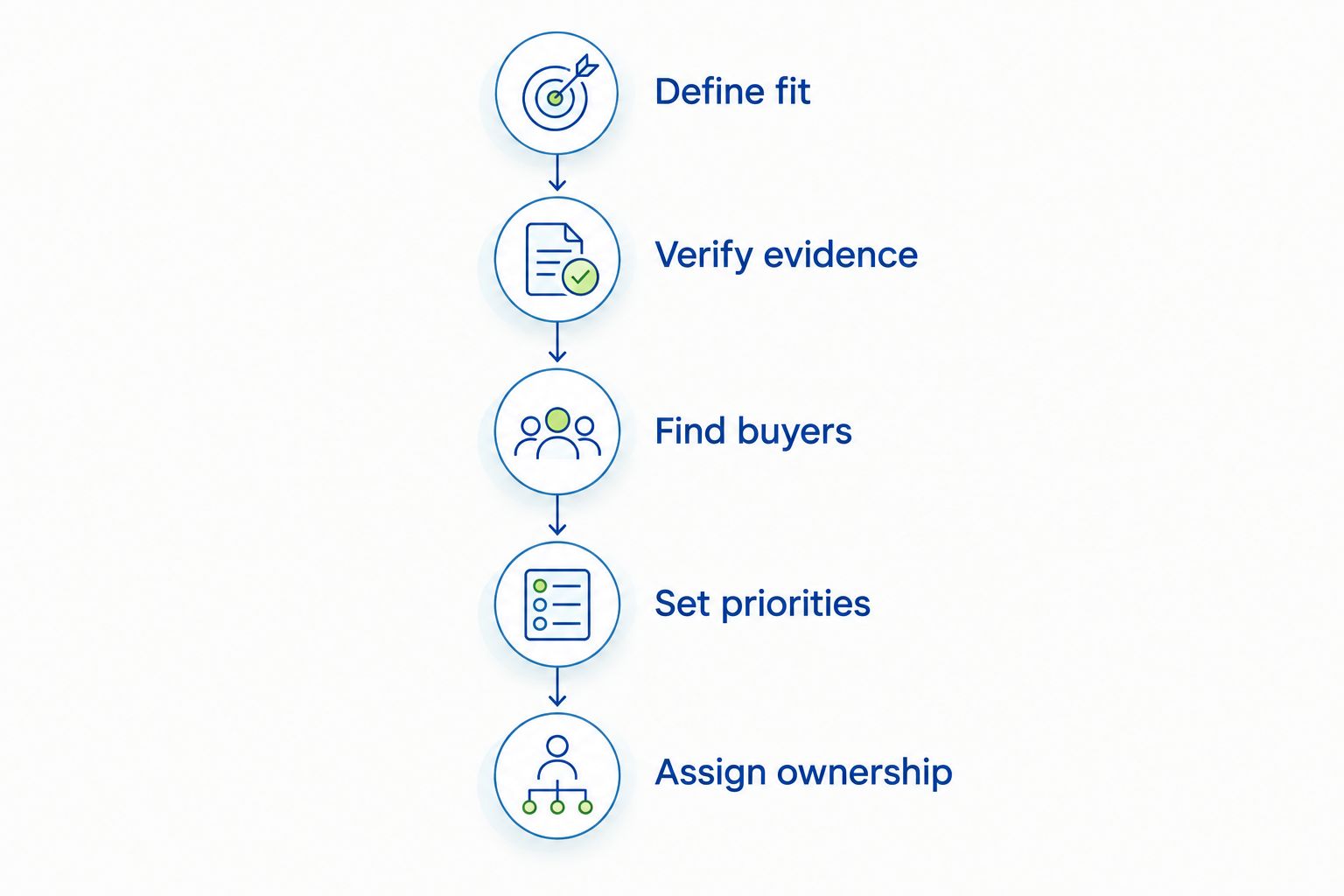
Choose accounts by matching observable operating requirements to what your company can deliver. Then identify the people involved in recognizing the problem, approving the work, and accepting the result. Use the following sequence before expanding your prospect list.
Define fit
Write down the work you want to win in operational terms. An industry label such as manufacturing is too broad to guide a useful sales conversation. Specify the applications, production environments, service requirements, and geographic boundaries your team can support.
Include disqualifiers. If a prospective job requires capabilities you do not provide, it should not remain a target because the company is recognizable. Make those boundaries explicit enough that someone other than the founder can apply them.
The output is a usable account definition, not a description of an ideal customer that could fit almost any industrial company. Your salesperson should be able to explain why a particular plant belongs on the list.
Verify evidence
Record what supports the fit decision. Public company information can establish a location or stated capability. A buyer conversation can establish a current operating problem. Neither source should be treated as proof of facts it does not contain.
Separate confirmed information from assumptions in the account record. For example, a company operating a relevant production process does not establish that its local plant needs your service now. That distinction keeps research from turning into an invented sales narrative.
Give unresolved questions an owner. If nobody is responsible for verifying a critical requirement, the account is not progressing; it is sitting in a database with an optimistic label.
Find buyers
Identify the roles connected to the work, rather than collecting names indiscriminately. Depending on the application, technical users, plant leadership, maintenance, engineering, or procurement can hold different parts of the decision. Confirm the actual roles during discovery.
Separate the person experiencing the problem from the person who can authorize action. Also identify who must accept the technical scope and who controls purchasing requirements. A useful contact map explains responsibilities, not just reporting lines.
Start outreach with the operating issue relevant to that role. Asking every contact for a general introductory meeting leaves the buyer to work out why the conversation matters.
Set priorities
Rank accounts by the strength of the fit evidence and the relevance of the buying situation. Do not manufacture a precise score from incomplete information. A clear explanation of why an account deserves attention is more useful than an unexplained number.
Distinguish a suitable account without a confirmed need from an active buying situation. Both can belong in your commercial system, but they require different actions. The former needs verification or continued attention; the latter needs discovery and a defined next step.
Record why the priority changed. That gives your team a way to review decisions instead of repeatedly debating the same accounts from memory.
Assign ownership
Every account under active pursuit needs an owner, a next action, and a review date. Shared responsibility without a named owner makes follow-up dependent on whoever remembers the conversation.
Define what happens after outreach receives a reply. Specify who runs discovery, who checks technical suitability, and who decides whether the conversation becomes an opportunity. Those handoffs matter as much as the initial message.
Keep account status separate from deal stage. An account can remain attractive after a particular opportunity closes or stalls. Your records should preserve the relationship without leaving an inactive deal in the forecast.
What belongs in an account-fit record?
A useful record connects the reason to pursue an account with the evidence behind that decision. Keep the structure short enough that salespeople will maintain it. Adding fields that nobody uses does not improve qualification.
| Fit criterion | Evidence to record | Reason to pause or exclude |
|---|---|---|
| Operating application | The process or problem your capability addresses | The application falls outside your scope |
| Delivery fit | Location, access, scheduling, and service requirements | Your team cannot support the required work |
| Technical fit | Requirements confirmed with an appropriate buyer | A critical requirement remains unresolved |
| Buying roles | Who defines, approves, purchases, and accepts the work | Contact names exist, but responsibilities are unknown |
| Buying situation | A stated need and an agreed next action | Interest exists without a defined reason to proceed |
Do not turn every blank field into a rejection. Some information only becomes available through a conversation. The distinction is between an open question your team will investigate and a known mismatch your team should respect.
For 2026 account planning, use the same definitions across sales and marketing. If marketing calls every matching company qualified while sales requires a confirmed project, the reports describe different things.
Choose the commercial model that matches the constraint
You have different options for doing this work. Continuing founder-led selling, hiring an industrial marketing agency, and installing a repeatable commercial system solve different problems. Compare the ownership model before comparing deliverables.
| Approach | Best for | Practical advantage | Limitation |
|---|---|---|---|
| Founder-led or internal selling | Businesses with available commercial leadership and defined responsibilities | Keeps account judgment close to operating knowledge | Judgment and follow-up can remain dependent on individual people |
| Industrial marketing agency | Businesses with clear targets and sales ownership that need campaign execution | Provides an external owner for agreed marketing activity | Campaign execution alone does not define qualification or sales handoffs |
| Revenue Systems engagement | Businesses whose targeting, qualification, and revenue process are disconnected | Connects account selection to pipeline execution and ownership | Requires internal decisions and participation, not just an external brief |
Do not replace a functioning internal team simply because outside help is available. If your team already applies clear account criteria, qualifies consistently, and follows through, the constraint could be a specific execution task rather than the commercial system.
Conversely, a new campaign does not resolve disagreement about which opportunities deserve attention. Define the operating rules before asking an agency to send more prospects into an unclear process.
Why manufacturing account fit varies
The same company can be attractive for one service and unsuitable for another. Your account criteria should reflect the work being sold rather than a general view that a large manufacturer must be a good prospect.
- Application: A relevant industry classification does not establish a relevant operating problem.
- Service boundary: The account must fit the locations and delivery requirements your business can support.
- Technical requirements: Requirements need confirmation before your team commits to a proposed solution.
- Buying responsibilities: The technical contact, approver, and purchasing contact can have different roles.
- Timing: A suitable account without a current buying situation belongs in a different workflow from an active opportunity.
- Commercial ownership: An attractive account still needs someone responsible for research, follow-up, and progression.
Review these criteria when your operating capabilities or commercial priorities change. Do not keep an account on the active list solely because it appeared in an earlier campaign.
Should you target the company or the individual plant?
Choose the level where the operating need and buying authority sit. A corporate account record provides organizational context; a plant record captures the local application, contacts, and requirements.
Do not assume that a relationship at one facility establishes demand at another. Confirm whether purchasing and technical decisions are local, centralized, or shared. Keep those connections visible so your team does not treat related facilities as either identical buyers or entirely unrelated businesses.
When should a target account become a sales opportunity?
Create an opportunity when a relevant buyer confirms a need and agrees to a defined next step. A matching company, email reply, or introductory meeting is not enough on its own.
Make the entry rule explicit in your 2026 deal-stage definitions. Record the problem being evaluated, the people involved, the unresolved qualification questions, and the next commitment. Keep unverified accounts available for further work without presenting them as active deals.
What should you inspect before adding more lead volume?
Inspect the handoff from selected account to active opportunity. Take recent account records through the process and ask whether another team member could understand the decision without calling the founder.
Use these questions in your pipeline review:
- Why does this account fit the work you want?
- Which facts are confirmed, and which are assumptions?
- Who owns the operating problem and the buying decision?
- What did the buyer agree to do next?
- Who owns follow-up inside your company?
- What would justify stopping pursuit?
For your 2026 review, distinguish a targeting failure from an execution failure. An unsuitable account calls for tighter selection. A suitable account with unclear follow-up calls for better ownership. A confirmed opportunity stalled at technical review calls for attention to that handoff, not another prospect list.
Do not use activity totals to answer a process question. Calls made and messages sent describe work performed; they do not explain whether the selected accounts fit or whether buyers have committed to progress.
Where senior commercial leadership fits
FieldForge is best for industrial and field-service companies that need a defined commercial system rather than more disconnected marketing activity. Its Revenue Systems work addresses the foundation, targeted pipeline execution, and visible revenue process described here.
FieldForge brings senior commercial leadership backed by industrial operating experience. That experience informs diagnosis by connecting commercial choices to delivery constraints: what work to pursue, what technical questions to resolve, and where responsibility passes between sales and operations.
The trade-off is participation. Installing a repeatable system requires your leadership team to agree on fit, qualification, ownership, and deal progression. It is not a substitute for those decisions. Use the P.R.O. Index diagnostic to examine the commercial constraint before choosing another campaign or an external execution brief.
Distinguish parent fit from plant fit
Illustrative scenario—not a FieldForge client case: a multi-site manufacturer operates a relevant process at one facility but not another. Keep the parent relationship, verify the process and service boundary at each plant, and record the local buying responsibilities. An attractive parent account earns research; it does not justify assigning every site the same priority or creating opportunities without a confirmed requirement.
Check the commercial foundation
FAQ
What’s the first step in manufacturing lead generation?
Define which accounts fit the work your company can deliver. Specify the application, service boundaries, technical requirements, and disqualifiers before building the contact list.
How do I know whether a manufacturer is a good target account?
A manufacturer is a good target when evidence connects its operating requirements to your capabilities. A matching industry label alone does not establish technical fit or a current buying need.
Should I contact procurement or the plant engineer first?
Start with the role connected to the problem you need to understand, then confirm the buying responsibilities. Do not assume that the technical contact can authorize the purchase or that procurement defines the technical scope.
Is a meeting a qualified manufacturing lead?
A meeting is not automatically a qualified opportunity. Confirm a relevant need, the people involved, and an agreed next step before treating the conversation as an active deal.
Is an industrial marketing agency better than an internal sales team?
An industrial marketing agency and an internal sales team have different responsibilities. Choose agency support for defined marketing execution; retain clear internal ownership of qualification, technical decisions, and sales progression.
What should I track besides the number of leads?
Track the evidence for account fit, qualification decisions, next actions, ownership, and movement through defined deal stages. Those records explain whether your team is pursuing suitable work and progressing real opportunities.
Where should I start with FieldForge manufacturing lead generation support?
Start by completing the P.R.O. Index diagnostic. Use the diagnosis to distinguish a targeting problem from a qualification, follow-up, or revenue-process problem before choosing the work to undertake.
One last thing
Your exclusion rules are as useful as your target criteria. Ask your team to explain which accounts it would stop pursuing and why. If nobody can answer, the list is still a collection of possibilities rather than a commercial decision.
For 2026, write those boundaries before expanding outreach. Complete the P.R.O. Index diagnostic as the next step with FieldForge, rather than defaulting to a generic marketing brief. More activity belongs after a clear decision about where activity should go.
Related guides
- Revenue operations consulting for industrial service companies
- How to choose a manufacturing marketing agency
- Private equity value creation when the founder owns every sale