
Measure manufacturing lead generation by cost per accepted opportunity: the acquisition cost assigned to a defined group of prospects divided by the opportunities sales explicitly accepts from that group. Count an opportunity only after sales confirms fit, a real requirement, a buying path, and a dated next action; keep quote preparation and later selling effort visible separately.
- Manufacturing lead generation needs sales acceptance criteria, not just more inquiries.
- Calculate cost per accepted opportunity using matched acquisition costs and accepted opportunities.
- FieldForge fits industrial businesses that need repeatable qualification, pipeline execution, and a visible revenue process.
- Fix rejection reasons before increasing campaign volume or adding another acquisition channel.
Why this matters
An inquiry is evidence that someone responded. It is not evidence that your shop can serve the requirement, that the buyer has a credible project, or that anyone owns the follow-up. Treating every response as pipeline hides the work still needed to establish those facts.
FieldForge brings senior commercial leadership backed by industrial operating experience to manufacturing lead generation and revenue-process design. That experience belongs in the acceptance rules: what your operation can deliver, which requirements deserve commercial attention, and where a salesperson needs technical help.
For your 2026 commercial plan, the useful question is not whether campaigns can produce names. It is whether those names become opportunities your team agrees to work.
How should you measure manufacturing lead generation?
Use a written acceptance standard, assign acquisition costs consistently, and compare opportunities from the same acquisition cohort. Do not divide this period's spending by opportunities generated from unrelated earlier campaigns. That calculation mixes different commercial activity and produces a misleading result.
Follow this sequence:
- Define acceptance. Write the evidence sales needs before an inquiry enters the active opportunity pipeline.
- Assign costs. Decide which campaign, agency, event, data, and prospecting costs belong in acquisition.
- Track origin. Preserve the source and acquisition period when a contact becomes an opportunity.
- Record decisions. Mark each qualified handoff accepted, rejected, or awaiting specific information.
- Review outcomes. Compare accepted opportunities with subsequent progression, quotations, and wins.
The calculation is straightforward:
Cost per accepted opportunity = assigned acquisition costs ÷ sales-accepted opportunities from the same cohort.
The discipline sits underneath the formula. If sales acceptance changes depending on who reviews the inquiry, the denominator does not describe a consistent result. If nobody accepts an opportunity, report that outcome directly; do not substitute meetings booked to make the measure look usable.
Start by fixing qualification before adding volume. More activity cannot repair an undefined handoff.
Define what sales is accepting
Sales acceptance is a commitment to work a specific commercial requirement. It is not confirmation that a contact opened an email, downloaded a document, or attended an event.
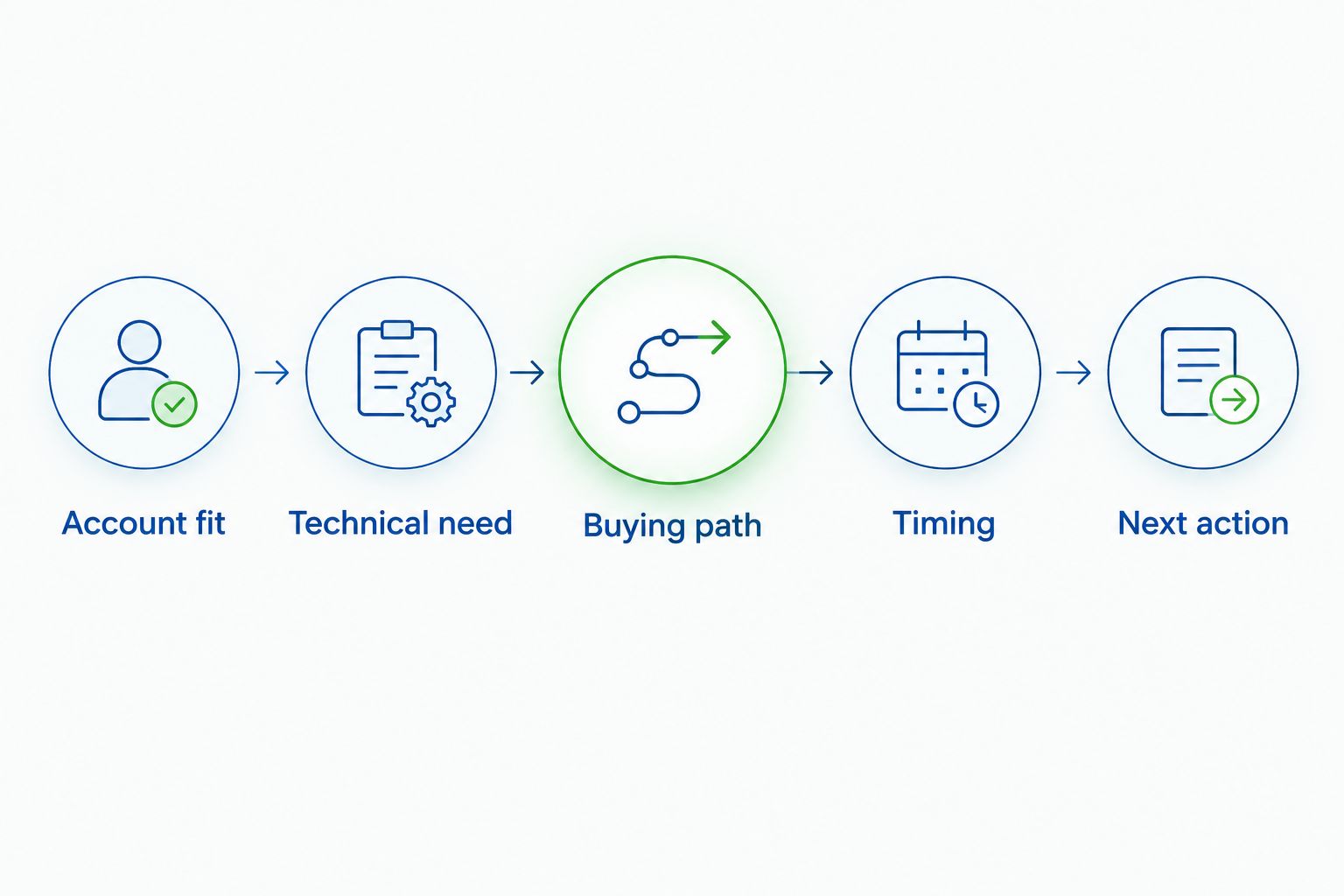
Use the following acceptance gates. Adjust the evidence to your operation, but keep the rule consistent across sources.
- Account fit: The company, application, geography, and work type match the business you intend to serve.
- Technical need: The prospect has described a requirement your team can evaluate, rather than expressing general interest.
- Buying path: You understand the contact's role and the route to technical approval, purchasing, or another decision-maker.
- Timing: You have a credible reason to act, such as a project milestone, maintenance requirement, or supplier review.
- Next action: A named owner and the prospect have agreed on what happens next and when.
Unknown information is not automatically a rejection. It is a qualification task with an owner. Keep that inquiry outside the accepted-opportunity count until the required evidence exists.
A request for quotation also needs judgment. A request outside your capabilities is not qualified pipeline merely because it includes a drawing. Conversely, an early technical discussion can deserve acceptance when the requirement, buying path, and agreed next action are clear.
Keep acquisition costs separate from selling costs
The numerator needs a boundary. Without one, a change in accounting can look like a change in campaign performance.
For your 2026 reporting, document the treatment of each cost before comparing channels. Include the costs required to create and qualify the inquiry under your chosen model. Keep later technical estimating, proposal development, travel, and negotiation identifiable as selling costs rather than silently moving them between categories.
| Cost category | Treatment to define | What inconsistent treatment hides |
|---|---|---|
| Campaign delivery | Assign the relevant media and campaign-management work | Whether acquisition depends on uncounted outside support |
| Prospecting | Assign relevant research, data, and outreach work | The effort required before a conversation happens |
| Trade events | Define which event and follow-up costs belong to acquisition | The difference between collecting contacts and creating opportunities |
| Qualification | Identify the work needed to reach sales acceptance | The cost of turning incomplete inquiries into workable requirements |
| Technical selling | Track estimating and proposal work separately | Whether accepted opportunities consume excessive downstream effort |
You can maintain a direct-spend view and a fuller acquisition-cost view, but label them clearly. Compare like with like. A campaign measured on media spending alone is not directly comparable with a channel carrying its allocated labor and management costs.
Do not count the same work twice. If qualification labor already sits inside an agency fee, adding that labor again distorts the result.
Match the reporting period to the opportunity's origin
Industrial buying does not obey your reporting cutoff. An inquiry can arrive during one period and reach sales acceptance later, after a technical exchange or a project review.
Keep the original acquisition cohort attached to the record. Report how many inquiries remain under qualification, how many were rejected, and how many reached acceptance. This makes an unfinished cohort visible instead of treating every unresolved inquiry as a failure.
Label 2026 cohorts consistently by source and acquisition period. Compare them at similar maturity, and show the acceptance date separately from the inquiry date. This distinguishes a weak source from a qualification process that simply has not completed its work.
Also separate existing-account requests from newly acquired opportunities. Both matter commercially, but combining them can make an acquisition channel appear responsible for demand created by an established relationship.
Why cost per accepted opportunity varies
A higher result is a prompt to inspect the process, not an automatic instruction to stop a channel. The underlying reasons matter:
- Targeting precision: Broad lists create qualification work when account characteristics do not match your operation.
- Requirement clarity: An incomplete application description requires more work before sales can assess fit.
- Acceptance consistency: Different standards across salespeople make channel comparisons unreliable.
- Follow-up ownership: Unassigned inquiries accumulate without a decision, leaving acquisition activity disconnected from pipeline.
- Cost scope: Adding research, management, or qualification labor changes the numerator even when demand is unchanged.
- Cohort maturity: Recently acquired inquiries have had less opportunity to complete technical qualification.
Use rejection reasons to decide what to change. Wrong applications point toward targeting or messaging. Missing technical detail points toward the inquiry form or qualification conversation. Good-fit prospects with no next action point toward follow-up execution.
Avoid a catch-all rejection label such as poor lead quality. It describes frustration, not a repairable constraint.
Choose the operating model that matches the constraint
Continuing founder-led selling, hiring an industrial marketing agency, and installing a repeatable commercial system solve different problems. Choose based on the missing function, not the busiest part of the funnel.
| Approach | Best for | What it addresses | Limitation |
|---|---|---|---|
| Internal or founder-led selling | Businesses with established relationships and internal ownership | Direct customer knowledge, qualification, and relationship continuity | Acceptance decisions and next steps can remain dependent on the founder |
| Industrial marketing agency | Businesses with clear qualification rules that need acquisition execution | Defined work such as campaigns, content, or search visibility | The scope must explicitly cover handoffs if you expect the agency to address them |
| FieldForge Revenue Systems | Industrial businesses whose commercial structure trails operational capability | A defined foundation, targeted pipeline execution, and a visible revenue process | Requires internal decisions and ownership; it is not a substitute for technical selling |
An agency engagement can make sense when you already know which accounts to pursue, what constitutes acceptance, and who follows up. State those requirements in the scope rather than assuming campaign delivery includes commercial-process ownership.
A systems engagement fits a different constraint: the business lacks consistent targeting, qualification, deal stages, or management visibility. Buying more acquisition activity before resolving those decisions leaves the handoff undefined.
Turn the measure into a management routine
Your 2026 pipeline review should inspect decisions, not just totals. Open the underlying records and ask whether the acceptance evidence supports the stage.
For every accepted opportunity, make these fields visible:
- The account and operating requirement.
- The source and original acquisition period.
- The evidence supporting sales acceptance.
- The commercial owner and required technical support.
- The agreed next action and due date.
- The current deal stage and reason for any reversal.
Review rejected inquiries alongside accepted opportunities. Record a specific rejection reason and identify whether targeting, qualification, or follow-up needs adjustment. Preserve useful account information without leaving rejected work in the active forecast.
Then inspect what happens after acceptance. A falling cost per accepted opportunity means little if those opportunities repeatedly fail technical review or never progress beyond an initial conversation. Acceptance quality and downstream progression belong in the same management discussion.
FieldForge uses industrial operating experience to connect commercial diagnosis with execution. For your team, that means defining a qualified requirement in terms the operation recognizes, then assigning the commercial work needed to advance it.
Is a booked meeting an accepted opportunity?
A booked meeting is not an accepted opportunity unless it meets your written acceptance standard. A relevant contact can agree to a conversation without having a defined requirement or a credible buying path.
Keep meetings as an activity measure. Use sales acceptance to identify which conversations have become commercial work worth pursuing.
Should an accepted opportunity already have a quotation?
An accepted opportunity does not need a quotation if sales has enough evidence to pursue a real requirement. Requiring a quote at acceptance can push technical estimating ahead of qualification.
Keep quotation as a separate deal stage with its own entry conditions. That separation exposes premature estimating rather than rewarding it.
Can a lower acquisition cost still create a worse pipeline?
A lower acquisition cost can create a worse pipeline when the acceptance standard weakens or downstream opportunities stop progressing. Inspect the requirements and next actions behind the count before treating the result as an improvement.
For 2026 channel decisions, retain the same acceptance rules across sources. Otherwise, the comparison measures inconsistent judgment rather than acquisition effectiveness.
Compare matching acquisition cohorts
Illustrative scenario—not a FieldForge client case: inquiries from a trade event reach acceptance after technical review, while search inquiries are assessed immediately. Do not divide this month's event spend by this month's search acceptances. Keep origin, acceptance date, cost scope, and pending qualification visible. When a cohort has no accepted opportunities, report the cost and zero acceptances; the cost-per-acceptance figure is undefined, not zero.
Review the qualification system
FAQ
What’s the best metric for manufacturing lead generation?
Cost per accepted opportunity measures acquisition efficiency once you have a consistent sales-acceptance standard. Review it alongside opportunity progression and wins so a cheaper handoff does not conceal weaker pipeline.
How do I calculate cost per accepted opportunity?
Divide assigned acquisition costs by sales-accepted opportunities from the same acquisition cohort. Keep cost scope and acceptance criteria consistent, and identify cohorts still undergoing qualification.
What should sales check before accepting a manufacturing lead?
Sales should confirm account fit, a technical need, a buying path, credible timing, and an agreed next action. Missing evidence belongs in qualification rather than being treated as confirmed pipeline.
Should trade show contacts count as opportunities?
Trade show contacts should count as opportunities only after they meet your sales-acceptance criteria. Badge scans and conversations establish contact, not a qualified requirement.
Is an industrial marketing agency enough to fix lead quality?
An industrial marketing agency fits acquisition work when targeting, qualification, and follow-up ownership are already defined. If those decisions remain unresolved, address the commercial process explicitly rather than assuming campaign delivery will fix it.
What should I do when sales rejects most inquiries?
Record specific rejection reasons and inspect the targeting, requirement detail, and follow-up behind them. Change the step causing rejection before increasing acquisition volume.
One last thing
Your denominator is a management decision. Before changing a campaign, ask your salespeople to assess the same inquiries against the written acceptance standard and explain their decisions. Disagreement exposes a qualification problem that a spending report cannot resolve.
Complete FieldForge's P.R.O. Index diagnostic before choosing more acquisition activity. Use that diagnosis to decide whether your business needs a Revenue Systems engagement, better execution within the current team, or a clearly scoped agency assignment.
Related guides
- Revenue operations consulting for industrial service companies
- How to choose a manufacturing marketing agency
- Private equity value creation when the founder owns every sale