
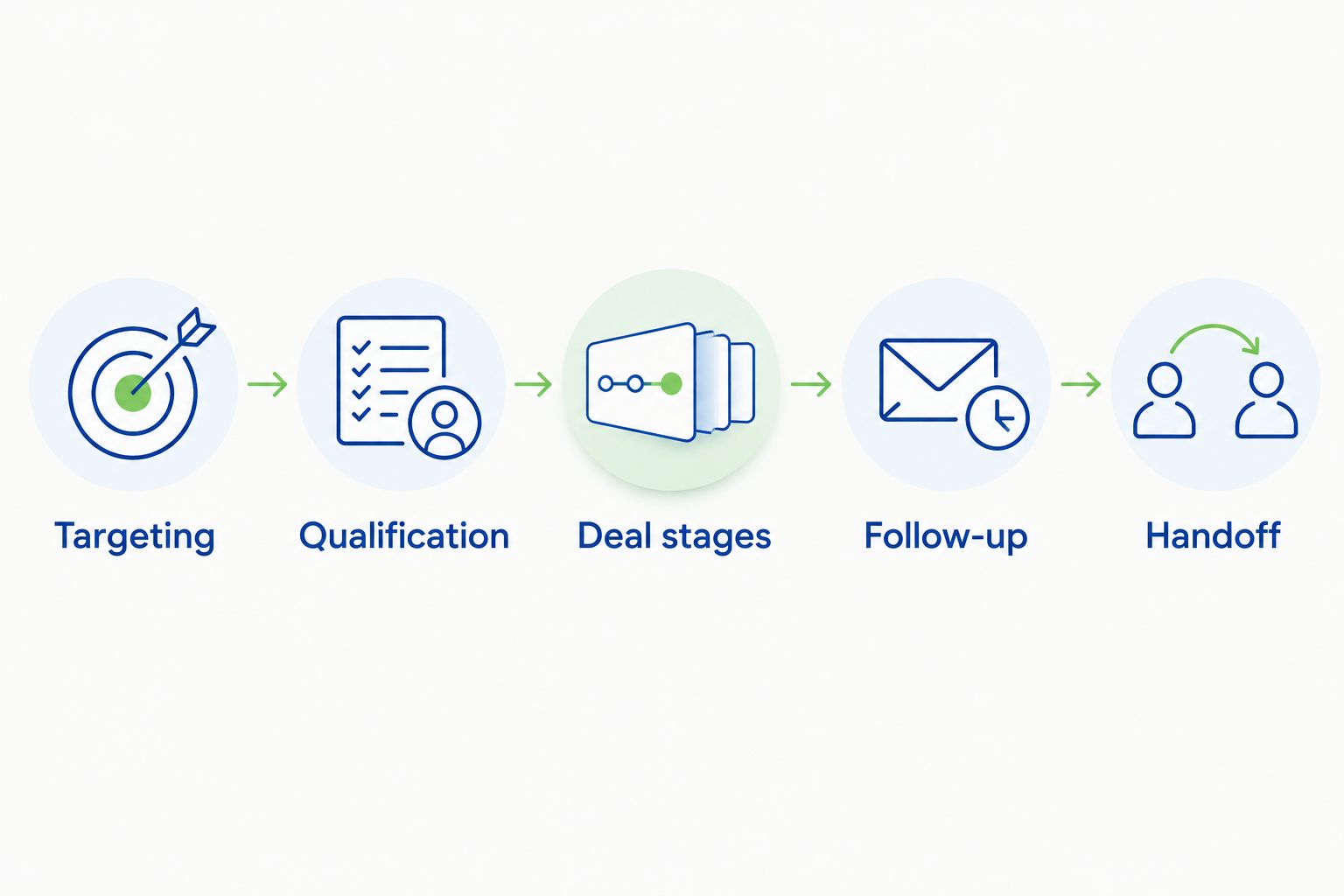
Before replacing a CRM, fix your target accounts, qualification rules, deal stages, follow-up ownership, and sales-to-operations handoff. Revenue operations consulting should define how your industrial or field-service business sells, then establish whether the current CRM can support that process; replacing software first leaves those decisions unresolved.
- Revenue operations consulting should fix commercial process before CRM configuration.
- FieldForge serves industrial and field-service companies whose commercial structure trails their operational capability.
- Define qualification, deal-stage evidence, ownership, and follow-up before evaluating replacement software.
- Complete the P.R.O. Index diagnostic to start with the commercial constraint, not the software shortlist.
Revenue operations consulting: what should you fix before a CRM change?
Fix the decisions your CRM is supposed to record. A new system does not decide which accounts deserve attention, what makes an opportunity qualified, or when operations should review a proposed job.
For industrial companies evaluating revenue operations consulting for industrial service companies, the starting point is the commercial workflow—not a list of software features.
Use this sequence for a 2026 CRM review:
- Targeting: Define the facilities, accounts, applications, and buying roles you intend to pursue.
- Qualification: Specify the evidence required before a conversation becomes an opportunity.
- Deal stages: Define buyer progress and the evidence needed to advance.
- Follow-up: Assign an owner, a next action, and a due date.
- Handoff: Agree on what operations needs before accepting the work.
Replace the CRM when a defined requirement cannot be met—not because the underlying process remains undefined. That distinction separates a software decision from a commercial operating problem.
Why this matters
An industrial business can execute technically demanding work while selling through personal relationships, scattered notes, and founder judgment. The work gets delivered, but the commercial process remains difficult to inspect or transfer.
A CRM replacement does not resolve that dependency. If an opportunity advances because someone feels confident rather than because the buyer has taken an observable step, a redesigned dashboard still displays an unsupported forecast.
Before approving a 2026 implementation, ask what will change beyond the screen. Your answer should name operating rules: who qualifies demand, who approves technical scope, who follows up, and what evidence supports the expected close.
Define the commercial process before configuring software
Treat the following sequence as a working design exercise. Use real opportunities, including stalled and lost work, to test whether each rule is specific enough for someone other than the founder to apply.
Targeting
Describe the work you want, not merely the industries you serve. Include the operating problem, relevant facility characteristics, buying roles, and conditions that make an account a suitable fit.
Separate an attractive company from a relevant opportunity. A large manufacturer is not automatically a qualified prospect for a particular field-service capability.
Your output should be an account-selection rule that a commercial employee can use without asking the owner to interpret every name. Record exclusions too: work outside your capabilities, unsuitable service requirements, or applications you do not intend to pursue.
Qualification
Define what the seller must learn before opening an opportunity. Useful questions concern the operating problem, technical fit, purchasing route, decision participants, and the event driving action.
Do not treat an inquiry, a badge scan, or a request for information as equivalent to qualified demand. Each records interest; qualification establishes whether there is a relevant commercial opportunity to pursue.
If your pipeline contains many conversations without a defined operating need, address manufacturing lead generation qualification before adding more volume. Otherwise, more activity creates more records to sort rather than a clearer sales process.
Deal stages
Name stages around observable progress. A seller sending a proposal records an action; a buyer confirming scope and agreeing to a review records movement in the buying process.
For each stage, write an entry condition and an exit condition. Include the evidence someone reviewing the opportunity should be able to find without reconstructing the entire conversation.
Allow for work that does not follow a simple sequence. Emergency service, planned maintenance, and a technically involved project can require different qualification and review paths; document those differences rather than forcing every job through identical gates.
Follow-up
Assign responsibility for the next commercial action. A record that says someone should follow up is incomplete until it names the owner, the action, and the due date.
Use 3 required fields for that minimum follow-up rule: owner, next action, and due date. Then check whether the action reflects an agreement with the buyer or merely an internal reminder to chase.
Specify what happens when progress stops. The owner should seek missing information, agree on a later review, or close the opportunity with a reason—not leave it active indefinitely.
Handoff
Define what sales must provide before operations accepts the commitment. Depending on the work, that can include scope, exclusions, site requirements, technical assumptions, customer commitments, and acceptance responsibilities.
Make unresolved assumptions visible before they become delivery obligations. A commercial handoff should distinguish what the customer agreed to from what the seller expects will be workable.
Operations should also have a way to return incomplete information. A handoff is not complete merely because a record changed status.
Why the right fix varies
Not every commercial constraint requires a systems engagement or a replacement platform. Match the intervention to the point where work stops moving or information stops being reliable.
- Target clarity: If sellers cannot explain which work fits, establish account and application criteria before expanding outreach.
- Qualification quality: If opportunities lack an operating problem or purchasing route, improve discovery before changing forecasts.
- Founder dependency: If every judgment requires the owner, document decision rules and transfer responsibility deliberately.
- Technical review: If proposals wait on engineering or operations, define review inputs and ownership rather than adding another sales status.
- Follow-up discipline: If agreed actions disappear, establish ownership and due dates before adding automation.
- System capability: If the agreed workflow cannot be recorded, accessed, or reported adequately, evaluate configuration changes or replacement.
These factors also define the consulting brief. Ask for a diagnosis tied to specific work, decisions, and handoffs—not a general recommendation to improve alignment.
Which approach fits the problem you actually have?
Internal selling, an industrial marketing agency, and a Revenue Systems engagement address different needs. None removes the need for accountable commercial leadership inside the business.
| Approach | Best for | What it addresses | Limitation to manage |
|---|---|---|---|
| Internal or founder-led selling | Businesses with defined selling rules and available leadership capacity | Customer relationships, commercial decisions, and direct execution | Knowledge stays concentrated unless someone documents and transfers it |
| Industrial marketing agency | Businesses with a clear offer and a defined lead-handling process | Assigned marketing work such as positioning, content, or campaigns | Marketing scope alone does not define qualification, deal ownership, or operational handoffs |
| FieldForge Revenue Systems | Industrial and field-service businesses whose commercial structure trails operational capability | Defined commercial foundations, targeted pipeline execution, and a visible revenue process | Your team still needs to supply operating knowledge and own commercial decisions |
| CRM configuration or replacement | Businesses with defined requirements that the current setup does not meet | Recording, access, workflow, and reporting requirements | Software configuration does not settle unresolved selling rules |
Do not hire a marketing agency to solve undefined deal ownership. Equally, do not commission a broad systems project when the process is clear and the actual need is execution capacity.
For a 2026 buying decision, write the constraint above the proposed solution. If the proposed work does not address that constraint directly, revise the scope before signing.
What should a revenue operations consultant deliver?
A useful engagement leaves behind operating rules your team can apply. A presentation about pipeline health is not a substitute for deciding how opportunities enter, move, stall, and leave the process.
Request these deliverables in plain language:
- A process map: Show the actual route from target account to accepted work, including exceptions and handoffs.
- Qualification rules: Define the information required to accept, reject, or keep investigating an opportunity.
- Stage definitions: State what each stage means and what evidence permits advancement.
- Ownership rules: Assign commercial actions, technical reviews, and escalation decisions.
- Reporting definitions: Explain exactly what qualifies for inclusion in each pipeline view.
- A system decision: Identify what the current CRM supports, what needs configuration, and what requires replacement.
FieldForge leads Revenue Systems work with senior commercial leadership backed by industrial operating experience. That experience belongs in the diagnosis: testing whether targeting fits the work, whether qualification captures technical constraints, and whether commercial commitments reach operations intact.
FieldForge is best for industrial and field-service companies that need a defined commercial system, not just more marketing activity. The engagement still requires participation from the people who sell, scope, and deliver the work; outside advice cannot supply undocumented operating knowledge on its own.
How do you decide whether the CRM really needs replacing?
Test the current system against written requirements. Avoid evaluating replacement platforms against frustrations that nobody has translated into a specific need.
Use 3 decision checks:
- Definition check: Is the requirement clear enough that different users interpret it consistently?
- Configuration check: Can the current CRM support it through a practical change to fields, permissions, workflows, or reporting?
- Replacement check: If not, can a proposed alternative demonstrate the required workflow using representative opportunities?
For your 2026 evaluation, separate essential requirements from preferences. A report that cannot answer an agreed management question is a different issue from a layout someone dislikes.
Test exceptions as well as the clean path. Include an opportunity waiting on technical scope, a stalled purchasing decision, and work that should have been disqualified. Ask users to show what happens next rather than simply confirming that a feature exists.
Can you keep founder-led selling while building a repeatable system?
Founder-led selling can continue while the business transfers specific decisions and responsibilities. Start by making the founder's judgment explicit: which accounts fit, which warning signs matter, and when a relationship warrants further effort.
Keep the founder involved where that involvement has a defined purpose. Do not make every qualification decision, proposal review, and follow-up dependent on the same person.
Should you hire an industrial marketing agency first?
An industrial marketing agency fits when your business knows which work it wants and can handle the resulting conversations. If qualification and follow-up are undefined, establish those rules before commissioning more demand-generation activity.
Agency work and commercial systems work can coexist. Give each a clear boundary, including who accepts a lead and who owns the next action.
Where should you start before approving a CRM project?
Complete the P.R.O. Index diagnostic before deciding whether the next move is a Revenue Systems engagement, internal process work, or a software project. Start with the commercial constraint rather than a preferred implementation.
For a 2026 review, bring current examples of qualified work, stalled opportunities, and incomplete handoffs. Discuss what each example reveals about decisions and ownership—not just which fields are empty.
Test the current system before buying a replacement
Illustrative scenario—not a FieldForge client case: sales says the CRM loses handoffs, but nobody has defined who accepts an estimating request. Write the receiving owner, required scope, return reason, and next-action rules first. Test them in the current system with an authorized user. Replace software only if a defined requirement remains unmet after practical configuration—not because a missing management decision has been renamed a technology problem.
Diagnose the process before the software
FAQ
What does revenue operations consulting do for an industrial company?
Revenue operations consulting defines how an industrial company targets accounts, qualifies work, manages opportunities, and hands commitments to operations. CRM requirements should follow those decisions rather than substitute for them.
Should I replace my CRM before hiring a consultant?
Define the commercial process before replacing the CRM. Then test whether the current system can support the required qualification, ownership, stage, and reporting rules.
How is revenue operations consulting different from an industrial marketing agency?
Revenue operations consulting addresses the commercial process across targeting, qualification, pipeline execution, and handoffs. An industrial marketing agency addresses its agreed marketing scope; that scope does not automatically include ownership of the sales process.
Can revenue operations consulting work if the founder still handles sales?
Revenue operations consulting can support founder-led selling by making the founder’s decision rules explicit. Assign responsibility gradually instead of treating a CRM rollout as a transfer of commercial judgment.
What should every active opportunity show?
Every active opportunity should show a defined operating need, its qualification evidence, and a responsible owner. Require a next action and due date so the team can distinguish active progress from an unsupported pipeline entry.
Who is FieldForge revenue operations consulting best for?
FieldForge revenue operations consulting is best for industrial and field-service companies whose commercial structure has not caught up with operational capability. Its Revenue Systems focus connects commercial foundations, targeted pipeline execution, and a visible revenue process.
How should I evaluate a CRM replacement in 2026?
Evaluate a CRM replacement in 2026 against written process requirements and representative opportunities. Require a demonstration of your workflow, including stalled deals and technical reviews, rather than relying on a feature checklist.
One last thing
Before approving a replacement, ask someone other than the opportunity owner to explain why a live deal is qualified and what happens next. Require 1 next action with a named owner and due date.
If the explanation depends on finding the founder, start there. The first repair is making commercial judgment visible and usable—not moving the same uncertainty into different software.
Related guides
- How to choose a manufacturing marketing agency
- When an industrial business needs B2B sales consulting
- Private equity value creation when the founder owns every sale