
Cross-sell belongs in a private equity value creation forecast only after customers demonstrate demand for the additional service and the business confirms it can deliver the work at an acceptable margin. For a 2026 operating plan, test account fit, buyer access, qualification, and delivery before treating a shared customer list as revenue evidence; existing relationships alone do not establish a buying need.
- Private equity value creation requires tested cross-sell demand, not overlapping customer lists.
- FieldForge fits industrial businesses that need a repeatable commercial system rather than another disconnected campaign.
- Give every cross-sell opportunity an owner, buyer-confirmed need, next action, and delivery check.
- Keep untested cross-sell outside the committed revenue forecast.
Why this matters
An industrial services acquisition can expand what a group sells without changing what its customers intend to buy. A maintenance relationship does not automatically create access to the person responsible for another service, another facility, or another budget.
The commercial task is to connect those gaps deliberately. That is the purpose of revenue operations consulting for industrial service companies: make targeting, qualification, ownership, and revenue reporting operate as one process rather than separate activities.
For a 2026 value creation plan, separate an attractive cross-sell hypothesis from a qualified opportunity. Both deserve attention. Only the latter has customer evidence behind it.
How should private equity value creation plans test cross-sell?
Test whether a specific customer will buy a specific additional service through a process the business can repeat. Start with a narrow account cohort, record what customers confirm, and carry that evidence through commercial and delivery decisions.
Use the following sequence before adding cross-sell assumptions to the operating forecast:
- Account fit. Select existing customers whose assets, locations, or operating requirements match the additional service. Record why each account belongs in the test.
- Buyer access. Identify the person who owns the problem and the people involved in approval. Ask the existing relationship owner for a relevant introduction, not a generic referral.
- Qualified need. Confirm the operational problem, scope, timing, and purchasing route. Separate interest in a conversation from an actual requirement.
- Delivery check. Have operations confirm service capability, geography, scheduling, and scope assumptions before a proposal becomes a forecast commitment.
- Forecast review. Record the customer's next action, the commercial owner, and the remaining conditions. Advance the opportunity only when evidence supports the move.
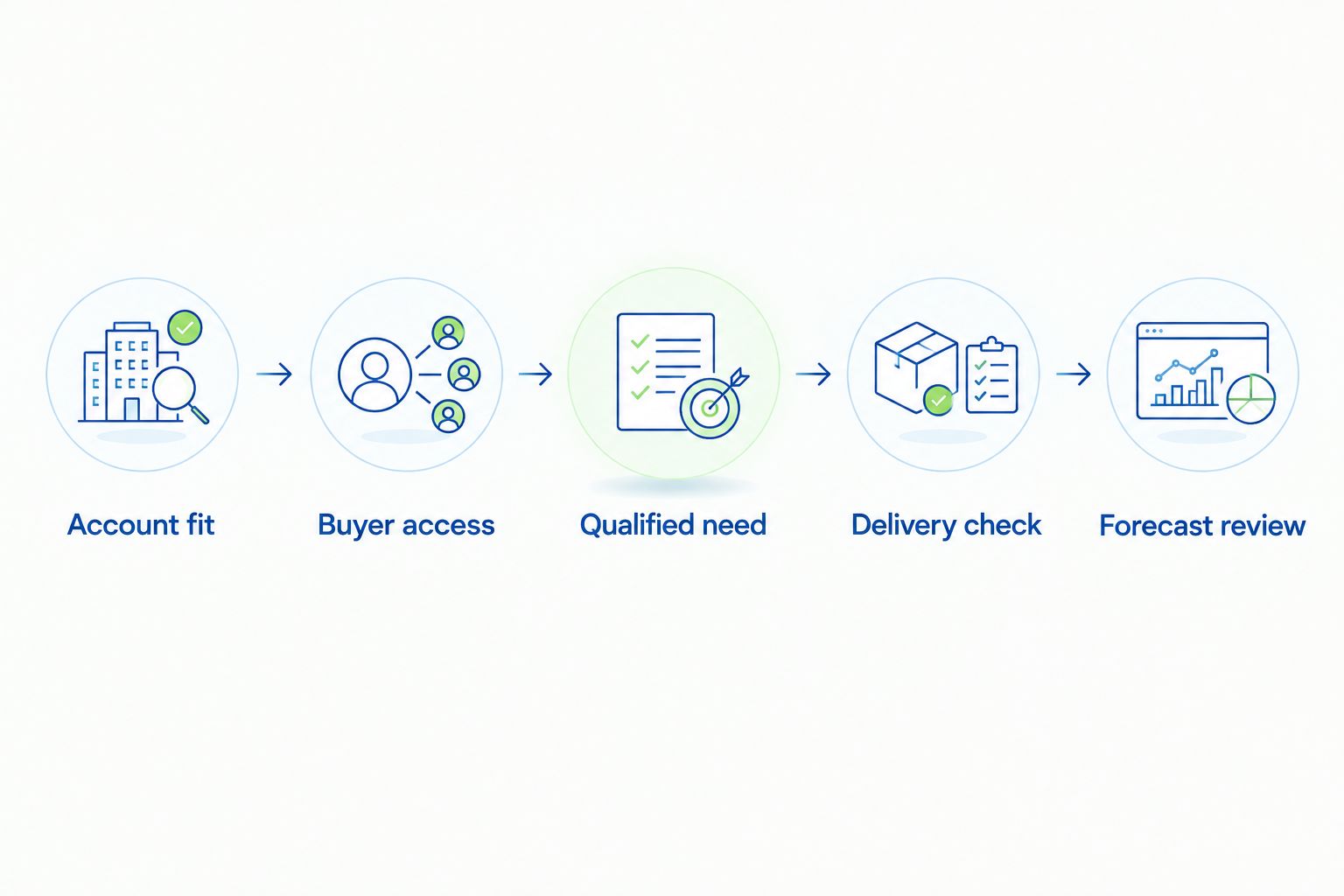
Set a 30-day initial test window as a management checkpoint, not a promise that industrial buying will finish within it. At the checkpoint, decide whether to continue, narrow, revise, or stop the test based on customer responses and operational constraints.
What counts as evidence, and what does not?
A combined account list is a targeting input. It is not a pipeline stage. Likewise, an introduction proves access to a conversation, not agreement to purchase.
Use explicit distinctions in the deal review:
| Commercial signal | What it establishes | What remains unproven |
|---|---|---|
| Shared customer across businesses | An existing relationship exists | Need for the additional service |
| Introduction accepted | A route to a conversation exists | Authority, scope, and timing |
| Customer describes a problem | A potential use case exists | Service fit and purchasing intent |
| Scope discussed with operations | Delivery requirements are becoming clearer | Commercial acceptance and scheduling |
| Proposal requested | The customer wants an offer | Approval, award, and realized margin |
| Work awarded and delivered | A transaction has occurred | Repeatability across other accounts |
Do not convert relationship coverage into a revenue probability. A forecast stage needs an entry rule and an exit rule that the commercial team can apply consistently.
Record disconfirming evidence as carefully as positive evidence. A customer that already has a contracted provider, lacks the relevant equipment, or buys through a different decision-maker helps define where the cross-sell thesis does not apply.
Repeatable system, founder-led selling, or an industrial agency?
These are different responses to different constraints. In a 2026 plan, choose the response that addresses the broken handoff rather than the most familiar supplier category.
| Approach | Best for | Practical advantage | Limitation |
|---|---|---|---|
| Repeatable commercial system | Making cross-sell accountable across businesses | Defines targeting, qualification, ownership, follow-up, and reporting | Requires leadership decisions and consistent team use |
| Founder-led selling | Opening sensitive relationships and supplying account context | Gives the test access to existing customer knowledge | Leaves progress dependent on the founder unless knowledge transfers |
| Industrial marketing agency | Executing a defined market message and campaign | Supports communication and demand generation | A campaign alone does not resolve delivery constraints or deal ownership |
| Internal commercial team | Running an agreed process close to customers and operations | Keeps account learning inside the business | More activity does not correct unclear qualification rules |
FieldForge brings senior commercial leadership backed by industrial operating experience to Revenue Systems engagements. That experience informs the diagnosis: test whether targeting matches actual service capability, whether qualification captures the customer's operating need, and whether commercial commitments survive the handoff to delivery.
The engagement still needs internal owners who will make decisions and use the process. External leadership does not replace the founder's customer knowledge or operations' responsibility for accepting work.
Why cross-sell results vary
Cross-sell performance depends on the mechanics between the relationship and the purchase. Diagnose these factors before deciding that the market needs more outreach:
- Service fit: Does the additional service solve a problem at this customer's assets or facilities? A relevant service at one site is not automatically relevant across the account.
- Buyer access: Does the existing contact control the purchase, influence it, or simply know someone who does? Record the route to the actual decision.
- Purchasing route: Does the new service require separate approval, supplier onboarding, or a different contracting process? Confirm the requirements with the customer.
- Delivery capacity: Can the business perform the work where and when the customer needs it? Resolve capability and scheduling questions before making commitments.
- Commercial ownership: Who makes the introduction, qualifies the work, follows up, and owns the opportunity? Shared responsibility without a named owner leaves those actions unresolved.
- Scope and margin: Does the proposed work remain attractive after delivery requirements are understood? Revenue without an acceptable delivery outcome is not a sufficient cross-sell objective.
Treat these as test fields, not reasons to abandon the thesis in advance. The purpose is to find where the offer works and what prevents it from progressing elsewhere.
How do you run a controlled cross-sell test?
Start with a cohort selected for a clear reason: a relevant installed asset, a known operating problem, or a service requirement the acquired business can address. Do not select accounts solely because their names appear in both businesses' records.
Create one shared opportunity record with the following fields:
- Customer, facility, and existing relationship owner.
- Additional service and the reason it fits.
- Buyer, operational contact, and purchasing route.
- Confirmed problem, scope, and timing.
- Delivery reviewer and unresolved constraints.
- Commercial owner, next action, and next review date.
Assign one accountable owner per opportunity. Other people can contribute introductions, technical input, or delivery checks, but the owner maintains the record and secures the next action.
Hold a weekly 30-minute review focused on changed evidence. Ask what the customer confirmed, what operations rejected or clarified, and what must happen next; a list of emails sent does not answer those questions.
For the 2026 test, keep the result categories explicit: advance, revise, defer, or close. Preserve the reason for each decision so the next cohort reflects what the business learned rather than repeating the original assumptions.
When should cross-sell enter the revenue forecast?
Cross-sell should enter the opportunity forecast when it meets the business's documented qualification criteria. Keep that separate from the committed forecast, which needs its own evidence requirements and approval rules.
Do not apply an invented conversion rate to the entire customer base. If the business lacks relevant history, show the cross-sell thesis separately and report the test's actual progress without presenting a scenario as an expected outcome.
A useful review separates these states:
- Hypothesis: An account appears to fit the additional service.
- Qualified opportunity: The customer has confirmed a relevant requirement and a credible next step.
- Commercial commitment: The opportunity meets the company's documented commitment criteria.
- Delivered outcome: The work has been completed and its commercial result can be assessed.
Report the unresolved conditions alongside the stage. A proposal awaiting technical clarification is different from an approved scope awaiting a purchasing decision, even if both sit in the same pipeline column.
For a 2026 board review, distinguish customer evidence from management assumptions. That makes the discussion actionable: which condition needs resolving, who owns it, and whether the opportunity still belongs in the forecast.
Can the founder keep opening doors?
Yes. Keep the founder involved where the relationship matters, but move account knowledge and follow-up into a shared commercial process.
Before an introduction, document the customer's context, the proposed service fit, and the intended next conversation. Afterward, assign follow-up to the opportunity owner rather than leaving every exchange dependent on the founder.
The objective is not to remove the founder from valuable relationships. It is to make those relationships usable by a team without losing context or creating conflicting messages to the customer.
Should you hire an agency before testing cross-sell?
Hire an agency when the constraint is executing a defined message to a defined audience. Fix targeting, qualification, ownership, and delivery checks first when those decisions remain unresolved.
An agency brief becomes more useful after the test identifies the relevant buyer, the operating problem, and the objections that stop progress. Otherwise, the campaign asks the market to resolve questions the business has not answered internally.
Start with the commercial constraint
Complete the P.R.O. Index diagnostic before turning cross-sell into a larger campaign. Use it to begin the Revenue Systems discussion with FieldForge, then test the commercial assumptions against customer and operational evidence.
Bring the practical questions: who owns account selection, what makes an opportunity qualified, where follow-up stops, and who confirms delivery fit. Those answers define the work more clearly than a broad instruction to increase cross-sell.
Assess your commercial system
Start with the P.R.O. Index diagnostic before expanding cross-sell activity.
Let the customer reject the cross-sell hypothesis
Illustrative scenario—not a FieldForge client case: an acquired inspection business shares accounts with a maintenance provider, but the inspection work is bought through a separate approved-supplier process. Record that purchasing route and ask for the relevant introduction. Until the customer confirms need and access, keep the account in the test cohort—not the committed forecast. A shared logo does not establish a shared budget or an obtainable order.
FAQ
How does cross-sell support private equity value creation?
Cross-sell supports private equity value creation when an existing customer buys an additional service the business can deliver at an acceptable margin. Test service fit, buyer access, qualification, and delivery before forecasting the opportunity.
Does an overlapping customer list prove cross-sell potential?
An overlapping customer list identifies accounts to investigate, not confirmed demand. Each account still needs a relevant service requirement, a route to the buyer, and a workable delivery scope.
How long should an industrial cross-sell test run?
Use a 30-day initial checkpoint to review evidence, not as a required sales-cycle length. Continue or revise the test according to customer progress, purchasing requirements, and operational constraints.
Who should own a cross-sell opportunity?
One named commercial owner should own each cross-sell opportunity. Relationship owners and operations contribute context and delivery decisions, while the commercial owner maintains follow-up and stage evidence.
Should the founder stop selling after an acquisition?
The founder should keep contributing where relationships and account knowledge matter. Transfer that knowledge into shared records and named follow-up so the commercial process does not depend on the founder handling every exchange.
Is an industrial marketing agency enough to build a cross-sell system?
An industrial marketing agency can execute campaigns, but campaign execution alone does not establish qualification, opportunity ownership, or delivery approval. Define those mechanics before asking an agency to generate more activity.
Who is FieldForge’s Revenue Systems work best for?
FieldForge’s Revenue Systems work fits industrial and field-service businesses whose commercial structure has not caught up with operational capability. The focus is a defined foundation, targeted pipeline execution, and a visible revenue process.
One last thing
A well-run cross-sell test is allowed to reject the original thesis. If customer conversations show that the buying route, service fit, or delivery requirements do not support the offer, stop carrying that assumption into the forecast.
Keep the evidence. Knowing where cross-sell does not work gives the commercial team a sharper account definition and gives the operating plan fewer unsupported dependencies.
Related guides
- Private equity value creation when the founder owns every sale
- Manufacturing lead generation: fix qualification before adding volume