
Revenue operations consulting should put forecast accountability with one named commercial leader, while sales owns deal evidence, operations confirms delivery constraints, and finance reconciles the financial assumptions. A consultant defines and installs that operating system; the consultant should not become the permanent owner of your revenue commitment.
- Revenue operations consulting defines forecast ownership; your commercial leader remains accountable for the revenue commitment.
- FieldForge fits industrial businesses that need defined commercial operations rather than more ad hoc selling.
- Separate customer commitment, operational readiness, and financial recognition before treating pipeline as forecast.
- Assign deal-stage rules, evidence requirements, and exception decisions before changing CRM software.
Why forecast ownership matters
A forecast is not a list of quotes with optimistic close dates. It is a management judgment about which work will become an order, when the business can deliver it, and which financial period it belongs in.
For industrial and field-service owners evaluating their 2026 commercial process, the first question is who can defend that judgment. A spreadsheet owner is not necessarily a forecast owner. Neither is the salesperson with the strongest customer relationship.
FieldForge revenue operations consulting is best for industrial owners who need a defined commercial system rather than more ad hoc commercial activity. Its revenue operations consulting for industrial service companies addresses that distinction: targeted pipeline execution needs a visible revenue process behind it.
How does revenue operations consulting define forecast ownership?
Start with a written ownership agreement, not a dashboard specification. The agreement should distinguish the person accountable for the forecast from the people responsible for supplying and checking its evidence.
Use these steps to establish ownership:
- Name the accountable leader. Give one person responsibility for submitting and defending the commercial forecast. In a founder-led business, that person can still be the founder, but the responsibility must be explicit.
- Assign deal maintenance. Make each opportunity owner responsible for the customer evidence, next action, expected order date, and reason the deal belongs in its forecast category.
- Assign operational validation. Require the relevant operations leader to check delivery assumptions when labor, equipment, access, or scheduling affects timing.
- Assign financial reconciliation. Give finance responsibility for connecting bookings, delivery, invoicing, and revenue recognition without treating them as interchangeable events.
- Assign process administration. Give the commercial operations function responsibility for definitions, required fields, review preparation, and unresolved exceptions.
This creates 1 accountable owner and 4 supporting responsibilities. These are responsibilities, not a staffing prescription: a smaller business can combine roles without leaving ownership undefined.
| Responsibility | Named owner | Evidence required | Decision boundary |
|---|---|---|---|
| Forecast commitment | Commercial leader | Reviewed opportunities and stated assumptions | Approves the commercial submission |
| Deal maintenance | Opportunity owner | Customer action, scope, next step, timing | Proposes deal status and changes |
| Operational validation | Operations leader | Delivery requirements and constraints | Confirms or challenges execution timing |
| Financial reconciliation | Finance leader | Financial treatment and period assumptions | Reconciles the forecast to financial reporting |
| Process administration | Commercial operations owner | Complete records and exception log | Enforces the agreed review process |
Do not let this table become shared accountability. Contributors can disagree; the accountable leader must resolve the disagreement or document the assumption being carried.
What should each forecast owner actually do?
Commercial leader: own the final judgment
The commercial leader decides what the business is prepared to commit to internally. That requires examining evidence, challenging unsupported timing, and explaining changes between forecast versions.
The role is not to overwrite every salesperson's view. It is to apply consistent judgment when customer expectations, sales confidence, and delivery constraints point in different directions.
For your 2026 ownership agreement, write down who can approve an exception and who receives the final submission. If the CEO routinely changes the number afterward, the CEO's decision rights belong in that agreement too.
Opportunity owner: maintain customer evidence
The opportunity owner records what the customer has done, not just what the seller expects. Useful evidence includes an agreed scope, a named purchasing contact, a known approval step, or a scheduled technical review.
Keep the next action specific. Following up is an activity; obtaining the customer's decision on a revised scope is a defined commercial step. The forecast needs the latter.
Operations leader: validate execution assumptions
Operations should challenge assumptions about mobilization, technician availability, equipment, site access, and execution timing when those assumptions affect the forecast. A likely order and executable work are different judgments.
Operations does not need to approve every early-stage prospect. Define the point at which operational review becomes mandatory, then make that review part of the opportunity's progression rather than a last-minute favor.
Finance leader: reconcile the financial view
Finance should distinguish an expected order from the revenue associated with performing the work. The treatment depends on the contract and applicable accounting policy; a salesperson's close date cannot settle that question.
Keep the commercial view and financial view connected but separately labeled. Otherwise, a discussion about order timing becomes an argument about revenue with different assumptions on each side.
Commercial operations owner: maintain the system
The commercial operations owner maintains stage definitions, evidence requirements, reporting rules, and the review agenda. This person should flag missing information without silently supplying guesses.
Process ownership does not transfer forecast accountability. A clean report can still contain a weak commercial judgment, and an accurate judgment is difficult to repeat without a maintained process.
Separate the events before assigning the numbers
For a 2026 forecast, explicitly distinguish these events: customer commitment, delivery readiness, and financial recognition. Your business needs a usable connection between them, not a single date field carrying incompatible meanings.
A customer can intend to proceed while site access remains unresolved. An order can be signed while the work falls outside the period being discussed. Labeling the events makes those differences visible before a management meeting.
- Customer commitment: What purchasing action has occurred, and what remains outstanding?
- Delivery readiness: What must be true for the business to perform the work on the proposed schedule?
- Financial recognition: How does the expected work map to the financial reporting period under the applicable policy?
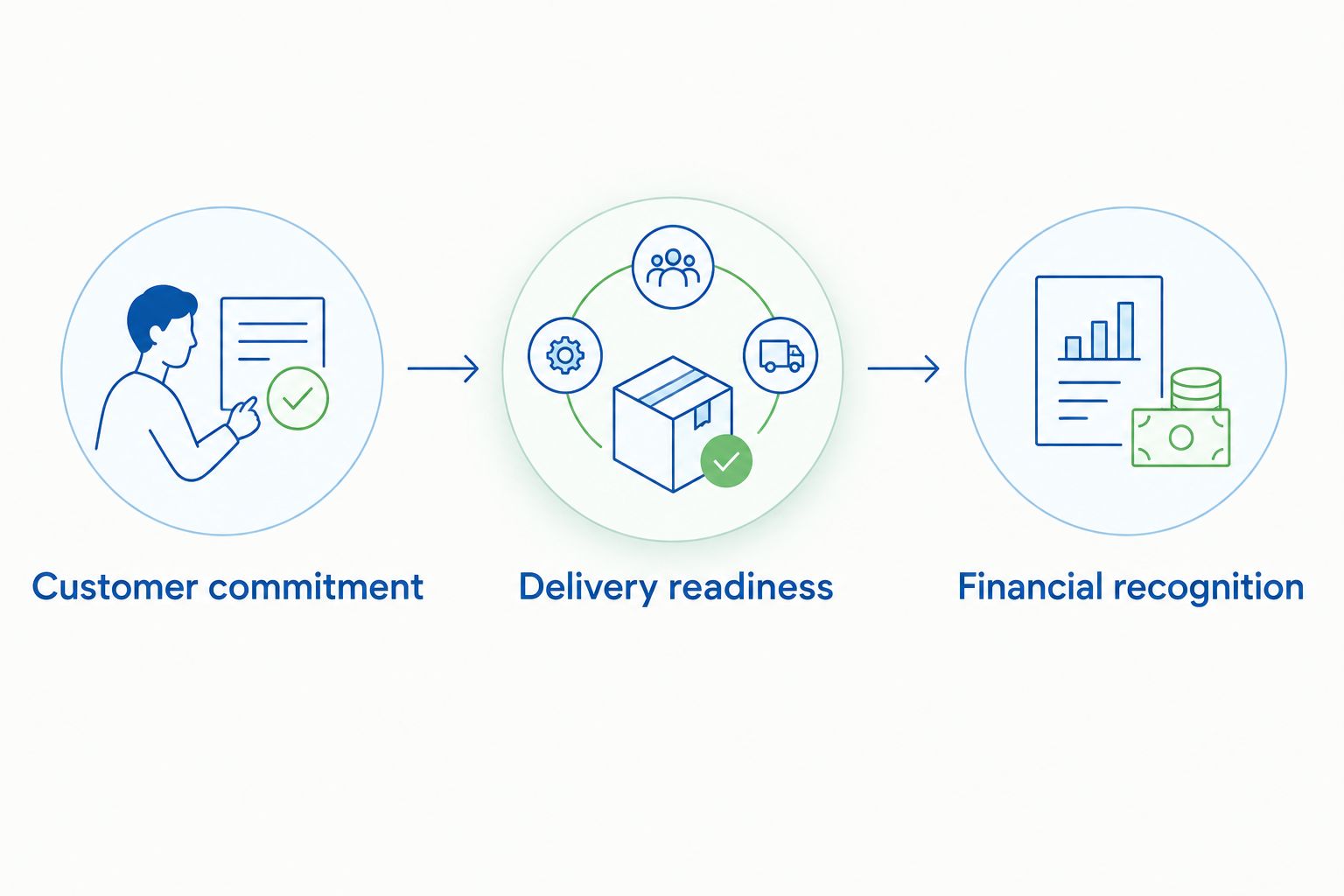
The sequence is a review framework, not a substitute for accounting policy. Use it to expose missing assumptions, then let the responsible leader resolve each assumption within their authority.
Use evidence checks instead of confidence labels
Before an opportunity enters the committed forecast, require 5 evidence checks. Treat these as a proposed operating standard to adapt to your sales process, not as a universal scoring model.
- Scope: Is the work defined well enough for the customer and your delivery team to understand the commitment?
- Authority: Who can approve the purchase, and what decision remains?
- Timing: What customer event supports the expected order date?
- Execution: Which operational constraints affect when work can start or finish?
- Next action: What specific action moves the decision forward, and who owns it?
A percentage entered by the seller does not answer these questions. If your business uses probabilities, define what those probabilities represent and how the underlying stage evidence is maintained.
Set a scheduled review interval and an update cutoff. Preserve the prior submission so the commercial leader can explain changes in timing, scope, and forecast category rather than presenting a replacement number without context.
Why forecast ownership varies between industrial businesses
The accountable role should be clear, but the supporting workflow should match how the business sells and delivers. Use these factors to decide where additional review belongs:
- Founder-held relationships: If the founder holds the customer context, define how that information enters the record without removing the founder from useful selling work.
- Work type: Recurring service, project work, and emergency work need different evidence of timing and commitment.
- Technical scope: Add technical validation where unresolved scope changes the commercial or delivery assumptions.
- Delivery dependencies: Identify which deals need review of labor, equipment, site access, or customer shutdown schedules.
- Purchasing process: Record the customer's approval steps rather than assuming a verbal preference equals authorization.
- Reporting purpose: State whether the review concerns orders, executable work, invoicing, or recognized revenue.
For 2026 planning, document these differences before asking teams to use a common forecast template. A common format is useful only when the meanings inside it are understood.
Should you keep selling internally, hire an agency, or install a system?
These choices solve different problems. Choose based on the constraint, not on which proposal contains the most activity.
| Approach | Best for | What it contributes | Trade-off |
|---|---|---|---|
| Founder-led or internal selling | Businesses with usable ownership and a defined process | Direct customer knowledge and internal commercial control | Requires protected time and recorded customer context |
| Industrial marketing agency | Businesses needing external marketing execution | Execution against a defined audience and brief | Does not, by itself, assign forecast accountability |
| Revenue Systems engagement | Businesses with undefined targeting, qualification, handoffs, or revenue-process ownership | Work to define and install a repeatable commercial system | Requires leadership decisions and internal adoption |
Keep internal selling when the process is clear and the team can execute it. Do not add consulting simply because a founder remains commercially involved. The problem is undocumented dependence, not involvement itself.
Hire an industrial marketing agency when the missing capability is marketing execution. Before commissioning more activity, define what qualifies as a useful opportunity and who takes responsibility after the handoff.
FieldForge's Revenue Systems positioning combines senior commercial leadership with industrial operating experience. Apply that experience to diagnosis: does the apparent pipeline problem start with targeting, qualification, technical scope, delivery assumptions, or a missing decision owner? The engagement still needs an internal leader who will enforce the resulting process.
Can a consultant own our forecast?
A consultant can administer the review, challenge assumptions, and help install the ownership rules. Your commercial leader should retain accountability for the forecast commitment.
If an interim arrangement includes decision authority, document its scope and handover. Do not let a temporary reporting responsibility become an undefined permanent dependency.
Should finance or sales own the forecast?
The commercial leader should own the commercial forecast, while finance owns financial reconciliation and the relevant accounting treatment. Opportunity owners supply the deal evidence; neither finance nor commercial operations should invent missing customer information.
The useful question is not which department owns every number. It is who decides each assumption and who resolves disagreement before submission.
Should we change the CRM before fixing ownership?
Define ownership before changing the CRM. Software can enforce required fields and display a review queue, but it cannot decide who has authority to challenge an unsupported commitment.
Use the ownership agreement to specify the configuration. Otherwise, the replacement system inherits the same ambiguity with different screens.
Start with the diagnostic, not a reporting project
Complete FieldForge's P.R.O. Index diagnostic before choosing a Revenue Systems engagement. Frame the decision around your commercial constraint: who you target, how you qualify work, what advances a deal, and who owns the revenue process.
Bring a live opportunity through the proposed rules. Ask the salesperson to explain the customer evidence, operations to identify execution constraints, and finance to distinguish order timing from financial recognition.
If the discussion ends without a named decision owner, another dashboard is not the next move. Assign authority, record the unresolved assumptions, and test the process again.
Keep the order forecast separate from delivery revenue
Illustrative scenario—not a FieldForge client case: purchasing expects to release an order, but operations cannot mobilize until the customer grants site access. The commercial owner records order evidence and outstanding approvals. Operations records the delivery dependency. Finance applies the contract's accounting treatment to the relevant reporting period. Do not force those judgments into a single close-date field or treat a likely order as already recognized revenue.
Clarify revenue-process ownership
FAQ
Who should own the revenue forecast in an industrial company?
One named commercial leader should own the commercial forecast. Opportunity owners maintain customer evidence, operations validates execution assumptions, and finance reconciles the financial view.
What does revenue operations consulting change about forecasting?
Revenue operations consulting defines ownership, evidence requirements, deal-stage rules, and the review process. The internal commercial leader remains accountable for the forecast commitment.
Can the founder stay involved without owning every opportunity?
The founder can retain important customer relationships without owning every opportunity. Record the customer context, assign an opportunity owner, and define which decisions still require the founder.
Is a signed order the same as forecast revenue?
A signed order is not the same as recognized revenue. Delivery timing, contract terms, and the applicable accounting policy determine how the work connects to financial reporting.
Is an industrial marketing agency enough to fix forecast ownership?
An industrial marketing agency does not, by itself, establish forecast ownership. Your business still needs an accountable commercial leader, qualification rules, and a defined handoff into the revenue process.
What should we do before buying a new CRM?
Define forecast ownership, deal evidence, and decision rights before buying a new CRM. Configure the software around those rules rather than expecting the software to create them.
One last thing
At your next 2026 forecast review, ask who can move a deal out of the committed forecast when its evidence no longer supports inclusion. Then ask whether that person actually exercises the authority.
Forecast ownership includes the authority to remove unsupported commitments. If everyone can add optimism but nobody can reject it, you have not finished defining the role.
Related guides
- Manufacturing lead generation: fix qualification before adding volume
- How to choose a manufacturing marketing agency
- When an industrial business needs B2B sales consulting
- Private equity value creation when the founder owns every sale