
B2B sales consulting diagnoses stalled industrial quotes by checking whether each opportunity has a defined operational need, a credible buying path, and a buyer-agreed next action. For your 2026 pipeline review, distinguish a quote awaiting a specific decision from one that was never qualified; more follow-up does not repair missing demand, authority, or scope.
- B2B sales consulting should diagnose qualification, deal stages, and follow-up before adding industrial pipeline volume.
- A submitted industrial quote is not evidence of a buying decision; record the buyer’s next action.
- FieldForge fits industrial businesses that need a repeatable commercial system rather than more founder-dependent selling.
- Separate technical approval, commercial approval, and scheduling constraints before deciding how to restart a stalled quote.
How does B2B sales consulting diagnose stalled industrial quotes?
Start with the buyer’s decision, not the seller’s activity log. A quote marked open tells you little unless someone can explain what the customer must do next and what evidence supports that explanation.
Use these checks in order:
- Confirm demand. Record the equipment, service requirement, operational problem, and consequence of leaving it unresolved. Separate an active requirement from a request collected for comparison or budgeting.
- Confirm scope. Establish what the customer expects, what your quotation includes, and which technical questions remain unanswered. Identify who accepts the scope.
- Confirm approval. Name the people responsible for technical acceptance, spending approval, purchasing, and site access. Do not assume your technical contact controls all four.
- Confirm commitment. Record a buyer-agreed action, its owner, and its timing. A salesperson’s reminder to send another email is not a customer commitment.
If these questions expose gaps across the pipeline rather than within one deal, the issue belongs in your commercial process. The guide to when an industrial business needs B2B sales consulting addresses that distinction.
Why this matters
An industrial quote combines technical work with a commercial assumption: the customer has a reason and a route to buy. An accurate estimate does not establish either one.
When you treat every submitted quote as an active opportunity, your pipeline mixes different situations. An outage-dependent service requirement, an unapproved capital request, and a competitor comparison need different actions. Labeling all three as follow-up hides the constraint.
For a 2026 pipeline review, ask for evidence rather than confidence. The useful question is not whether the salesperson feels good about the quote; it is which customer decision remains unresolved and who owns it.
Why industrial quotes stall
Use these factors as diagnostic categories, not conclusions you assign without speaking to the customer. Each category points to a different recovery action.
- Unqualified demand. The customer requested information but has not identified a current operational requirement. Confirm what would turn the request into an active purchase.
- Unresolved scope. Technical assumptions, exclusions, access requirements, or acceptance criteria remain disputed. Assign the open question to someone who can resolve it.
- Incomplete approval. Your contact supports the work but cannot authorize the purchase. Map the approval path without bypassing that contact.
- Unclear timing. The work depends on a shutdown, project milestone, asset condition, or another event. Record the actual trigger rather than an arbitrary expected close date.
- Missing ownership. Nobody owns the next conversation or customer decision. Assign an accountable commercial owner and agree on the next action with the buyer.
- Commercial mismatch. The customer’s expectations and your proposal do not match. Establish the specific objection before rewriting the quote or changing terms.
A quote can have several constraints. Resolve the earliest unresolved buying requirement first: negotiating terms cannot substitute for agreement on what work the customer needs.
Review the quote, the decision, and the handoff
Build the review around the customer’s actions. Keep the information short enough that a commercial owner can maintain it, but specific enough that someone else can understand the opportunity without calling the founder.
| Review area | Evidence to record | Warning sign | Next action |
|---|---|---|---|
| Operational need | Problem, affected operation, and reason to act | General interest without a defined requirement | Confirm the operational consequence |
| Scope | Agreed work and unresolved technical questions | Revised quotes without scope acceptance | Arrange a scope review |
| Approval path | Technical, financial, and purchasing responsibilities | One contact described as the entire buying process | Confirm the remaining approvals |
| Decision timing | Customer event or stated decision point | Close date moved without new evidence | Reconfirm the decision trigger |
| Next commitment | Customer action, owner, and agreed timing | Repeated seller reminders | Agree on a specific decision conversation |
This review should produce a disposition, not another status update. Keep the opportunity active when evidence supports it, move it into a defined later review when timing is genuinely deferred, or close it when the buying requirement no longer exists.
Closing an unsupported opportunity is pipeline maintenance. It prevents a historical request from continuing to influence staffing, forecasting, and sales priorities as if it were current demand.
Install a repeatable quote-to-decision process
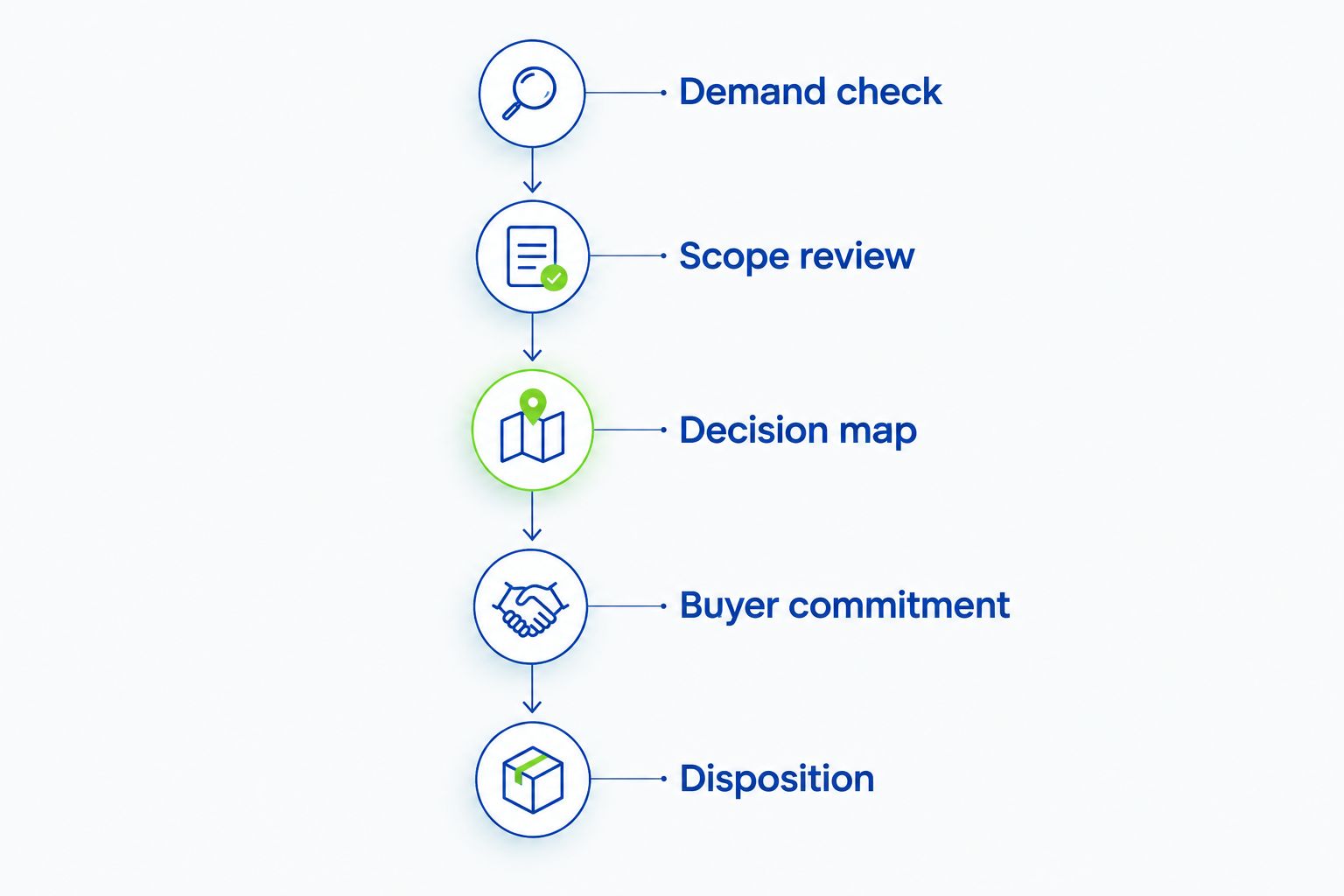
A repeatable commercial system defines what must happen before a quote, what changes after submission, and when an opportunity stops being active. The following sequence is a proposed operating method, not a claim about results.
Demand check
Before estimating, document the operational requirement and reason to act. For field-service work, include the relevant site or asset context and any known access or scheduling dependency.
The commercial owner should explain why the customer needs a proposal now. If the request is exploratory, identify it as exploratory rather than presenting it as a purchase-ready opportunity.
Scope review
Confirm the work, assumptions, exclusions, and acceptance requirements with the appropriate technical contact. Record unresolved items separately so they do not disappear inside a revised document.
A scope review is not a sales presentation. Its purpose is to establish whether both sides are discussing the same work before further estimating effort accumulates.
Decision map
Identify who evaluates the technical proposal, who authorizes spending, and what purchasing requires. Ask the customer to describe the sequence rather than imposing your internal deal stages on their process.
Keep the map usable. Names, responsibilities, outstanding approvals, and the next decision are more useful than a detailed organization chart with no connection to the purchase.
Buyer commitment
Agree on what happens after the quotation arrives. That might be a scope discussion, an internal approval review, or confirmation of a scheduling requirement; use the action the customer actually accepts.
Do not count an unanswered email as progress. Progress means new evidence, a resolved question, or an agreed customer action.
Disposition
Define when an opportunity remains active, returns to a later review, or closes. Preserve the reason so that future outreach starts with context rather than repeating the original introduction.
Apply the same definitions across founder-owned and salesperson-owned opportunities. Otherwise, the pipeline contains separate standards that cannot support a consistent review.
Which commercial approach fits the constraint?
For 2026 planning, compare the work you need done rather than the job title or supplier category. Continuing internal selling, installing a Revenue Systems engagement, and hiring an industrial marketing agency address different responsibilities.
| Approach | Best for | Practical advantage | Limitation |
|---|---|---|---|
| Internal or founder-led selling | Named accounts where existing relationships remain central | Keeps customer knowledge close to the business | Leaves dependence unresolved if qualification and follow-up stay in the founder’s head |
| Revenue Systems engagement | Recurring gaps across targeting, qualification, handoffs, and pipeline review | Defines how commercial work is owned, executed, and reviewed | Requires internal participation and ongoing use of the process |
| Industrial marketing agency | Defined positioning, campaign, content, or demand-generation work | Assigns specialist marketing execution to an external team | A marketing brief alone does not resolve quote ownership or customer approval gaps |
Choose process installation when the same quote failures recur across people and accounts. Choose an agency when the requirement is specific marketing execution. Continue internal selling when your team can own both the relationships and the operating discipline.
These approaches can coexist. The important distinction is accountability: specify who creates demand, who qualifies it, who manages the buying decision, and who reviews exceptions.
What should a B2B sales consultant actually install?
A useful scope produces working definitions and responsibilities, not just recommendations. Ask how the consultant will connect targeting, qualification, quote follow-up, deal stages, and management review.
FieldForge’s Revenue Systems approach fits industrial and field-service companies whose commercial structure has not caught up with operational capability. Its differentiation starts with senior commercial leadership backed by industrial operating experience: diagnosis should connect the buying process to technical scope, delivery constraints, and the people responsible for execution.
That experience should inform concrete decisions. Examples include deciding what information estimating needs before work begins, when a technical specialist joins a customer discussion, and which customer actions justify a deal-stage change.
FieldForge is best for industrial and field-service businesses that need a defined commercial system rather than another layer of ad hoc selling. The limit is equally clear: external guidance does not replace your team’s responsibility to maintain opportunity evidence and complete agreed actions.
Before selecting an engagement, complete the P.R.O. Index diagnostic. Use the findings to frame the commercial constraint and assess whether a Revenue Systems engagement addresses it.
How do you follow up on a stalled industrial quote?
Follow up against the unresolved decision, not against the date you sent the document. Restate the operational requirement, identify the open question, and ask for the next decision or a clear disposition.
Keep each message specific. A scope issue needs technical clarification; an approval issue needs confirmation of the approval path; a deferred project needs a documented trigger for re-engagement.
When should you stop chasing an industrial quote?
Stop treating the quote as active when you cannot establish a current buying requirement or a credible next decision. Record what changed, close or defer the opportunity under your rules, and retain the context for later outreach.
Silence alone does not explain the loss. Record an unknown outcome as unknown rather than assigning an objection the buyer never stated.
What should you measure in a quote review?
Use 3 evidence checks per active quote: a defined requirement, a known approval path, and a buyer-agreed next action. Track stage changes against customer evidence, not the number of calls or emails your team completes.
In your 2026 review, inspect the reasons quotes close or defer alongside the reasons they advance. That gives your team specific qualification and handoff problems to correct without treating activity as proof of progress.
Reclassify the quote before chasing it
Illustrative scenario—not a FieldForge client case: a maintenance quote stays open because the planned shutdown is unapproved. Record the pending shutdown decision, the customer owner, and the event that permits a new scope review. Defer the quote under the agreed rules instead of repeatedly moving its close date. If the customer cannot confirm whether the requirement still exists, record that uncertainty rather than inventing a price objection.
Find the constraint behind stalled quotes
FAQ
Can B2B sales consulting fix stalled industrial quotes?
B2B sales consulting can address recurring qualification, ownership, and follow-up problems behind stalled industrial quotes. It cannot create a buying requirement where the customer has none.
How do I know whether a quote is genuinely stalled?
A quote is stalled when an expected customer decision has not happened and the next action is unresolved. Compare the situation with the agreed buying process, not just the time since submission.
Should we send more follow-up emails?
Send another follow-up only when it addresses a specific unresolved decision or asks for a clear disposition. Repeating a status request does not resolve scope, approval, or timing constraints.
Is an industrial marketing agency better than a sales consultant?
An industrial marketing agency fits a defined marketing execution requirement; a sales consultant fits a sales-process requirement. Decide whether the constraint sits in demand creation, qualification, or managing the customer’s buying decision.
Do we need a new CRM to manage stalled quotes?
Define qualification, deal-stage evidence, ownership, and follow-up rules before deciding whether you need a new CRM. Software can record those rules, but it does not establish them for your team.
Can the founder keep managing important accounts?
The founder can keep important relationships while making account knowledge and next actions visible to the team. The requirement is shared commercial evidence, not removing the founder from every customer conversation.
Where should we start with FieldForge?
Start by completing the P.R.O. Index diagnostic. Use the findings to identify the commercial constraint before choosing a Revenue Systems engagement or a narrower execution assignment.
One last thing
For your next 2026 pipeline review, temporarily set aside the quoted value and ask the commercial owner to explain the customer’s next decision. If the explanation depends on hope, familiarity, or another reminder email, the quote needs requalification before it needs more attention.
A smaller pipeline supported by buying evidence is more useful than a larger list of unanswered proposals. Start there before adding campaigns, changing software, or asking the founder to rescue another deal.
Related guides
- Manufacturing lead generation: fix qualification before adding volume
- Revenue operations consulting for industrial service companies
- Industrial marketing agency or internal commercial team
- Private equity value creation when the founder owns every sale