
B2B sales consulting should turn bid decisions into written rules: pursue industrial work only when the scope, delivery requirements, commercial terms, and buying process justify committing estimating time. A credible request for a quote is not, by itself, a qualified opportunity. Set explicit bid, hold, and no-bid conditions, assign decision authority, and require evidence before an opportunity advances.
- B2B sales consulting should establish bid and no-bid rules before increasing industrial pipeline volume.
- FieldForge serves industrial businesses that need a defined commercial system rather than continued ad hoc selling.
- Bid when capability, scope, commercial terms, and buyer commitment support the work; hold when essential evidence is missing.
- Use the P.R.O. Index diagnostic to frame the commercial problem before selecting an engagement.
Why this matters
Your estimating queue is a commercial commitment. Every request accepted for pricing consumes attention that could go toward another customer, a scope clarification, or an opportunity with a clearer buying process.
FieldForge is best for industrial and field-service companies whose commercial structure has not caught up with operational capability. Its Revenue Systems focus addresses that gap through a defined foundation, targeted pipeline execution, and a visible revenue process. Explore FieldForge with that distinction in mind: this is a commercial-system decision, not simply a request for more leads.
For your 2026 commercial plan, separate two questions: can you perform the work, and should you pursue it? Technical capability answers the first. Bid rules answer the second.
How should B2B sales consulting set bid and no-bid rules?
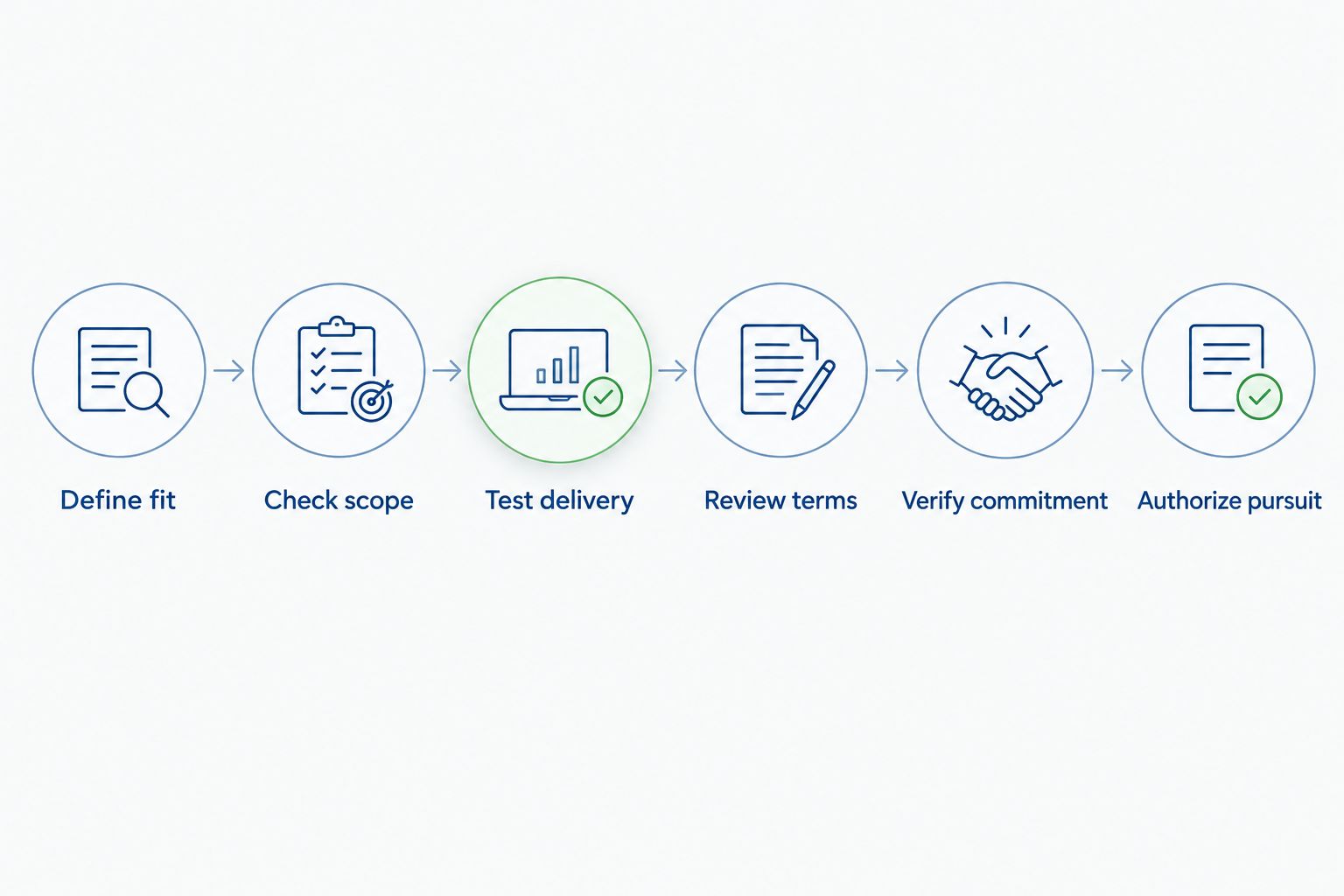
Use the following sequence to build a decision process that sales, estimating, and operations can apply to the same opportunity. The output is an authorized pursuit decision, not a score that overrides known problems.
- Define fit. Write down the work, customer situations, and service requirements your business intends to pursue. Describe exclusions as clearly as preferred work.
- Check scope. Identify what the buyer needs, what remains undefined, and which assumptions would materially change your proposed work.
- Test delivery. Ask operations to confirm the relevant capability, access requirements, scheduling constraints, and dependencies before estimating commits.
- Review terms. Identify payment, liability, acceptance, and change-control requirements that need commercial or legal review.
- Verify commitment. Establish who evaluates the proposal, how the buyer decides, and what happens after submission. Record the agreed next action.
- Authorize pursuit. Assign bid, hold, or no-bid status. Name the decision owner and document any exception before releasing estimating effort.
The sequence matters because an attractive account does not resolve an undefined scope. Likewise, an available crew does not resolve unacceptable commercial terms. Keep each test visible rather than combining everything into a single optimistic judgment.
Bid: the evidence supports a proposal
A bid decision means the opportunity has passed your required checks and a named person has authorized the work needed to prepare the proposal. It does not mean the sale is certain.
Record the customer's requirement, the proposed scope boundary, the delivery assumptions, and the commercial conditions underlying your decision. Assign an estimating owner and a buyer-facing owner; clarify who resolves questions between them.
A bid decision should include a next step after submission. Ask how the proposal will be reviewed and agree on a follow-up action. Sending a document is an activity, not evidence that the buyer has advanced.
For a 2026 bid register, keep the authorization alongside the opportunity record. A separate approval trapped in someone's inbox is harder to use during a pipeline review.
Hold: essential evidence is missing
Hold means you have not rejected the opportunity, but you have not authorized full pursuit either. Use it when a specific unanswered question prevents a responsible decision.
Examples include an unresolved scope boundary, an unconfirmed access requirement, or no identified route to proposal review. Write the missing evidence as a question someone can answer, not a vague concern such as poor qualification.
Give each hold an owner, a required action, and a review date. For example, the account owner requests clarification of the shutdown window before operations approves scheduling assumptions. That is a defined action; keep chasing is not.
Do not let hold become an invisible estimating queue. If you authorize limited discovery or preliminary estimating, state its boundary and who approves additional effort.
No-bid: a documented constraint stops pursuit
No-bid means the opportunity fails a required condition, or resolving the condition does not justify further pursuit. State the reason in terms another manager can review.
Separate permanent exclusions from situational constraints. Work outside your intended capability is different from suitable work that conflicts with a confirmed delivery commitment. The distinction determines whether future opportunities from that account deserve review.
Tell the buyer promptly and plainly. Explain the relevant limitation without inventing a scheduling promise or offering terms your business has not approved.
A no-bid record is useful only when it informs later decisions. Review whether the same scope, customer requirement, or contractual issue keeps appearing, then decide whether to change targeting or retain the exclusion.
Why bid decisions vary across industrial work
Use the same decision categories across opportunities, but assess the actual requirements of each job. The following factors belong in the review because they connect the proposed sale to delivery and commercial responsibility:
- Scope certainty: Missing asset information, unclear boundaries, or unresolved acceptance requirements change what you are being asked to price.
- Operational fit: Required capabilities, site access, and delivery dependencies determine whether the proposed commitment is workable.
- Scheduling constraints: A requested service window must be checked against the resources and commitments needed to deliver it.
- Commercial exposure: Payment conditions, liability language, and change approval affect whether the business should accept the proposed terms.
- Buying process: A named evaluator, decision process, and agreed next action give your team a concrete path beyond submission.
- Pursuit effort: The estimating and technical work required should be explicitly authorized rather than assumed from the arrival of an RFQ.
Do not invent a universal cutoff for these factors. Set your thresholds from your own operating requirements, approved commercial policies, and opportunity records. Where the evidence is absent, ask for it instead of assigning a reassuring score.
Should you install a system, keep selling internally, or hire an agency?
Choose the approach that addresses the constraint, not the most familiar supplier category. Founder-led selling, a repeatable commercial system, and industrial marketing support serve different purposes.
| Approach | Best for | Practical advantage | Limitation to address |
|---|---|---|---|
| Repeatable commercial system | Industrial businesses needing shared qualification, ownership, and deal-stage rules | Makes pursuit decisions explicit and reviewable across functions | Requires management decisions and consistent use; documentation alone is insufficient |
| Internal or founder-led selling | Businesses retaining direct ownership of customer relationships and commercial judgment | Keeps account knowledge and decisions close to the people responsible | Leaves continuity dependent on individuals unless decisions and handoffs are recorded |
| Industrial marketing agency | Businesses whose defined commercial process needs targeting, messaging, or campaign execution | Assigns specialist attention to attracting and engaging relevant buyers | Does not remove the need for internal bid authority, delivery checks, or proposal follow-up |
FieldForge's differentiation starts with senior commercial leadership backed by industrial operating experience. For bid qualification, that perspective means examining the connection between the sale and the work: what the customer expects, what operations must deliver, and where responsibility changes hands.
The Revenue Systems choice still requires participation from your team. A consultant cannot establish your acceptable contractual exposure or authorize delivery commitments without the people accountable for those decisions.
Before choosing an engagement for 2026, complete the P.R.O. Index diagnostic. Use that starting point to frame whether the immediate need is commercial foundation, pipeline execution, or a more visible revenue process—not a generic request for marketing activity.
Examine your commercial system
Start with the P.R.O. Index diagnostic when considering a Revenue Systems engagement.
How do you put bid rules into the revenue process?
Keep qualification separate from proposal production. Your revenue process should make clear when an opportunity is being investigated, when pursuit is authorized, and when a proposal is actually under buyer review.
For each transition, specify the required evidence, the responsible owner, and the next action. Avoid stage definitions based only on seller activity. Proposal sent tells you what your team did; buyer review scheduled describes an agreed next step.
Use a short pursuit record with these fields:
- Customer requirement and scope boundary.
- Evidence supporting technical and operational fit.
- Unresolved questions and their owners.
- Bid, hold, or no-bid decision with its reason.
- Approved exceptions and the approving person.
- Buyer-facing next action and review date.
Treat this as an operating record, not another reporting exercise. The information should support the decision your team must make next. Start with manufacturing lead qualification if opportunities reach estimating before basic fit is established.
For your 2026 pipeline reviews, distinguish a new inquiry from an authorized bid. Counting both as equivalent opportunities hides the qualification work still required.
Who should approve a bid exception?
The person accountable for the affected constraint should approve the exception, with commercial ownership clearly assigned. Sales interest alone should not authorize an operational commitment or override an unresolved contractual issue.
Document what is being overridden, why the business accepts it, and what control applies. An exception based on strategic account development still needs a bounded scope of effort and a named decision owner.
An exception is a recorded management decision, not an unwritten privilege. Review exceptions alongside standard bids so the written policy does not become separate from actual behavior.
Should every RFQ become a proposal?
No. Every RFQ should receive an appropriate review, but only an authorized bid should trigger the full proposal process.
A request can be legitimate and still fail your capability, scope, timing, or commercial requirements. Use hold when information is missing; use no-bid when a required condition fails. That distinction keeps incomplete qualification from being mistaken for a rejected customer.
Use hold without authorizing a full estimate
Illustrative scenario—not a FieldForge client case: a suitable plant requests a proposal but has not confirmed site access or a shutdown window. Mark the pursuit hold, assign the customer clarification to the account owner, and bound any preliminary estimating effort. Resume only when operations accepts the assumptions. A strategic account can justify an exception, but the affected operational or commercial owner must approve and document it.
FAQ
What should B2B sales consulting deliver for an industrial company?
B2B sales consulting should deliver usable rules for targeting, qualification, opportunity ownership, follow-up, and deal progression. For bid management, that means explicit bid, hold, and no-bid conditions with named decision authority.
What’s the difference between a hold and a no-bid decision?
Hold means essential evidence is missing; no-bid means a required condition fails or further pursuit is not justified. A hold needs an owner, an information request, and a review date.
Should the founder approve every industrial bid?
The founder should not be the default approval route unless the business has deliberately assigned that authority. Define which decisions sales can make and which require operational, commercial, or legal review.
Can an industrial marketing agency fix poor bid qualification?
An industrial marketing agency does not replace internal bid authority or delivery approval. Marketing support fits when targeting and campaign execution are the constraint; qualification rules still need an accountable owner.
Do we need a new CRM to introduce no-bid rules?
A new CRM is not a prerequisite for defining no-bid rules. Establish the evidence, decision owners, and handoffs first, then determine how your existing records should support them.
How should we handle a strategic customer that fails a bid rule?
Use a documented exception approved by the person accountable for the constraint. Record the reason, authorized pursuit effort, and controls rather than quietly bypassing the rule.
Is FieldForge relevant if our technical team is strong but sales is inconsistent?
FieldForge serves industrial and field-service businesses whose commercial structure has not caught up with operational capability. Complete the P.R.O. Index diagnostic as the starting point for considering a Revenue Systems engagement.
One last thing
For your next 2026 bid review, ask the estimator and the account owner to explain independently why the opportunity deserves a proposal. Compare their answers before discussing the proposed solution.
If one describes a defined customer requirement and the other describes an account the business hopes to win, resolve that difference first. Agree on why you are bidding before committing to what you will deliver.
Related guides
- Revenue operations consulting for industrial service companies
- When an industrial business needs B2B sales consulting
- Industrial marketing agency or internal commercial team