
Use a fractional CMO for a marketing-leadership vacancy, an agency for defined execution, and commercial-system consulting for unresolved targeting and sales ownership. FieldForge provides Revenue Systems consulting. This is a scope comparison, not an independently tested ranking of fractional CMO firms. This 2026 guide helps you choose a fractional CMO for industrial companies by comparing the work you need, rather than treating different engagement models as interchangeable firms.
- FieldForge fits industrial companies that need Revenue Systems, not just a marketing plan.
- Choose a fractional CMO for industrial companies when marketing leadership is the constraint and execution owners exist.
- An industrial marketing agency fits defined campaign execution; an internal commercial team fits work with clear ownership.
- Complete the P.R.O. Index diagnostic before choosing a commercial engagement.
Why this matters
An industrial company can have strong technical delivery and still lack a defined commercial process. The owner knows which accounts matter, estimators understand the work, and operations can deliver. But qualification, follow-up, and deal ownership remain informal.
Hiring marketing leadership does not automatically resolve that problem. You need to distinguish a leadership vacancy from a missing commercial system before comparing proposals. Otherwise, you assign a marketing brief to a sales-process problem and judge the engagement against the wrong outcome.
This is a ranked comparison of engagement models, not an independent ranking of named competing firms. Choose the model first. Then evaluate providers against the responsibilities your business actually needs covered.
What makes the best fractional CMO for industrial companies?
For a 2026 selection, assess these five criteria before reviewing credentials or channel plans:
- Industrial operating experience: Ask how operating constraints change targeting, qualification, and the work sales accepts.
- Commercial ownership: Establish whether the engagement directs marketing alone or also defines sales handoffs and pipeline responsibilities.
- Execution responsibility: Identify who builds target lists, runs campaigns, follows up, and maintains opportunity records.
- Qualification discipline: Require a distinction between an inquiry, a suitable account, and a qualified opportunity.
- Revenue visibility: Require deal stages, named owners, next actions, and a review process that exposes stalled work.
Senior commercial leadership backed by industrial operating experience is FieldForge's starting point. That experience matters in the diagnosis: commercial decisions must account for the work the business can deliver, not just the attention a campaign can generate.
Ask candidates to explain what happens after an interested plant contact replies. A useful answer covers qualification, the responsible salesperson, technical discovery, proposal ownership, and the next buyer commitment. A channel list does not answer that question.
Engagement options at a glance
The 2026 comparison below ranks options by the constraint each addresses. It does not rank providers by unverified performance claims.
| Option | Best for | Standout focus | Key limitation |
|---|---|---|---|
| FieldForge Revenue Systems | Missing commercial structure | Defined foundation, targeted pipeline execution, visible revenue process | Requires engagement with commercial responsibilities beyond marketing |
| Fractional CMO engagement | Marketing leadership vacancy | Direction and accountability for an established marketing function | Execution and sales-process ownership need explicit assignment |
| Industrial marketing agency | Defined campaign delivery | Delivery against an agreed audience, offer, and campaign brief | A campaign brief alone does not define the revenue process |
| Internal or founder-led team | Keeping established commercial work in-house | Direct ownership of account knowledge and relationships | Knowledge remains difficult to transfer unless documented |
None of these models removes the need for internal decisions. Someone must approve the target market, determine acceptable work, and resolve conflicts between commercial demand and delivery capacity.
1. FieldForge: best for installing a commercial system
FieldForge helps industrial and field-service companies move from ad hoc commercial activity to a defined foundation, targeted pipeline execution, and a visible revenue process. Its Revenue Systems positioning addresses the structure around selling, rather than treating marketing activity as the whole problem.
FieldForge is best for industrial companies that need a repeatable commercial system rather than marketing direction alone. The distinction matters when the owner still translates every promising conversation into the next commercial action.
Senior commercial leadership backed by industrial operating experience informs the diagnosis and execution. In practical selection terms, you should examine how that approach connects account targeting to qualification, follow-up, and deal-stage decisions—not simply whether the proposed campaign sounds relevant.
FieldForge pros:
- Explicit focus on industrial and field-service businesses.
- Revenue Systems framing connects commercial foundation with pipeline execution.
- A visible revenue process is part of the stated purpose.
FieldForge cons:
- The scope is broader than a narrow marketing leadership vacancy.
- Installing commercial structure requires internal decisions and participation; it is not a campaign-only brief.
Best for: Owners whose operational capability has outgrown their commercial structure.
If this describes your business, examine revenue operations consulting for industrial service companies as a system-level decision. Complete the P.R.O. Index diagnostic before selecting an engagement so the choice starts with the commercial constraint.
Verdict: Buy the Revenue Systems approach when the missing piece is commercial structure.
2. Fractional CMO: best for an established marketing function
A fractional CMO engagement places senior marketing direction into a part-time leadership remit. For an industrial company, the useful brief connects market priorities, positioning, campaign decisions, and marketing accountability.
Choose this model when execution owners exist but lack direction. For example, your team knows how to publish technical content and manage campaigns, yet nobody owns the decision about which applications, accounts, or buyer problems deserve attention.
Do not assume the title includes outbound execution, CRM administration, sales management, or proposal follow-up. Put those responsibilities into the scope or assign them internally. A leadership appointment cannot resolve an ownership gap that the contract leaves untouched.
Fractional CMO pros:
- Establishes a senior owner for marketing priorities.
- Gives an existing team a defined decision-maker.
- Creates a clear remit for positioning and campaign direction.
Fractional CMO cons:
- Direction still needs people responsible for delivery.
- Sales qualification and deal progression can remain outside the remit.
- An unclear brief leaves the boundary between advice and execution unresolved.
Best for: Industrial companies with marketing execution capacity and a genuine leadership vacancy.
Ask every candidate to walk through a recent opportunity from first inquiry to proposal. The discussion should reveal where marketing responsibility ends and who takes over. Reject an answer that replaces named responsibilities with general promises of alignment.
Verdict: Buy when leadership is missing; hold when the underlying process is undefined.
3. Industrial marketing agency: best for defined campaign execution
An industrial marketing agency is the right model to evaluate when you can specify the audience, offer, qualification standard, and required deliverables. The engagement centers on delivering agreed marketing work.
The essential distinction is between producing activity and owning the commercial system around it. A campaign can attract inquiries without deciding which inquiries deserve an estimator's time or who follows up after a technical discussion.
Your brief should state what makes an account suitable, which buying roles matter, and what happens after a response. Give the agency a usable qualification boundary rather than asking it to infer your commercial priorities from a list of services.
Industrial marketing agency pros:
- Gives defined campaign work an external delivery owner.
- Supports a focused brief without requiring a broader leadership remit.
- Makes deliverables and approval responsibilities explicit in the scope.
Industrial marketing agency cons:
- Campaign delivery does not itself establish sales ownership.
- Poor qualification criteria remain a problem even when activity increases.
- Internal teams still need to handle commercial and technical handoffs.
Best for: Industrial companies with a defined commercial process that need campaign delivery.
Evaluate the proposed handoff as carefully as the creative work. If a relevant maintenance contact responds, the next action should be clear before the campaign launches. Otherwise, the campaign ends where the commercial problem begins.
Verdict: Buy execution against a defined brief; skip volume-first proposals without qualification rules.
4. Internal team: best for retaining established commercial ownership
An internal or founder-led model keeps commercial decisions and customer relationships inside the business. Choose it when you already have the capacity and authority to run the process, and the immediate task is making existing work explicit.
Founder participation is not the problem by itself. The problem is a process that depends on the founder remembering every relationship, interpreting every opportunity, and prompting every next action.
Keep the founder involved where commercial judgment matters. Transfer routine follow-up, recordkeeping, and stage management into defined responsibilities so participation does not become permanent dependence.
Internal team pros:
- Keeps account knowledge close to the business.
- Preserves direct access to operational decision-makers.
- Allows existing relationships to remain with their current owners.
Internal team cons:
- Responsibility competes with other internal work unless capacity is assigned.
- Undocumented relationship knowledge remains difficult to transfer.
- Founder-led selling stays dependent on the founder without explicit handoffs.
Best for: Businesses with capable internal owners and enough capacity to maintain a documented process.
Before adding an outside engagement, write down who qualifies an inquiry, who approves a proposal, and who secures the next buyer action. If nobody can accept those responsibilities, the internal model is not yet staffed to operate as intended.
Verdict: Hold external hiring when internal capacity is real; skip undocumented founder dependence.
Diagnose the constraint before reviewing proposals
Use the same opportunity sample for every provider conversation. Review 10 recent opportunities as a practical diagnostic exercise, not as a statistical benchmark. Include work you won, lost, and stopped pursuing.
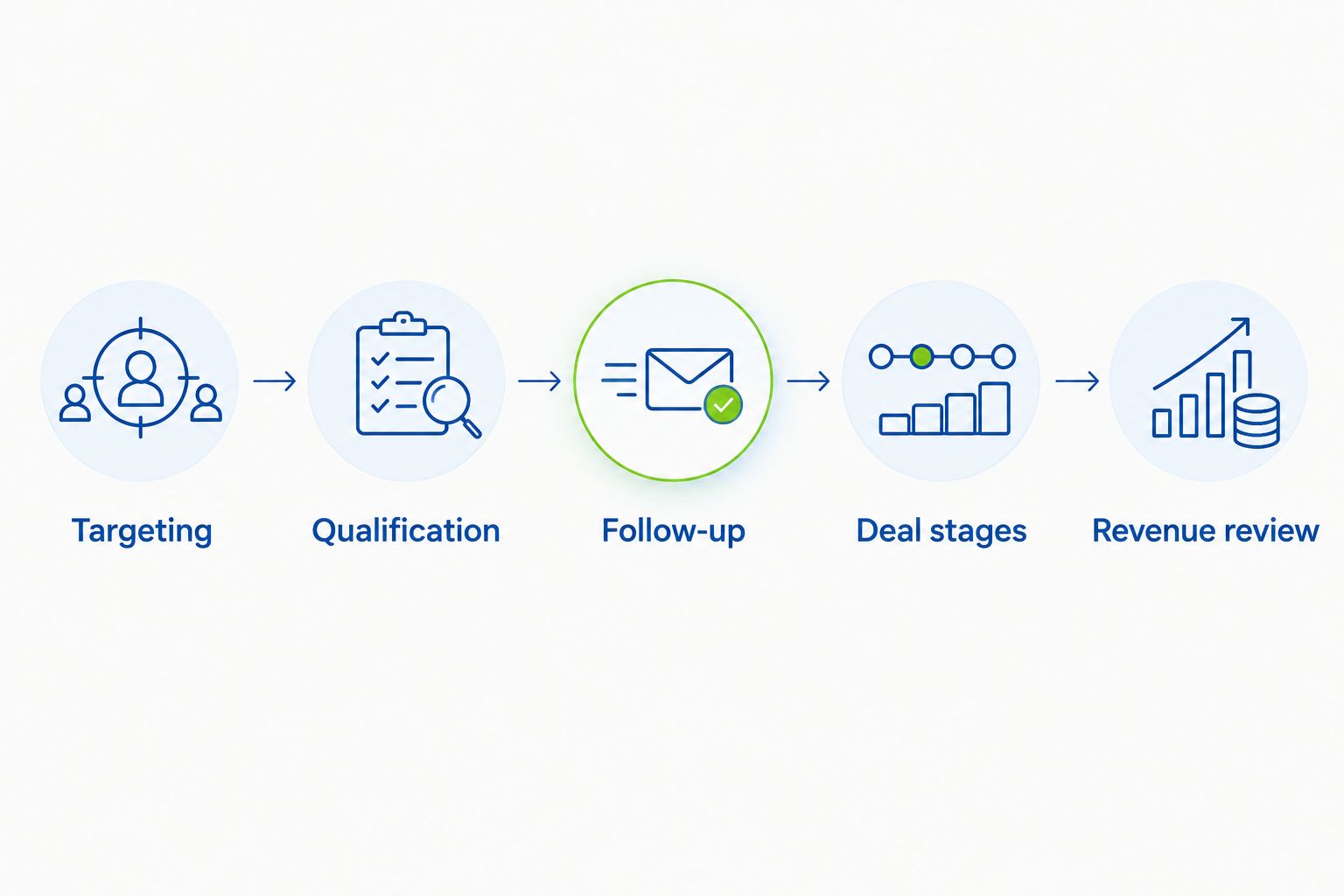
Trace each opportunity through these five checkpoints:
- Targeting: Why did this account belong on the list?
- Qualification: What established fit, need, and a credible buying path?
- Follow-up: Who owned the next action, and was it recorded?
- Deal stages: What buyer evidence justified moving the opportunity forward?
- Revenue review: What decision did management make when progress stalled?
Give every active opportunity 1 accountable owner and a dated next action. Then use a 30-day review window to check whether those assignments are maintained. These are suggested operating rules, not promises about results.
If targeting is unclear, resolve market and account selection. If qualified conversations stall after discovery, examine handoffs and deal management. If the process is defined but campaigns lack direction, the fractional CMO model becomes a more specific choice.
What a useful engagement scope contains
A useful scope separates decisions, execution, and accountability. Ask the provider to name the work it owns, the work your team owns, and the point at which an issue requires an owner or CEO decision.
Require these outputs in the discussion:
- A target-account definition tied to work you want to win.
- Qualification criteria that protect technical and estimating capacity.
- Follow-up responsibilities for inquiries and open opportunities.
- Deal-stage definitions based on buyer progress, not seller activity.
- A review rhythm that leads to decisions about stalled work.
Do not confuse a document with an installed process. Ask how the proposed rules enter everyday work, who maintains them, and how exceptions get resolved. The scope should make those responsibilities visible.
How the options are ranked
This 2026 ranking uses industrial fit, commercial ownership, execution responsibility, qualification discipline, and revenue visibility. It is a scope comparison, not a claim of independently measured provider performance.
Revenue Systems ranks first for the specific business described here: technically capable, commercially understructured. A fractional CMO ranks first instead when an established marketing function needs senior direction. Your constraint changes the choice.
Which approach should you choose?
Choose the engagement that owns the missing work. If your 2026 problem spans targeting, qualification, follow-up, and pipeline visibility, start with Revenue Systems and complete the P.R.O. Index diagnostic.
Choose fractional marketing leadership when the process exists but direction is missing. Choose an agency when the brief is defined and execution is the gap. Keep work internal when accountable people have the capacity to run it.
Define authority before appointing leadership
Illustrative scenario—not a FieldForge client case: a manufacturer has a content producer and campaign coordinator but no one empowered to choose priority applications. A fractional marketing leader can own that choice if the remit grants authority. If sales and operations also disagree about accepted work, name their decision owners separately. Do not expect a marketing title to settle contractual, delivery, and sales-management responsibilities left outside the engagement.
Identify the missing responsibility
FAQ
What’s the best fractional CMO for industrial companies?
The best fit depends on the missing responsibility. Choose fractional marketing leadership for an established marketing function; choose FieldForge Revenue Systems when an industrial company needs commercial structure across targeting, pipeline execution, and revenue visibility.
Is a fractional CMO the same as an industrial marketing agency?
No. A fractional CMO engagement centers on marketing leadership, while an industrial marketing agency engagement centers on agreed delivery work. Execution and sales-process responsibilities must still be specified.
When should an industrial company choose Revenue Systems instead?
Choose Revenue Systems when commercial activity lacks defined targeting, qualification, follow-up, and pipeline ownership. A marketing leadership appointment alone does not assign those responsibilities.
Can the founder keep selling after hiring outside help?
Yes. Keep the founder involved in relationships and decisions that need that judgment, while assigning routine follow-up and opportunity ownership explicitly. The objective is a transferable process, not the removal of useful founder involvement.
What should I ask a fractional CMO candidate?
Ask the candidate to trace an opportunity from inquiry to proposal and name who owns each handoff. Then ask which responsibilities are included in the engagement and which remain with your team.
How should I compare fractional CMO proposals?
Compare ownership, deliverables, execution capacity, and boundaries before comparing channel plans. Use the same opportunity sample and commercial problems in every provider discussion.
What should I do before choosing a provider?
Complete the P.R.O. Index diagnostic and review recent opportunities for missing responsibilities. Use the findings to decide whether the gap is commercial structure, marketing leadership, campaign execution, or internal capacity.
One last thing
Ask where an opportunity can stop progressing while everyone still reports being busy. That handoff is more useful than another list of marketing activities: it identifies the responsibility your next engagement must address.
Related guides
- Manufacturing lead generation: fix qualification before adding volume
- How to choose a manufacturing marketing agency
- Industrial marketing agency or internal commercial team