
Scope revenue operations consulting around the commercial constraint you need to remove, the process changes required, and the evidence that those changes work without constant founder intervention. For an industrial or field-service business, the engagement should connect targeting, qualification, follow-up, deal stages, and ownership—not stop at a CRM configuration or a marketing activity plan.
- Revenue operations consulting should specify process changes, accountable owners, and acceptance criteria—not just activities.
- FieldForge fits industrial and field-service companies whose commercial structure has not caught up with operational capability.
- Separate Revenue Systems work from industrial marketing agency execution and continued founder-led selling.
- Complete the P.R.O. Index diagnostic before defining the engagement around a preferred tool or channel.
Why this matters
A scope that says improve sales and marketing leaves the hard decisions unresolved. Who qualifies an opportunity? What evidence moves it forward? Who follows up when the founder is on a customer site?
For your 2026 commercial plan, define the operating changes before approving channels or software. The practical distinction in revenue operations consulting for industrial service companies is whether the work installs a repeatable revenue process or simply adds more activity around an undefined one.
FieldForge revenue operations consulting is best for industrial and field-service companies whose commercial structure has not caught up with operational capability. Its stated differentiation is senior commercial leadership backed by industrial operating experience. Use that experience to test whether targeting, qualification, and handoffs reflect how your company actually sells and delivers work.
How do you scope a revenue operations consulting engagement?
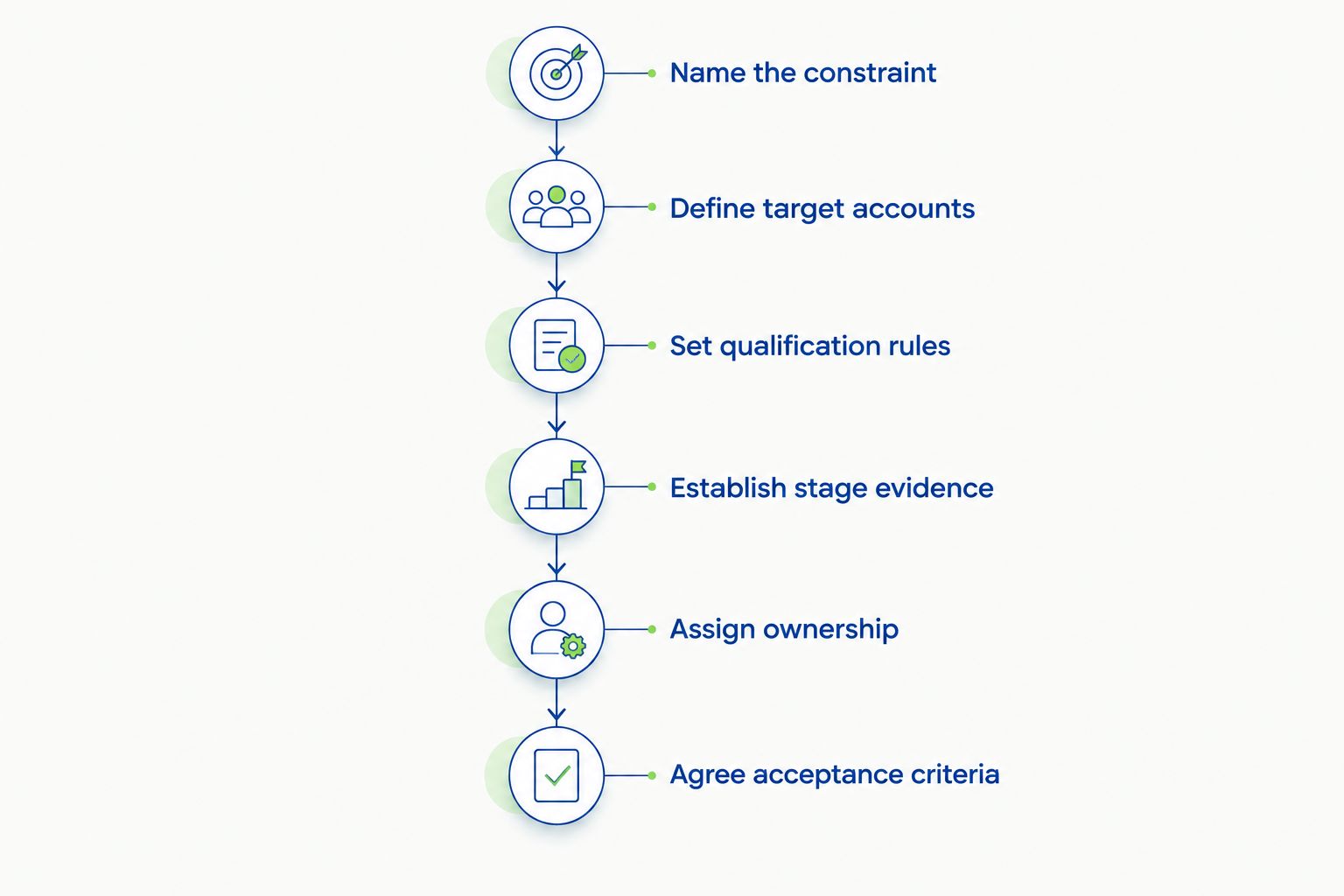
Write the scope as 6 decisions, each producing something your team can inspect and use. Keep discovery separate from implementation: understanding the constraint is not the same as changing the process.
1. Name the constraint
Describe where commercial work breaks down, not the department you want to improve. Leads do not progress is a symptom; opportunities reach estimating without a defined requirement is a process problem you can investigate.
Choose a primary constraint and record the evidence supporting it. Review actual opportunities, follow-up records, qualification notes, and handoffs rather than relying only on management impressions. If the evidence points elsewhere, require the scope to change before implementation begins.
Deliverable: A written constraint statement, supporting observations, and a clear boundary around the problem the engagement will address.
2. Define target accounts
Specify the customers and work your commercial process should pursue. For an industrial service business, useful targeting fields include application, service requirement, geography, buyer role, and delivery fit. Select the fields that matter to your operating model rather than adopting a generic prospecting template.
Define exclusions as carefully as targets. An account can fit a broad industry label and still require work you cannot deliver or do not want. The scope should explain who resolves borderline cases and where those decisions are recorded.
Deliverable: Target-account criteria, exclusion rules, and ownership of account selection.
3. Set qualification rules
Define what your team must know before treating an inquiry as an opportunity. Separate technical fit, commercial fit, and the buyer's next action. A conversation with a relevant engineer does not, by itself, establish an active requirement.
Write the qualification questions and specify where answers belong. Include the rule for incomplete information: continue discovery, place the account into follow-up, or close it out with a reason. Do not allow missing information to become implied qualification.
Deliverable: Qualification criteria, required information, and a documented decision path for incomplete or unsuitable inquiries.
4. Establish stage evidence
Define each deal stage through evidence rather than seller confidence. A proposal sent is an activity; a buyer-confirmed review with a named decision participant is stronger evidence of a next step. Your exact stages should fit how your work is bought.
Include entry criteria, exit criteria, and a named owner for each handoff. Where estimating, operations, or technical staff join the process, specify what information they receive and what decision they must return. Keep stalled opportunities visible without leaving them indefinitely in active stages.
Deliverable: Deal-stage definitions, handoff requirements, and rules for stalled or closed opportunities.
5. Assign ownership
Give each process decision 1 accountable owner. Other people can contribute, but shared responsibility must not leave follow-up, qualification, or stage approval unassigned.
Specify the founder's role explicitly. Identify which relationships or technical decisions still require the founder and which actions the commercial team should handle independently. Removing unnecessary dependence is different from excluding useful expertise.
Deliverable: Named process owners, escalation rules, and a clear division between founder involvement and routine execution.
6. Agree acceptance criteria
Define how you will judge completion before the work starts. A configured CRM, completed workshop, or delivered playbook proves that an output exists; it does not prove that your team uses the process correctly.
Require acceptance checks against actual work. Can a team member qualify an inquiry, record the evidence, assign the next action, and hand it over without someone reconstructing the conversation? Separate defects in the process from training gaps and missing management decisions.
Deliverable: Acceptance checks, unresolved-decision handling, and responsibility for maintaining the process after handover.
Which engagement route fits the actual constraint?
Compare these 3 engagement routes by the work you need done, not by which supplier category sounds most familiar. Each route has a useful role and a limit. The mistake is buying channel execution when the underlying qualification and revenue process remain undefined.
| Route | Best for | Practical advantage | Limitation to address |
|---|---|---|---|
| Revenue Systems engagement | Installing a repeatable commercial process | Connects targeting, qualification, follow-up, stages, and ownership | Requires internal decisions and ongoing process ownership |
| Internal or founder-led selling | Retaining direct control of relationships and technical selling | Keeps customer knowledge close to the business | Does not resolve dependence unless knowledge and decisions become transferable |
| Industrial marketing agency | Executing marketing against an agreed commercial brief | Gives marketing activity a defined execution owner | Marketing execution alone does not define sales qualification or deal ownership |
Choose Revenue Systems work when the missing piece is the system connecting commercial activity to managed opportunities. Choose marketing execution when your targeting, qualification, and handoffs are already clear and you need that brief executed.
Keeping sales internal is also a valid decision. However, internal ownership still needs stage definitions, follow-up rules, and a visible record. Hiring another person into an undefined process does not specify how the work should run.
What should the scope document contain?
Your 2026 statement of work should let an owner distinguish diagnosis, installation, and continued execution. Avoid a single undifferentiated list of workshops, campaigns, dashboards, and meetings.
Use these scope headings:
- Business constraint: The specific commercial failure the work addresses, with supporting evidence.
- Process boundary: Where the engagement starts and ends, including the handoffs it covers.
- Required outputs: Targeting rules, qualification criteria, stage definitions, ownership, and reporting requirements.
- Implementation responsibilities: What the consultant changes and what your team must supply, decide, or approve.
- Acceptance criteria: How the business confirms that the process is usable in actual opportunities.
- Ongoing ownership: Who maintains definitions, reviews exceptions, and approves later changes.
Make exclusions explicit. If the engagement does not include campaign production, outbound execution, CRM migration, or ongoing pipeline management, say so. Do not treat those activities as implied parts of consulting.
Also separate access from authority. A consultant can inspect records and recommend changes without having authority to resolve internal disagreements. Name the executive who decides when sales, estimating, and operations want different qualification or handoff rules.
Why revenue operations consulting scope varies
Scope varies with the decisions and implementation work required, not just company size. Use the following factors to explain differences between proposals rather than comparing lists of activities in isolation.
- Constraint clarity: A known qualification problem needs a different diagnostic boundary from a business that cannot explain where opportunities stall.
- Process coverage: Targeting alone is narrower than targeting through qualification, estimating, follow-up, and commercial review.
- Record quality: Incomplete opportunity histories limit what your team can establish from existing records and require direct investigation.
- Implementation depth: Written definitions, configured workflows, team training, and ongoing execution are distinct responsibilities.
- Founder dependence: Undocumented relationships and decisions require explicit transfer rules, not simply new reporting.
- Internal capacity: Someone inside the business must make decisions, supply context, and own the process after handover.
Do not accept a larger scope simply because more work is available. Tie each workstream to the primary constraint or a necessary dependency. Put unrelated improvements into a separate decision rather than allowing the engagement to expand without a boundary.
How do you measure whether the engagement worked?
For a 2026 engagement, agree the baseline, definition, data source, and owner for every measure before setting a target. Otherwise, a dashboard can present precise figures built on inconsistent qualification or stage rules.
Start with process evidence. Check whether active opportunities have a documented requirement, a justified stage, an assigned owner, and an agreed next action. Review the exceptions as well as completed records; a filled field is not proof that the underlying decision was sound.
Then select outcome measures that match the constraint. Qualification work calls for examining which inquiries become accepted opportunities and why others are rejected. Follow-up work calls for examining whether agreed actions happen and whether stalled opportunities receive a decision.
Do not accept reporting as a substitute for process ownership. The scope should identify who acts when a measure reveals a problem and what decision that person can make. Without that link, visibility stops at observation.
What should happen before you approve the engagement?
Before approving a 2026 scope, complete the P.R.O. Index diagnostic and use the result to frame the commercial problem. Do not begin with a request for a particular platform, campaign, or dashboard and work backward to justify it.
FieldForge's Revenue Systems focus fits this decision: establish the commercial foundation, define targeted pipeline execution, and make the revenue process visible. Industrial operating experience should inform practical decisions about delivery fit, technical qualification, and handoffs—not serve as a substitute for explicit deliverables.
Ask the proposed engagement lead to walk through an actual opportunity from first contact to its current position. Require a clear explanation of what changes, who owns it, and how your team will confirm that the change works. If those answers remain abstract, the scope is not ready.
Can your internal team own the work after consulting ends?
Your internal team should own the process after consulting ends, with named responsibility for definitions, exceptions, and review. Include that transfer in the scope rather than treating handover as a final presentation.
Ask the team to work through an opportunity using the agreed rules. If routine decisions still require the consultant to interpret the process, resolve that dependence before acceptance.
Should you buy a CRM before defining the scope?
Define the commercial process before selecting or reconfiguring the CRM. Otherwise, software decisions get ahead of decisions about qualification, deal stages, ownership, and follow-up.
Include CRM work only where it supports an agreed process requirement. Separate configuration from the management decisions the system records.
Make acceptance inspectable
Illustrative scenario—not a FieldForge client case: a consulting proposal promises a qualification playbook and dashboard. Add a live-use acceptance check: an authorized team member must assess a representative inquiry, record missing evidence, assign the next action, and route an exception to the correct owner. A delivered document meets an output milestone; a working handoff meets a different requirement. Specify both without turning adoption into an unsupported revenue guarantee.
Scope the commercial constraint first
FAQ
What should revenue operations consulting include for an industrial company?
Revenue operations consulting should include the process decisions needed to resolve a defined commercial constraint. Specify targeting, qualification, follow-up, deal stages, ownership, and acceptance criteria where they fall within that constraint.
Is revenue operations consulting the same as hiring an industrial marketing agency?
Revenue operations consulting is not the same as hiring an industrial marketing agency. The former defines and installs the commercial process; agency execution should work against an agreed brief and clear handoffs.
Can the founder stay involved in selling?
The founder can stay involved in selling while routine commercial work becomes transferable. Define which relationships and decisions require founder input and which actions belong to the commercial team.
What should I ask for in a consulting proposal?
Ask for a defined constraint, process boundary, deliverables, responsibilities, acceptance criteria, and ongoing ownership. Require exclusions so implementation and continued execution are not left implied.
How do I know whether I need consulting or another salesperson?
Check whether you have a defined process for the salesperson to follow. If targeting, qualification, follow-up, and deal ownership remain unresolved, specify those decisions before treating headcount as the answer.
Where should I start with FieldForge revenue operations consulting?
Start by completing the P.R.O. Index diagnostic. Use it to frame the commercial constraint before defining Revenue Systems work or selecting tools and channels.
One last thing
Before signing a 2026 engagement, ask your team to explain why a live opportunity occupies its current stage. Then ask what evidence moves it forward and who owns the next action.
If the answer requires reconstructing the founder's last conversation, include that knowledge transfer in the scope. A process is not repeatable while its essential decisions live only in someone's memory.
Related guides
- Manufacturing lead generation: fix qualification before adding volume
- How to choose a manufacturing marketing agency
- When an industrial business needs B2B sales consulting
- Private equity value creation when the founder owns every sale