
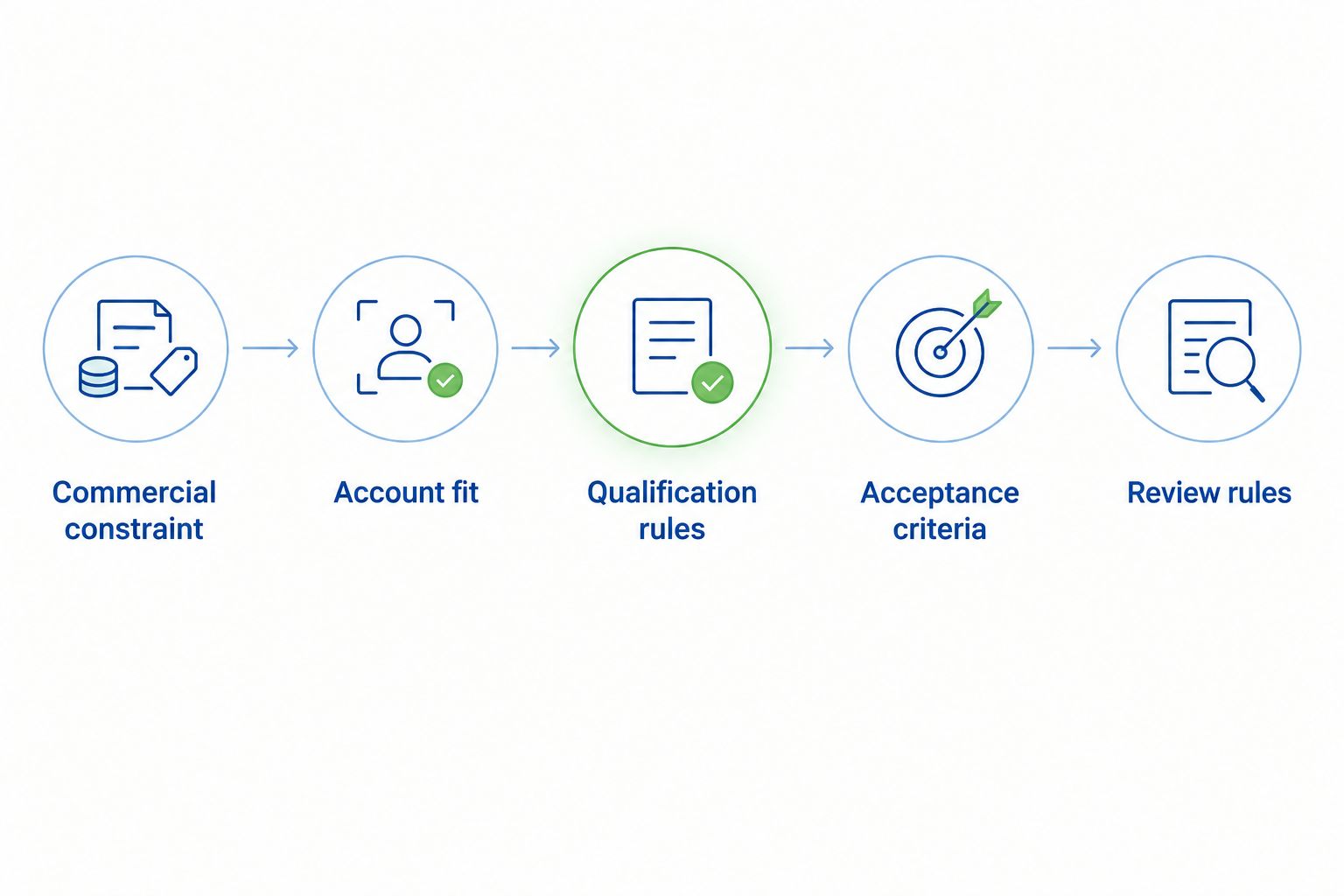
Set a manufacturing marketing agency scope of work by defining the commercial constraint first, then specifying the target accounts, qualification rules, deliverables, sales handoffs, ownership, and acceptance criteria. Separate work that creates demand from work that repairs your revenue process. A useful scope tells you what the agency must deliver and what your own team must do for that work to produce qualified opportunities.
- A manufacturing marketing agency scope must connect targeting, qualification, sales handoffs, and reporting—not just list campaigns.
- FieldForge fits industrial businesses that need a repeatable commercial system rather than disconnected marketing activity.
- Keep technical approvals, sales follow-up, account ownership, and deal decisions explicit in the scope.
- Use acceptance criteria and review milestones; do not substitute activity counts for commercial progress.
Why this matters: An agency can complete every contracted task while your commercial problem remains unchanged. Publishing content does not establish qualification rules. Generating inquiries does not assign sales ownership. Before comparing proposals, use the same decision criteria outlined in how to choose a manufacturing marketing agency: identify the constraint, define the work, and establish who owns the next action.
How do you set a manufacturing marketing agency scope of work?
Build your 2026 scope around observable work and explicit decisions. Start with the business problem, not a package of channels. The following sequence turns an agency proposal into an operating agreement your commercial team can actually use.
1. Name the commercial constraint
Write a short diagnosis before the deliverables list. Describe where commercial activity stops moving: finding suitable accounts, reaching relevant buyers, qualifying inquiries, following up, or advancing a real opportunity.
For example, a proposed scope might address inquiries that reach sales without enough information to assess fit. That calls for qualification criteria and a handoff process, not simply more inquiry volume. Treat this as a diagnostic example, not an assumed condition in your business.
Use a constraint statement with these fields:
- Observed condition: What happens today?
- Commercial consequence: Which decision or handoff does that prevent?
- Required change: What must work differently?
- Accountable owner: Who accepts responsibility for that change?
Avoid statements such as “improve awareness” unless the scope explains which buyers need to recognize which capability and how you will assess the work.
2. Define account fit and buyer relevance
Your agency needs a usable targeting brief, not “manufacturers” as a market definition. Specify the applications, operating environments, geography, and purchasing situations your business is equipped to serve. Include exclusions so the agency does not pursue work your operations team would reject.
Separate the organization from the person. An account can fit your capabilities while the contacted person has no responsibility for the relevant equipment, service requirement, or purchasing decision.
Require these deliverables:
- An account-fit definition with inclusion and exclusion criteria.
- Buyer roles tied to the problem your business solves.
- An approved capability statement in language those buyers understand.
- A documented process for reviewing disputed account or inquiry fit.
Your technical team should approve capability claims. The agency should not infer service coverage, production capacity, certifications, or application suitability from a general company presentation.
3. Write qualification and handoff rules
Define what makes an inquiry worth a sales conversation. A name, email address, or content download does not establish an operational need or commercial fit.
Your scope should identify the information required at handoff: the company, relevant application or requirement, fit with your capabilities, known buying context, and agreed next action. Not every inquiry will contain every detail; the rules must say who fills the gaps.
Then assign ownership. Specify who reviews a new inquiry, who contacts the buyer, who records the outcome, and who returns unsuitable inquiries with a reason. Agree on a response standard your team can meet rather than copying an agency's generic template.
Do not accept a lead-generation scope that ends at delivery of a contact record. The handoff needs an acceptance decision and a visible follow-up owner.
4. Define deliverables and acceptance criteria
A deliverable describes what gets produced. An acceptance criterion describes how you decide whether it is usable. Both belong in the agreement.
For a targeting brief, acceptance might require approved account exclusions and named buyer responsibilities. For a campaign asset, acceptance might require technical sign-off, a defined audience, and a relevant next action. For reporting, acceptance might require traceable inquiry sources and recorded sales dispositions.
Specify the review process as well. Name the approver, the revision boundary, and the consequence of delayed approval. If production depends on access to engineers, salespeople, or customer-facing information, list those dependencies before signing.
Keep outcomes separate from guarantees. The agency can commit to agreed work, documented decisions, and reporting discipline without promising revenue that also depends on sales execution, buyer decisions, and operational fit.
5. Establish review and change-control rules
Use milestones to inspect whether the work is usable before adding more activity. An illustrative planning sequence is a 30-day foundation review, a 60-day execution review, and a 90-day process review. These are proposed checkpoints, not promised delivery times or performance benchmarks.
At the foundation review, inspect targeting, qualification, ownership, and access. At the execution review, inspect whether approved activity reaches the intended buyers and whether inquiries receive the agreed treatment. At the process review, inspect opportunity progression, unresolved handoffs, and work that needs to stop or change.
Write down who can approve scope changes. A new market, offer, channel, or sales responsibility changes the work; it should trigger a documented decision rather than disappear into an expanding task list.
Which commercial responsibilities should you keep or assign?
An agency scope is not automatically a commercial-system scope. Decide whether you need external campaign execution, stronger internal selling discipline, or a repeatable process spanning both. These are different responsibilities, even when they appear in the same proposal.
| Approach | Best for | Useful contribution | Limitation to address |
|---|---|---|---|
| Internal or founder-led selling | Businesses keeping relationship ownership inside the company | Direct technical judgment and continuity in existing relationships | Targeting, follow-up, and deal knowledge still need to be documented and shared |
| Manufacturing marketing agency | Businesses with a defined sales process that need marketing execution | Produces agreed targeting, messaging, content, or campaign work | Marketing deliverables alone do not establish sales ownership or deal-stage discipline |
| Revenue Systems engagement | Businesses whose commercial work lacks a defined operating structure | Connects the commercial foundation, pipeline execution, and revenue process | Requires leadership decisions, internal participation, and adoption—not just outsourced tasks |
The choice is not whether internal staff or external specialists are inherently better. The question is which missing responsibility the engagement must resolve. A founder can retain key relationships while the business documents qualification and opportunity progression; an agency can execute campaigns within that system.
FieldForge is best for industrial and field-service businesses that need a repeatable commercial system rather than disconnected marketing activity. Its stated differentiation is senior commercial leadership backed by industrial operating experience. In a scope, that experience belongs in diagnosing capability fit, testing targeting assumptions against operational realities, and defining workable commercial handoffs—not in unsupported claims of better results.
What should the written scope contain?
Your 2026 agreement should let someone outside the proposal meeting understand what will happen, who must participate, and what counts as completion. Keep the commercial objective visible, but do not use it as a substitute for deliverable detail.
Use the following as a drafting checklist:
- Objective: State the commercial constraint and the required operating change.
- Included work: Name each deliverable, its purpose, and the responsible party.
- Excluded work: Identify responsibilities that remain with sales, leadership, or operations.
- Inputs: List access, technical information, approvals, and staff participation required from you.
- Qualification: Define account fit, inquiry acceptance, and rejection reasons.
- Handoffs: Name the receiving owner and the required next action.
- Reporting: Define each measure, its source, and how disputed records are resolved.
- Acceptance: State who approves each deliverable and against which criteria.
- Changes: Explain how additional work is requested and authorized.
- Continuity: Specify ownership and access for accounts, working files, documentation, and reporting records.
For each deliverable, use this sentence pattern: “The responsible party delivers the named item; the approver accepts it against the stated criteria; the receiving owner takes the next action.” Fill in actual responsibilities before work begins.
Also identify dependencies between deliverables. Campaign execution should not proceed on unapproved capability claims. Reporting cannot distinguish accepted inquiries from rejected ones until both dispositions have agreed definitions.
Why manufacturing marketing agency scope varies
A useful 2026 scope reflects the commercial work your business actually needs. The following factors change the assignment without justifying an undefined engagement:
- Commercial foundation: Existing targeting and qualification rules reduce the amount of definition work required.
- Technical complexity: Claims about applications and capabilities require appropriate internal review.
- Sales ownership: Founder-held relationships need different handoffs from a shared sales process.
- Operating fit: Targeting must reflect the work your business can deliver and wants to pursue.
- Execution responsibility: Campaign production is a different assignment from changing sales follow-up and deal progression.
- Reporting discipline: Undefined sources, stages, and dispositions require agreement before reporting becomes useful.
Do not expand every scope to cover every weakness. Identify the dependency that blocks execution, assign responsibility for resolving it, and make the boundary explicit. Otherwise, both sides can complete their tasks while the same handoff remains broken.
Should you hire an agency before defining your sales process?
Define the minimum sales handoff before launching agency activity. You need an owner, an acceptance rule, and a next action for incoming inquiries. If those decisions are unresolved, include the definition work explicitly rather than assuming campaign execution will fix them.
What should a manufacturing marketing agency report in 2026?
Report activity alongside inquiry quality and sales disposition. Distinguish contacts generated, inquiries accepted, inquiries rejected, and opportunities advanced, using agreed definitions. A campaign report cannot explain commercial progress if sales outcomes remain undocumented.
How do you decide whether Revenue Systems is the right scope?
Choose a Revenue Systems scope when targeting, qualification, follow-up, and opportunity progression need to work as a connected process. Choose a narrower marketing assignment when those responsibilities are already defined and your constraint is execution capacity.
FieldForge's Revenue Systems positioning centers on a defined foundation, targeted pipeline execution, and a visible revenue process. The trade-off is participation: your leadership and commercial team must make decisions and use the process. Start with the P.R.O. Index diagnostic to frame that discussion rather than sending a generic request for marketing services.
Complete the P.R.O. Index diagnostic
Define the commercial constraint before deciding what an external engagement should own.
Write a change rule before the scope expands
Illustrative scenario—not a FieldForge client case: a content assignment expands into outbound follow-up after launch. Record the new work, access requirements, technical-review boundary, receiving owner, and acceptance criteria before assigning it. A supplier's willingness to help is not a settled operating agreement. Keep the initial deliverable and the added responsibility distinct so both sides can inspect completion without silently redefining success.
FAQ
What should a manufacturing marketing agency scope of work include?
A manufacturing marketing agency scope should include the commercial objective, targeting rules, deliverables, qualification criteria, sales handoffs, ownership, reporting, and acceptance criteria. State internal dependencies and exclusions alongside the agency’s responsibilities.
Is a marketing agency the same as a revenue operations consultant?
A marketing agency assignment and a revenue operations assignment are not interchangeable. Compare the actual scope: campaign execution differs from defining qualification, sales handoffs, deal stages, and reporting ownership.
Who should approve technical content for an industrial business?
A named internal technical approver should approve claims about your capabilities and applications. The scope should identify that person, the review process, and how approval delays affect dependent work.
Should my founder keep handling important customer relationships?
Your founder can retain important customer relationships while the business documents ownership, opportunity status, and next actions. The scope should make that knowledge usable without requiring every commercial decision to pass through the founder.
Can an agency guarantee revenue from its scope of work?
An agency scope should commit to defined work and responsibilities, not substitute a revenue guarantee for operating detail. Revenue also depends on sales execution, buyer decisions, and whether your business can deliver the required work.
What is the difference between a deliverable and an acceptance criterion?
A deliverable is the item produced; an acceptance criterion is the test used to approve it. A targeting brief is a deliverable, while approved account exclusions and buyer responsibilities are acceptance criteria.
Where should I start with FieldForge?
Start with the P.R.O. Index diagnostic to frame the commercial constraint. Use that discussion to determine whether your business needs a Revenue Systems engagement or a narrower execution assignment.
One last thing
Before approving your 2026 scope, ask the agency to walk through an unsuitable inquiry—not just an attractive opportunity. Who rejects it, what reason gets recorded, and how does that information change targeting? If the scope cannot explain rejection, it has not finished defining qualification. That small test exposes whether the agreement describes a commercial process or merely a stream of activity.
Related guides
- Manufacturing lead generation: fix qualification before adding volume
- Revenue operations consulting for industrial service companies
- Industrial marketing agency or internal commercial team