
Instead of manually chasing sales notes before every service job, use revenue operations consulting to define what sales must transfer, what operations must accept, and who resolves exceptions. This guide shows you how to install that handoff workflow without treating a CRM purchase as the solution.
- FieldForge revenue operations consulting fits industrial businesses that need a defined commercial system, not just more leads.
- Require operational acceptance before treating a sold job as ready for scheduling.
- Connect qualification, deal stages, service handoffs, and follow-up through named owners and observable evidence.
- Keep scope changes visible without turning every service update into a sales opportunity.
Why this matters
A signed proposal does not tell a dispatcher whether the crew can enter the site, whether the equipment needs isolation, or whether the promised scope matches the estimate. When those details stay in the salesperson’s inbox, operations inherits the work of reconstructing the sale.
FieldForge revenue operations consulting is best for industrial and field-service owners who need a repeatable commercial system beyond founder-led selling. Its approach centers on senior commercial leadership backed by industrial operating experience: diagnosis must account for how work is qualified, estimated, scheduled, and delivered—not just how opportunities enter a pipeline.
The starting point is revenue operations consulting for industrial service companies, with the handoff treated as an operating constraint rather than an administrative task. For your 2026 process, define readiness through evidence that the receiving team can check.
Choose the intervention that matches the constraint
More marketing does not resolve an undefined scope. A new salesperson does not resolve missing acceptance rules. Match the intervention to the work that is actually breaking.
| Approach | Best for | What it contributes | Limitation |
|---|---|---|---|
| Revenue Systems engagement | Owners facing inconsistent qualification, handoffs, and pipeline visibility | Defined responsibilities, stage evidence, and a repeatable commercial process | Requires management decisions and participation from service operations |
| Internal or founder-led selling | Businesses where leadership can actively manage commercial decisions | Direct access to technical judgment and customer relationships | Decisions remain dependent on individual availability unless the process is documented |
| Industrial marketing agency | Businesses with a defined offer and sales process that need marketing execution | Work focused on attracting and engaging relevant buyers | Marketing execution alone does not define service acceptance or delivery ownership |
For FieldForge, the relevant distinction is installing the commercial system versus adding activity inside an undefined one. Senior operating experience informs questions about access, scope, capacity, and technical commitments; it does not remove your team’s responsibility to make those decisions.
Before you start
- Secure authority and access. Include the sales owner, the person who accepts work for service operations, and whoever controls your opportunity records. Gather the proposal, estimate, scope notes, and scheduling requirements for a completed job and an active opportunity.
- Choose the receiving record. Decide where operations will see the accepted scope and where sales will see acceptance or rejection. Use your existing systems if they can hold the required information and permissions.
- Resolve the non-obvious gotcha: sold is not accepted. Commercial agreement and operational readiness are separate events. Do not trigger scheduling solely because an opportunity becomes won.
The field labels below are proposed labels for your configuration, not existing buttons in a particular application. Create them in your current system or map them to equivalent fields. Establish this shared vocabulary before building automation.
Qualification record
Qualification sets the boundary of the work sales can responsibly advance. For your 2026 qualification standard, require evidence about the work itself—not just a contact name and an expression of interest.
- Create a Service requirement field. Record the asset, site, or operational problem the buyer needs addressed. Replace vague entries such as maintenance support with a description an estimator can evaluate.
- Add Site constraints. Capture known access restrictions, shutdown requirements, permits, operating conditions, and customer responsibilities. Mark unresolved items explicitly rather than leaving them blank.
- Assign a Technical reviewer. Name the person responsible for checking feasibility when the scope exceeds the salesperson’s authority or knowledge.
- Define Qualification evidence. Require a source for material assumptions: customer confirmation, a site observation, technical documentation, or an estimate review. Separate confirmed facts from assumptions.
- Record Next action, Action owner, and Action due date. Every active opportunity needs an accountable next move; a stage name alone does not explain what happens next.
Expected result: an estimator or service manager can understand the request, identify unresolved constraints, and decide whether further discovery is necessary without reconstructing the conversation.
If weak-fit enquiries already consume estimating time, address manufacturing lead generation qualification before expanding outreach. Increasing volume into an undefined acceptance process adds records, not clarity.
Stage and acceptance rules
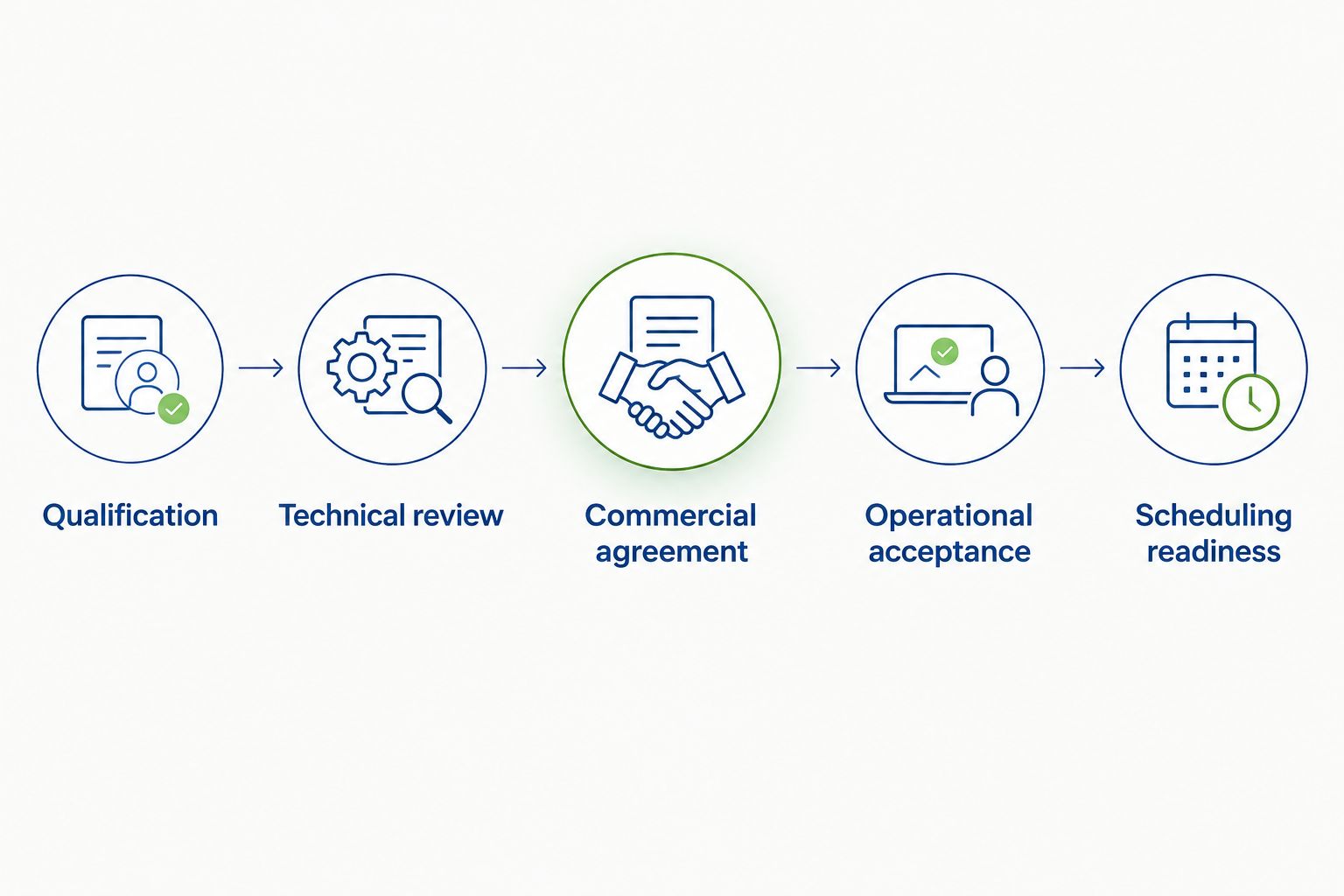
A stage should describe an observable state, not the salesperson’s confidence. Establish separate checkpoints for qualification, technical review, commercial agreement, operational acceptance, and scheduling readiness.
- Write an Exit evidence requirement for each checkpoint. Technical review, for example, should identify the approved scope, unresolved exclusions, and the reviewer responsible for the decision.
- Assign a Stage owner. Give one role accountability for moving the record and resolving missing evidence. Other people can contribute without sharing ambiguous ownership.
- Create Operational acceptance with the values Pending, Accepted, and Returned. These are proposed configuration values; apply equivalent labels consistently across connected systems.
- Require Return reason whenever operations returns a handoff. State what is missing or contradictory, who must resolve it, and what evidence will permit another review.
- Define Scheduling readiness separately. Operational acceptance confirms that the handoff is usable; scheduling readiness confirms that the required delivery conditions have been met.
Expected result: sales can explain why a deal advanced, and operations can accept or return the work without relying on an informal conversation.
Document this as your 2026 stage standard. Keep commercial agreement visible even when operational acceptance is pending; otherwise, fixing delivery visibility can accidentally erase the distinction between winning work and preparing to deliver it.
Handoff packet and routing
The handoff packet transfers commitments, not every note ever written about the customer. Keep the original proposal accessible, but identify which scope version operations is expected to execute.
- Create Accepted scope and Scope version. Reference the approved work, exclusions, assumptions, and customer responsibilities. Preserve earlier versions rather than overwriting the history.
- Add Customer commitments. Record promised deliverables, access arrangements, and any timing commitments made during the sale. Distinguish a customer request from a commitment your business accepted.
- Assign a Receiving owner in service operations. Route the packet to a named role or managed queue with a clear accountable owner—not an unmonitored shared inbox.
- Configure the handoff trigger. Use commercial agreement plus the required handoff evidence to request operational review. Do not make a won-stage change sufficient on its own.
- Configure the response. Acceptance updates the shared status; a return creates a correction task for the commercial owner. Notify the receiving owner again only when the missing evidence has been supplied.
- Test 3 outcomes: a complete packet, an incomplete packet, and a corrected resubmission. Confirm that each reaches the right owner and retains its history.
Expected result: both teams can see what was transferred, who reviewed it, and whether the work is ready for the next decision.
The sequence is simple: Qualification, Technical review, Commercial agreement, Operational acceptance, then Scheduling readiness. Each checkpoint exists because the next owner needs different evidence.
Exception ownership and review
A workflow needs a path for incomplete or changing information. Otherwise, people bypass it as soon as an urgent job appears.
- Create an Exception owner field. Assign responsibility to someone who can resolve the specific issue, such as a scope clarification or an unapproved technical commitment.
- Require Exception decision. Record whether the team corrected the packet, changed the scope, declined the commitment, or approved an explicit exception.
- Review returned handoffs by reason. Separate qualification gaps from estimating gaps, missing customer information, and internal ownership failures.
- Check the workflow against a completed job. Compare the accepted scope with the work actually delivered, then correct the rule responsible for any mismatch.
Expected result: exceptions become visible decisions rather than private workarounds. Your 2026 review should distinguish a missing field from a missing management decision; automation cannot supply authority that nobody has assigned.
When a service job changes: route scope back to sales
The reverse workflow matters when service discovers work outside the accepted scope. Keep a delivery update separate from a commercial change request.
- Let the service owner record Change description, Scope reference, and Customer request against the existing job. State what changed and whether the customer requested it or the crew discovered it.
- Require Commercial review required when the change affects the agreed scope or commitments. Routine progress notes should remain service updates.
- Assign a Commercial change owner to review the request. Preserve the original accepted scope while the proposed change is assessed.
- Record Change decision and supporting customer approval before treating additional work as authorized. Follow the customer’s contractual approval requirements rather than substituting an internal status update.
- Return the approved revision to operations with an updated Scope version. Keep the original job relationship visible so the change does not become a disconnected opportunity.
Expected result: service can surface additional work without silently expanding the job, and sales can assess the commercial decision without losing delivery context.
Troubleshooting
Won jobs still reach dispatch incomplete
The trigger is checking the deal stage rather than handoff evidence. Require a complete packet and operational acceptance before the scheduling-readiness decision; keep unresolved jobs visible in a review queue.
Sales and service show different scope versions
Someone copied the scope into a second record without maintaining the relationship. Establish an authoritative accepted scope, preserve version history, and pass its reference with every handoff and change request.
Returned work has no accountable owner
A notification is not an assignment. Require a correction owner and next action whenever operations returns a packet, then make unresolved returns visible during the commercial review.
Every service note becomes a sales task
The reverse trigger is too broad. Route only updates explicitly marked for commercial review, and require a change description tied to the accepted scope.
Staff complete fields but still bypass review
The workflow records information without controlling the decision. Check who can advance the status, who can approve exceptions, and whether operations has actual authority to return incomplete work.
Customize your workflow
Start with a service line where scope and ownership can be defined clearly. After the team can complete and return handoffs consistently, extend the pattern to other work types, customer sites, and commercial teams.
Add reporting around observable events: acceptance, return, correction, and approved scope change. Separate records awaiting customer information from records waiting on an internal decision. A single stalled category hides the action required.
Use the P.R.O. Index diagnostic to assess the commercial constraint before deciding what to install. FieldForge’s Revenue Systems work is relevant when qualification, pipeline execution, and revenue-process ownership need to operate together. For your 2026 plan, expand the system only after the initial handoff works in practice.
Assess your commercial system
Use the P.R.O. Index diagnostic to identify where your commercial process needs definition.
Return an incomplete handoff without losing the sale
Illustrative scenario—not a FieldForge client case: sales marks a service job won, but the packet omits the customer's isolation responsibilities. Operations returns the packet with that specific gap, assigns correction to the commercial owner, and retains the signed agreement. Scheduling readiness remains pending until the scope and access requirements are accepted. The return does not erase the sale; it stops an incomplete commercial promise becoming an unsupported delivery instruction.
FAQ
What does revenue operations consulting do for a field-service company?
Revenue operations consulting defines how qualification, sales decisions, operational handoffs, and follow-up work together. For a field-service company, that includes the evidence required to transfer a sold scope into delivery.
Do we need a new CRM to fix sales and service handoffs?
A new CRM is not the starting requirement. First define the owners, evidence, acceptance rules, and exception path, then assess whether your existing systems can support them.
Should a won deal automatically become a scheduled job?
A won deal should not automatically establish scheduling readiness. Commercial agreement, operational acceptance, and delivery conditions require separate checks.
Who should own the handoff from sales to operations?
Sales should own the completeness of the commercial packet, and a named operations owner should accept or return it. Corrections need a specific owner rather than shared responsibility across both teams.
What happens when a technician discovers additional work?
The service owner should document the proposed change and route it for commercial review. Preserve the accepted scope until the appropriate approval supports a revision.
Is an industrial marketing agency the same as revenue operations consulting?
An industrial marketing agency focuses on marketing execution, while revenue operations consulting addresses how commercial activity connects to decisions, ownership, and delivery. Choose based on whether the constraint is attracting buyers or managing the work those buyers create.
Where should an owner start with FieldForge?
Start with the P.R.O. Index diagnostic to assess the commercial constraint. Use that diagnosis to decide whether the business needs a Revenue Systems engagement rather than simply more activity.
One last thing
The right to return an incomplete handoff is part of the system. Without it, required fields become documentation theater: sales advances the record, operations absorbs the uncertainty, and the underlying decision remains unresolved.
Name the receiving owner and define an acceptable return reason before building the automation. That decision makes the workflow enforceable.
Related guides
- How to choose a manufacturing marketing agency
- When an industrial business needs B2B sales consulting
- Private equity value creation when the founder owns every sale