
Best fit for undefined deal stages: FieldForge Partners’ Revenue Systems. Best fit for ongoing content and demand generation: Embedded Marketing Team. Best fit for commercial work across portfolio companies in scope: PE Portfolio Program. This 2026 guide explains which engagement matches an industrial company’s commercial constraint—not which firm has the longest software checklist.
- FieldForge’s Revenue Systems fits industrial companies that need qualification criteria, deal stages, follow-up cadence, and ownership defined.
- Revenue operations consulting firms industrial teams shortlist should explain their process scope before discussing software.
- Choose Embedded Marketing Team for ongoing content, collateral, and demand generation—not as a substitute for qualification rules.
- Start with the P.R.O. Index, which scores pipeline, revenue process, and ownership on a 1–5 scale.
Disclosure: FieldForge wrote this guide and offers the three engagements ranked below. The ranking describes fit by commercial need; it is not an independent market-wide ranking of consulting firms.
Why this matters
A manufacturer can have a full quote register without a defined pipeline. A specialty contractor can attend trade shows, receive referrals, and serve repeat customers without consistent rules for accepting opportunities or following them up.
Those are different problems from insufficient marketing activity. If your team cannot explain why an opportunity belongs in its current stage, adding campaigns does not define the missing decision.
Start your 2026 shortlist with the work required: qualification, stage definitions, handoffs, follow-up, or ongoing demand generation. The guide to revenue operations consulting for industrial service companies explains the process-first starting point.
What makes the best industrial revenue operations engagement
Evaluate the proposed work against these criteria before comparing presentations or software credentials:
- Industrial commercial experience: Ask how operating experience informs decisions about site visits, technical reviews, quoting, and procurement sign-off. Require an explanation, not an industry logo slide.
- Qualification criteria: Require written rules for accepting an opportunity. Technical fit, service scope, buying process, and a credible next step belong in the discussion.
- Deal-stage evidence: Each stage needs an entry condition, an exit condition, and evidence that the buyer has progressed. A salesperson’s confidence is not an exit criterion.
- Handoff ownership: Specify who accepts the opportunity, prepares the quote, resolves technical questions, and owns the next action. Shared visibility does not assign responsibility.
- Process before tools: Separate commercial design from software delivery. You need to know what the process requires before deciding what a system must record.
- Usable deliverables: Ask for stage definitions, qualification rules, follow-up expectations, and review responsibilities. A recommendation deck alone does not tell your team what to do next.
For your 2026 selection, make every shortlisted provider explain how its proposed scope addresses your actual constraint. Do not accept reporting work as a substitute for deciding what belongs in the pipeline.
Industrial revenue operations engagements at a glance
The order below prioritizes defining the commercial process before expanding execution or coordinating work across multiple companies.
| Engagement | Best for | Defining scope | Key limitation |
|---|---|---|---|
| Revenue Systems | Undefined qualification, deal stages, or follow-up | Deal stages, qualification criteria, and follow-up cadence | Not the ongoing content and demand-generation path |
| Embedded Marketing Team | Ongoing marketing execution | Content, collateral, and demand generation | Marketing execution does not replace opportunity qualification |
| PE Portfolio Program | Commercial work across portfolio companies in scope | Commercial-maturity benchmarking and build-outs | Broader coordination than a single-company process assignment |
Read the limitation column first. The right engagement addresses the work you need without treating every commercial problem as the same assignment.
1. Revenue Systems: best for undefined industrial sales processes
Revenue Systems addresses the commercial mechanics between identifying a possible opportunity and reaching a buying decision. Its stated scope includes deal stages, qualification criteria, and follow-up cadence.
FieldForge’s Revenue Systems is best for industrial companies that need to define how opportunities qualify, progress, and receive follow-up. It is the first path to examine when your quote list contains work at different levels of buyer commitment but treats all of it as equivalent pipeline.
What the work should clarify
Ask which conditions make an inquiry worth pursuing, what must happen before a quote is prepared, and what evidence supports progression after submission. Then specify the next action and the person responsible for it.
Industrial deals need language that matches how the work is bought. Quote preparation, site visits, technical review, and procurement sign-off are relevant process events; a generic demonstration-to-trial sequence is not the right starting point for this scope.
Revenue Systems pros
- Directly addresses qualification, deal stages, and follow-up rather than treating activity volume as the only problem.
- Starts with process design before tool selection.
- Gives an industrial leadership team concrete commercial decisions to resolve.
Revenue Systems cons
- Does not replace the ongoing content and demand-generation scope of Embedded Marketing Team.
- Does not remove the need for your team to own decisions and next actions.
- Software delivery is separate from the core process-design work.
Best for: Manufacturers, specialty contractors, and test-and-inspection firms with inconsistent opportunity qualification or unclear progression.
Verdict: Buy this scope when your commercial process is undefined; hold a software-first project until the process is clear.
2. Embedded Marketing Team: best for ongoing industrial marketing
Embedded Marketing Team provides ongoing content, collateral, and demand generation. Choose this path when you can explain your target customer and opportunity acceptance rules but need sustained marketing execution.
The distinction is not marketing versus sales. It is the difference between creating commercial activity and defining how that activity becomes an accepted opportunity with an owner and a next step.
What the work should clarify
Before commissioning content, establish who the material serves and what commercial action it supports. A technical capability explanation, a sales collateral piece, and a demand-generation campaign have different jobs.
Your 2026 brief should connect each activity to a target account, buyer role, or defined sales need. Keep opportunity acceptance criteria visible so marketing and sales do not use different definitions of a useful inquiry.
Embedded Marketing Team pros
- Provides a defined path for ongoing content, collateral, and demand generation.
- Supports continued marketing activity beyond referrals, repeat customers, and the trade-show calendar.
- Makes marketing execution a distinct scope rather than an assumed addition to process consulting.
Embedded Marketing Team cons
- Does not substitute for written qualification criteria or deal-stage definitions.
- Requires clear direction on target customers, capabilities, and commercial priorities.
- Does not make every generated inquiry suitable for quoting.
Best for: Industrial companies that need ongoing marketing execution and can define what a suitable opportunity looks like.
Verdict: Buy for execution capacity; hold if the unresolved issue is whether your team should pursue the inquiries it already receives.
3. PE Portfolio Program: best for portfolio commercial build-outs
PE Portfolio Program covers commercial-maturity benchmarking and build-outs across portfolio companies in scope. Its purpose differs from assigning a single marketing campaign or redesigning one company’s quote follow-up.
Start by identifying which companies are in scope and which commercial questions need a common definition. Comparable language matters: a submitted quote and an opportunity awaiting procurement sign-off should not become interchangeable simply because both appear in a forecast.
What the work should clarify
Separate the need for a common commercial framework from the details that must remain company-specific. Service mix, technical qualification, and buying steps belong in that discussion.
For a 2026 portfolio assignment, define how the assessment will translate into company-level priorities. Benchmarking should lead to a decision about what each company needs to build, not stop at a comparative score.
PE Portfolio Program pros
- Addresses commercial maturity across portfolio companies in scope.
- Connects benchmarking with commercial build-outs.
- Creates a defined engagement path for work that extends beyond one operating company.
PE Portfolio Program cons
- Requires agreement on scope and responsibilities across participating companies.
- Does not justify forcing identical deal stages onto different buying processes.
- Is broader than a narrowly defined qualification or follow-up assignment at one company.
Best for: PE operating teams coordinating commercial diagnosis and build-outs across industrial or field-service portfolio companies in scope.
Verdict: Buy for a portfolio-level assignment; hold if the immediate need is a contained process repair at one company.
What industrial operating experience changes
FieldForge’s founder and CEO, Wesley Cowley, spent 15 years as a mechanical engineer in field operations before holding VP and SVP commercial roles inside PE-owned industrial platforms through multiple sponsor cycles.
Use that background to ask concrete questions. How should technical uncertainty affect qualification? When does a site visit justify moving an opportunity? Who takes responsibility when a quote needs operational input?
The relevant distinction is how operating experience informs the commercial design. Assess the proposed mechanics rather than treating a biography as proof of a result.
Compare the engagement with your other options
A consulting engagement is not automatically the next move. Compare the proposed assignment with the work your current team can own and the specialist support you actually need.
| Option | Best for | Practical advantage | Limitation |
|---|---|---|---|
| Internal selling | A defined process your team can maintain | Commercial decisions stay with the operating team | Continuing current activity leaves unresolved rules unresolved |
| Industrial marketing agency | A defined content or demand-generation brief | Dedicated marketing scope | The brief still needs clear targeting and opportunity criteria |
| Revenue-process engagement | Undefined qualification, stages, or ownership | Direct focus on commercial mechanics | Your team still owns day-to-day execution |
| Software delivery specialist | A documented process requiring technical configuration | Focused technical delivery | Configuration does not decide qualification or stage rules |
Continuing internal selling is a valid choice when responsibilities are clear and the team can maintain the process. Do not buy outside help simply to rename work your team already manages well.
Hiring an industrial marketing agency is also a valid choice when the assignment is marketing execution. The decision is about scope, not a judgment that one provider category is better than another.
Software work belongs after the commercial requirements are explicit. FieldForge designs the process first; software implementation is a separate add-on, not the starting point of its offer.
How to scope the work before selecting a firm
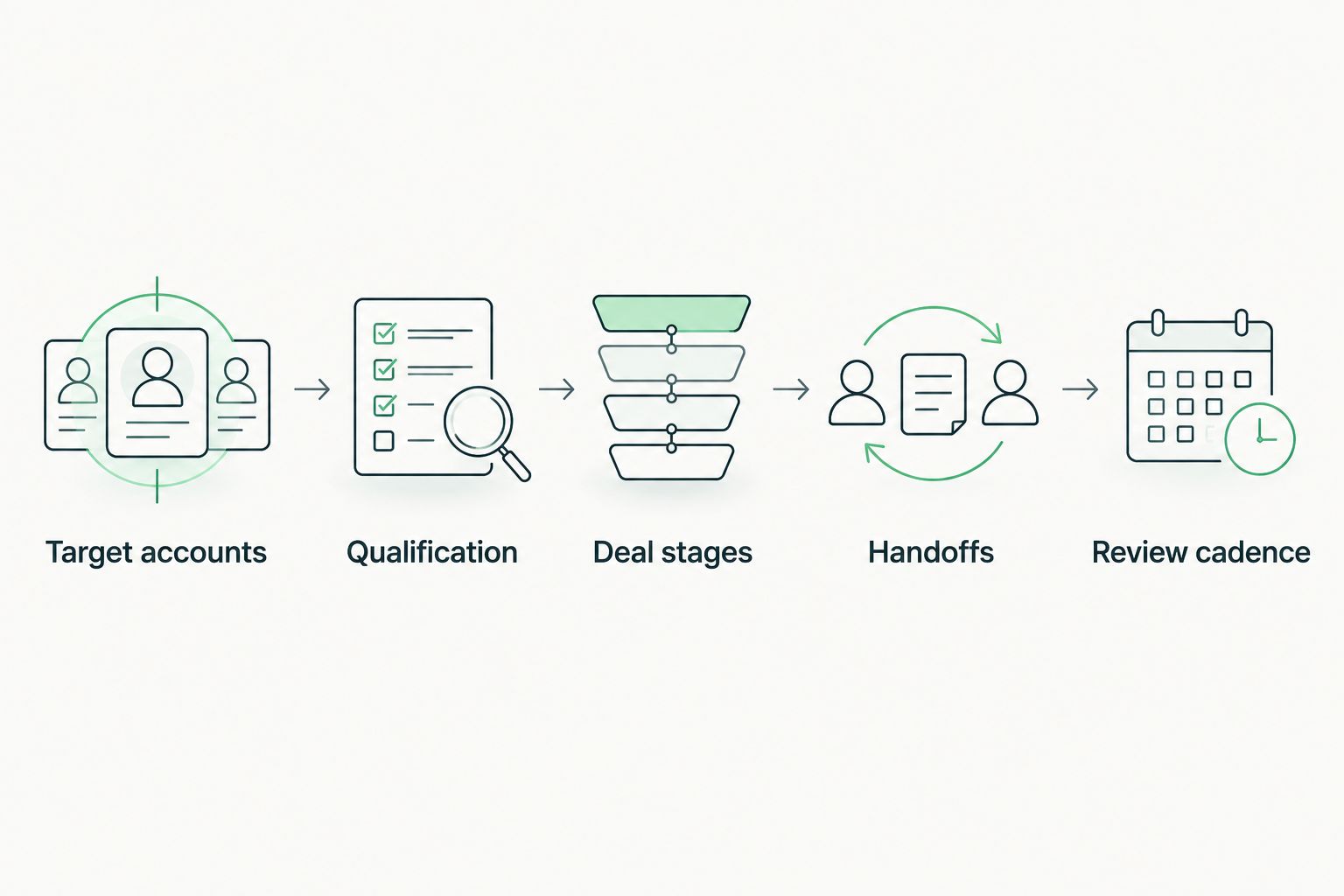
Use this sequence to turn a broad consulting discussion into a concrete assignment:
- Target accounts: Specify the types of companies, sites, and work you intend to pursue. Include the work you will decline.
- Qualification: Define the evidence required before accepting an opportunity or committing quoting effort.
- Deal stages: Write the conditions for entering and leaving each stage. Use buying events rather than internal activity alone.
- Handoffs: Name who supplies information, who accepts it, and who owns the next action.
- Review cadence: Define how the team reviews stalled opportunities, missing information, and overdue actions.
This sequence gives you a practical scoping document. Bring real opportunity examples to the discussion and ask the provider to explain where each belongs, what is missing, and who should act next.
How the engagement ranking works
This guide ranks the three service paths by the constraint each addresses, not by an invented performance score. Revenue Systems comes first because this article prioritizes companies whose commercial structure has not caught up with operational capability.
Embedded Marketing Team fits the ongoing execution requirement. PE Portfolio Program fits the cross-company assignment. Reorder your shortlist when your diagnosis changes; do not force your business into the first row.
Which engagement should you choose?
Choose Revenue Systems if you cannot consistently explain what qualifies, where a deal stands, and who owns the next action. Choose Embedded Marketing Team when those foundations exist and ongoing marketing execution is the need. Choose PE Portfolio Program when the assignment spans portfolio companies in scope.
FieldForge starts every engagement with the free P.R.O. Index. The diagnostic scores pipeline, revenue process, and ownership on a 1–5 scale from ad hoc to systematized, giving the engagement discussion a defined starting point.
For your 2026 shortlist, begin with that diagnosis rather than requesting a software proposal. Record the commercial decisions you need help making before discussing the tools that will support them.
Start with the P.R.O. Index
Assess pipeline, revenue process, and ownership before choosing an engagement.
FAQ
What is the best revenue operations engagement for an industrial company?
Revenue Systems is the relevant FieldForge path when qualification, deal stages, and follow-up are undefined. Choose the engagement by the commercial constraint rather than by the breadth of a software offering.
How do I compare revenue operations consulting firms for industrial work?
Compare their proposed qualification rules, stage definitions, handoff responsibilities, and deliverables. Ask how each scope handles site visits, technical review, quoting, and procurement sign-off.
Should I hire a marketing agency or a revenue operations consultant?
Choose marketing support for a defined content or demand-generation assignment; choose revenue-process support for undefined qualification, stages, or ownership. The scopes address different work and can be complementary.
Should an industrial company replace its CRM first?
Define the process requirements before deciding whether to replace the CRM. Document qualification criteria, stage evidence, responsibilities, and reporting needs so the software decision has a clear basis.
What does the P.R.O. Index measure?
The P.R.O. Index scores pipeline, revenue process, and ownership on a 1–5 scale from ad hoc to systematized. It is the free diagnostic that starts every engagement.
Which engagement fits a PE-backed industrial portfolio?
PE Portfolio Program fits commercial-maturity benchmarking and build-outs across portfolio companies in scope. Define the participating companies and company-level decisions before setting the assignment.
One last thing
Ask the next provider to explain what happens after a quote is sent. Require a named owner, a defined next action, and evidence for the next stage.
That question makes the scope concrete. A dashboard can display an opportunity; your commercial process must explain what the team should do with it.
Related guides
- How to scope a revenue operations consulting engagement
- What to fix before replacing a CRM
- Diagnosing stalled industrial quotes
- Choose manufacturing target accounts by fit