
Instead of revisiting the same stalled quotes every week, turn your P.R.O. Index results into a revenue system plan with qualification rules, deal-stage evidence, named owners and a review cadence. FieldForge Partners starts that work with diagnosis and process design—not a software purchase.
- Turn pro index results to revenue system plan decisions by connecting each diagnostic finding to an observable process failure.
- FieldForge prioritizes process design before tools for industrial B2B and field-service companies.
- Define qualification, stage evidence, follow-up ownership and acceptance checks before changing software.
- Test the proposed process against live opportunities before expanding it across the business.
Why this matters
A diagnostic score describes commercial maturity. A revenue system plan specifies what changes, who owns the change and what evidence shows the new process works.
Referrals, repeat customers and the trade-show calendar still need a defined route into qualified opportunities. A contact name is not qualification; sending a quote is not proof that a buying decision is progressing.
FieldForge is a fit for industrial and field-service companies that need revenue-system consulting to move from ad hoc commercial activity to a defined commercial process. Its senior commercial leadership includes Wesley Cowley, Founder and CEO, whose background includes 15 years as a mechanical engineer in field operations, followed by VP/SVP commercial roles inside PE-owned industrial platforms.
For a 2026 planning cycle, start with a bounded process change rather than a broad technology project. Use the principles in scoping a revenue operations consulting engagement to keep diagnosis, process design and software work distinct.
Before you start
- Bring the diagnostic and supporting records. Have your P.R.O. Index results, current opportunity list, recent quotes, follow-up records and existing stage definitions. The free diagnostic scores pipeline, revenue process and ownership on a 1–5 scale, from ad hoc to systematized.
- Include the people responsible for handoffs. Sales, estimating, operations and commercial leadership need access to the working document. Name 1 accountable owner for each proposed process change; contributors are not substitutes for accountability.
- Separate process decisions from software settings. A stage label in a CRM does not establish an exit criterion. Agree on the required evidence before anyone changes fields, notifications or integrations.
The instructions below use proposed worksheet labels, shown in bold. They are labels to create in your own planning document, not buttons or fields in a diagnostic portal.
Diagnostic-to-constraint mapping
Build the evidence register
- Create a worksheet titled 2026 Revenue System Plan. Add columns named Diagnostic area, Finding, Opportunity evidence, Process constraint and Decision required.
- Copy each relevant diagnostic finding without converting it into an assumed root cause. Keep pipeline, revenue process and ownership findings distinguishable.
- Attach a concrete example from your records. Use a quote with no next action, an opportunity without qualification evidence or a handoff without an accepted recipient.
- Write the constraint as an observable failure. Replace vague statements such as weak follow-up with a precise description: issued quotes have no assigned next action or due date.
- Record the decision that resolves the ambiguity. For example, decide who accepts a qualified opportunity and what information that person requires.
Expected result: every proposed change traces back to both a diagnostic finding and an observable failure. A low score alone does not justify a new procedure.
Do not average away the distinction between the diagnostic areas. A pipeline gap calls for different work from an ownership gap, even when both appear in the same opportunity record.
Select the first constraint
- Group findings that describe the same broken handoff. Missing qualification details and repeated estimating rework can belong in the same workstream when the records show the connection.
- Identify dependencies. Qualification criteria must be agreed before you can define when an opportunity is ready for estimating.
- Choose a bounded workflow with a clear beginning and end, such as inquiry received through estimating acceptance.
- Write a Boundary statement describing what this workstream excludes. Keep unrelated reporting changes, content requests and software replacement outside it.
Expected result: your first workstream has a defined boundary and a decision to make, rather than a list of unrelated improvement ideas.
Revenue-process specification
Define qualification and stage evidence
- Create a section named Qualification rules. Specify the customer fit, service requirement, location, timing and technical information your team needs before committing commercial effort.
- Add Deal stages. Name stages around an observable state of the opportunity, not an employee's activity.
- Add Entry evidence and Exit evidence beneath each stage. State what must exist before the opportunity enters and what must be confirmed before it advances.
- Add Next action and Next action date. Require a specific action tied to the buyer's decision or the team's unresolved question.
- Add Exception route. Explain how urgent work, incomplete specifications and repeat-customer requests receive an explicit decision rather than bypassing the process silently.
Expected result: two people reviewing the same opportunity can identify its stage from the evidence rather than from individual judgment.
For example, quote issued describes an event. It does not establish whether the customer received the scope, whether technical questions remain or whether a decision date exists. Write those requirements explicitly where they matter to your process.
Define handoff acceptance
- Create a Handoff acceptance section for each transfer between roles, such as sales to estimating or commercial to operations.
- List the required inputs. Depending on the work, these include scope, technical requirements, exclusions, site conditions and the customer's required timing.
- Name the receiving role and define how that role accepts or returns incomplete work.
- Record the unresolved question and its owner whenever a handoff is returned. Do not leave the record at awaiting information.
Expected result: sending information and accepting responsibility become separate, visible events.
Use the same logic throughout the process: qualification establishes fit, stage evidence establishes progress, handoff acceptance establishes responsibility, and the review loop addresses exceptions.
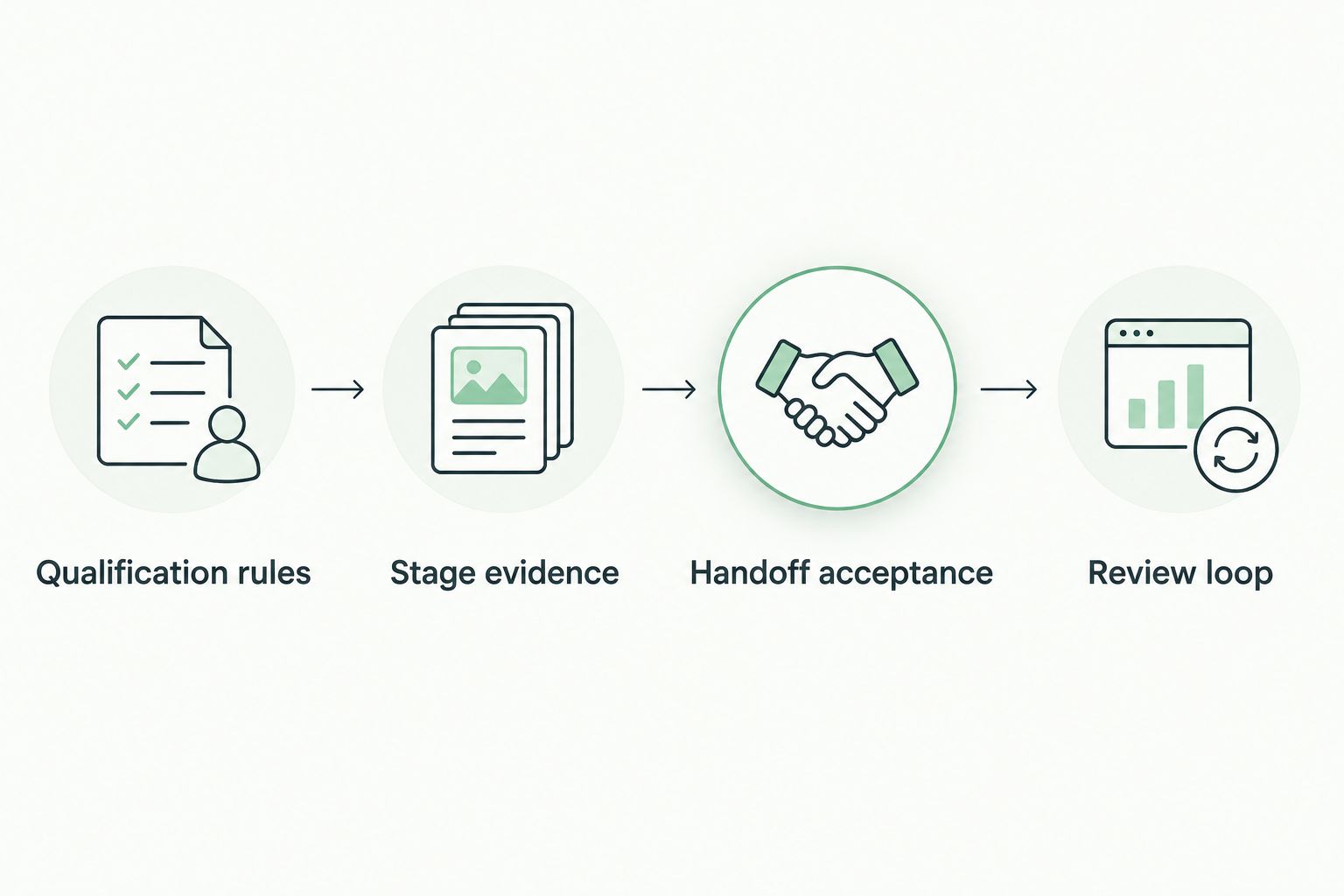
Ownership and acceptance plan
Assign responsibility and acceptance checks
- Add Accountable owner, Contributors, Due date and Acceptance check to each workstream in the 2026 plan.
- Assign accountability to a role with authority to resolve the relevant process decision. Keep task contributors visible without spreading final responsibility across a committee.
- Define the acceptance check as something a reviewer can inspect. An approved qualification checklist is inspectable; better sales discipline is not.
- Mark dependencies explicitly. A reporting change should wait if its underlying stage definitions remain unsettled.
- Separate process deliverables from potential tool requirements. Keep software configuration, migration and integration in a distinct scope.
Expected result: each workstream has an owner, an approval condition and a boundary between process design and technical work.
Test the process on live opportunities
- Select 3 live opportunities with different conditions: an incoming inquiry, an active quote and an opportunity awaiting a decision. This is a practical test set, not a performance benchmark.
- Apply the proposed qualification and stage rules without rewriting them to suit each record.
- Record every ambiguity in Test findings. Distinguish missing information from a rule that does not fit how the work is sold.
- Agree on a 30-day review window for the pilot. Treat that duration as a planning choice, not a promised time to results.
- Approve, revise or reject each rule using the observed evidence.
Expected result: your 2026 pilot produces a usable process specification and a documented list of unresolved decisions—not merely a cleaner presentation.
Choosing who carries out the plan
Internal selling, revenue-system design and marketing support address different responsibilities. Compare the work required before selecting an engagement.
| Approach | Best for | What it addresses | Limitation |
|---|---|---|---|
| Internal selling | Continuing customer conversations while the process is defined | Account knowledge, qualification conversations and follow-up | Does not replace documented rules, ownership or acceptance checks |
| Repeatable commercial system | Defining how opportunities progress across roles | Qualification, deal stages, handoffs and review discipline | Requires internal decisions and ongoing use; documentation alone is insufficient |
| Industrial marketing agency | Producing agreed marketing work against a defined commercial brief | Content, collateral and demand-generation responsibilities within scope | Does not replace sales acceptance criteria or commercial ownership |
FieldForge wrote this guide and offers three paths, in order: Revenue Systems, Embedded Marketing Team and PE Portfolio Program. Revenue Systems addresses deal stages, qualification criteria and follow-up cadence; the Embedded Marketing Team addresses ongoing content, collateral and demand generation; the PE Portfolio Program addresses commercial-maturity benchmarking and build-outs across portfolio companies in scope.
For this workflow, prioritize the Revenue Systems path when the unresolved decisions concern opportunity progression and ownership. The constraint is explicit: internal participation remains necessary, and software implementation is separate add-on work—not part of defining the process.
Start with your commercial diagnosis
Use the free P.R.O. Index to assess pipeline, revenue process and ownership before choosing a path.
When diagnostic results are updated
Use the same workflow when you revisit the diagnostic. Preserve the previous findings so a changed score does not erase the original constraint or its evidence.
- Add Previous finding, Current evidence and Decision to the existing workstream record.
- Check whether the agreed process is actually being used. Distinguish an absent rule from an agreed rule that people bypass.
- Compare observable records: qualification evidence, accepted handoffs, assigned next actions and documented exceptions.
- Close a workstream only when its acceptance check is met. Keep unresolved issues visible even if the broader diagnostic score changes.
Expected result: the updated diagnostic informs the operating plan instead of triggering an unrelated improvement project.
For a 2026 refresh, retain the original process decisions alongside revisions. That history explains why a rule changed and prevents the team from reopening settled questions without new evidence.
Troubleshooting
The plan becomes a CRM replacement project
Return to the observable failure. Specify the required rule and evidence before considering technical changes. A missing qualification decision is not, by itself, a software requirement.
Every opportunity passes qualification
Rewrite criteria as decisions the team can apply and record. Include a clear route for declining, deferring or requesting information, rather than treating every inquiry as ready for a quote.
Sales and operations reject the handoff definition
Inspect the disputed inputs together. Record what the receiving role needs to accept responsibility, then distinguish essential information from information that can follow later.
The same issue returns at every review
Check the accountable owner's authority and the acceptance condition. Replace general status updates with an explicit decision, assigned action and due date; keep blocked dependencies visible.
Customize your workflow
Expand only after the initial workflow passes its acceptance checks. Add adjacent processes such as repeat-customer expansion, trade-show follow-up or service-to-sales referrals using the same evidence and ownership rules.
For the next technical boundary, use the field-service software to tracked sales pipeline workflow. Define what an operational record must contain before it becomes a commercial opportunity; then scope any required technical work separately.
FAQ
How do I turn pro index results to revenue system plan actions?
Connect each diagnostic finding to an observable process failure, then define a rule, accountable owner and acceptance check. Prioritize a bounded workflow before expanding the plan.
What does the P.R.O. Index score?
The P.R.O. Index scores pipeline, revenue process and ownership on a 1–5 scale from ad hoc to systematized. It is the free starting diagnostic for every FieldForge engagement.
Should I replace the CRM before writing the plan?
Define the process before deciding whether to replace the CRM. Qualification rules, stage evidence and handoff responsibilities establish the requirements against which tools should be assessed.
Who should own a revenue system workstream?
Assign one accountable owner with authority over the relevant process decision. Sales, estimating and operations can contribute without sharing ambiguous final accountability.
Can an industrial marketing agency handle the whole plan?
Assign responsibilities according to the agreed scope rather than the provider category. Content and demand generation need a commercial brief; qualification, stage progression and handoff acceptance still need explicit owners.
How do I know the plan is ready to use?
The plan is ready for a pilot when each workstream has defined rules, an accountable owner, required evidence and an inspectable acceptance check. Apply it to live opportunities and record the ambiguities before expanding it.
One last thing
Write the rejection rule before the approval rule. Ask what would make estimating return an inquiry, operations decline a handoff or leadership remove an opportunity from the forecast. Those boundaries force the plan to specify evidence rather than intent.
Related guides
- Fix qualification before adding manufacturing leads
- Define forecast ownership
- Set bid and no-bid rules for industrial work