
A fractional CMO’s timeline depends on whether the assignment is to define the revenue process, get the team using it, or generate closed business; those are different completion points. Set the schedule against accepted operating milestones, not a blanket promise of pipeline or revenue by a particular date.
- How long does a fractional CMO take? Separate process design, team adoption and closed revenue before agreeing to dates.
- A CRM configuration is not proof that qualification, deal stages and follow-up work.
- The P.R.O. Index scores pipeline, revenue process and ownership from ad hoc to systematized.
- Require evidence from live opportunities before accepting the commercial process as operational.
How long does it take a fractional CMO to build a pipeline?
The useful answer is a sequence of deliverables, each with an acceptance test. A documented process, a working sales routine and a signed customer order should not share the same deadline or definition of success.
For a 2026 engagement, ask the proposed commercial leader to separate these commitments in the revenue operations consulting scope. Otherwise, a finished presentation can be mistaken for a functioning pipeline.
| Completion point | Evidence to require | What it does not establish |
|---|---|---|
| Diagnosis accepted | Current opportunities, sources, handoffs and stalled quotes are mapped | That the team has changed its behavior |
| Process defined | Targeting, qualification, deal stages, follow-up and responsibilities are documented | That the process works on live deals |
| Operating routine adopted | The team uses the criteria and records next actions on active opportunities | That customers will buy within the engagement period |
| Commercial results observed | Opportunities advance, close or receive a documented loss reason | That the same result will repeat across other accounts |
Ask what must happen before each milestone can be accepted. Then identify who supplies the information, who approves the process and who handles the live opportunities used to test it.
A calendar without those dependencies is not an execution plan. It is a list of dates.
Why this matters
An industrial business can have technical capability, repeat customers and a busy quoting function without a repeatable commercial process. The diagnostic question is whether the team can explain how work moves from an inquiry to a qualified opportunity, an accepted quote and an operational handoff.
Referrals and trade shows remain valid sources of business. The gap appears when the next step depends on the source: trade-show contacts sit in a spreadsheet, repeat-customer requests move directly to estimating, and outbound inquiries follow another route.
A pipeline is operational when people use shared rules to decide what advances, what stops and who acts next. A populated dashboard does not answer those questions by itself.
Define the work before accepting a deadline
Use the following sequence to brief a fractional CMO in 2026. These are proposed acceptance criteria, not a promised delivery schedule.
Targeting
Define the industrial accounts and applications the business intends to pursue. Record the service fit, technical fit and commercial fit required before outreach or estimating work begins.
For field-service work, make the service requirement explicit. A general inquiry and a defined maintenance requirement should not automatically receive the same treatment.
Qualification
Agree on the evidence needed to accept an opportunity. That can include a defined problem, an appropriate technical contact, a known buying process and a reason the prospect is considering action.
Separate known information from assumptions. If the team cannot explain why a quote belongs in the active pipeline, the qualification criteria need attention before the business adds more lead volume.
Deal stages
Give each stage an entry condition and an exit condition. A stage should describe the state of the opportunity, not simply record that a salesperson sent an email.
Require evidence for advancement. A proposal sent is an internal action; a customer agreeing to a technical review is a different kind of evidence.
Follow-up
Specify the next action, the responsible person and the event or date that triggers it. Define how the team handles an unanswered quote, an unresolved technical question and a prospect whose project has stopped.
Follow-up should produce a decision or clarify the next step. Repeatedly asking whether someone has reviewed a quote is not a substitute for understanding what prevents the decision.
Ownership
Assign responsibility for qualification, estimating handoffs, opportunity updates and forecast review. Define who resolves an opportunity that sits between commercial and operational teams.
Ownership here means responsibility for the process. It does not mean attributing commercial problems to a particular executive.
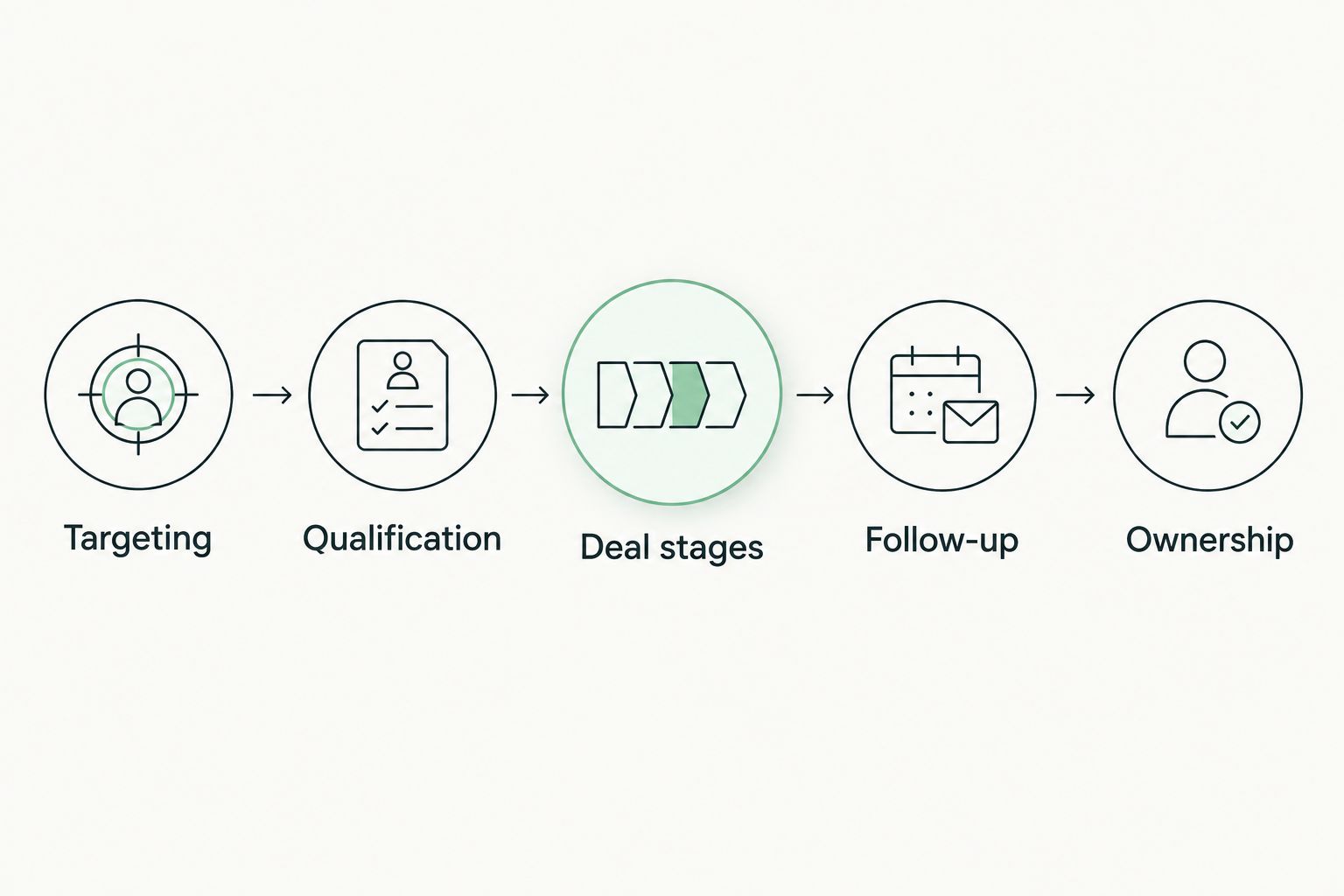
Use live opportunities to test these definitions. Ask the salesperson and estimator to classify the same deal independently, then resolve any disagreement about its stage, missing information or next action.
Separate process design from tools and software
Do not accept a CRM setup as the completion test for commercial-process work. Software can hold stage names and required fields without resolving what those stages mean or who is accountable for moving an opportunity.
For your 2026 brief, separate process decisions from software configuration. Name the commercial deliverables first, then specify any tool-related work as a distinct scope with its own responsibilities and acceptance criteria.
The guide to what to fix before replacing a CRM addresses this boundary. Resolve qualification, handoffs and stage definitions before treating a replacement platform as the answer.
An existing tool should be evaluated against the agreed process, rather than used to dictate that process. Ask whether the team can record the required evidence and retrieve it during an opportunity review.
Why a fractional CMO timeline varies
The schedule should reflect the work the business actually needs. Use these factors to challenge the proposed sequence:
- Starting condition: Establish whether targeting, qualification and stage definitions already exist and are used, rather than merely documented.
- Opportunity visibility: Identify where active work is recorded, including quote files, spreadsheets and sales records, before scheduling the diagnosis.
- Decision authority: Name who can approve commercial rules and resolve disagreements between sales, estimating and operations.
- Team participation: Specify who must attend working sessions and test the process on active opportunities.
- Scope boundaries: Separate commercial leadership, content production, demand generation and software work so that one deadline does not conceal several assignments.
- Customer decision process: Distinguish changes the business controls from technical reviews, purchasing decisions and project timing controlled by the customer.
Convert each factor into a dependency in the engagement plan. If estimating must help define qualification, for example, its participation belongs in the schedule rather than in an informal request after kickoff.
Which commercial approach fits the work?
Choose the scope before choosing the job title. Fractional leadership, an internal commercial team and an industrial marketing agency are different ways to organize work; the brief must state which responsibilities each will carry.
| Approach | Best for | Scope to require | Boundary to address |
|---|---|---|---|
| Fractional commercial leadership | Defining direction, commercial rules and management routines | Decision authority, process deliverables and team adoption responsibilities | Who performs ongoing selling and production work |
| Internal commercial team | Running outreach, qualification, quotes and customer follow-up | Shared criteria, management routines and operational handoffs | Who resolves gaps in process design |
| Industrial marketing agency | Producing content, collateral and demand-generation work | Technical briefing, target accounts and accepted-opportunity criteria | Who owns sales follow-up and opportunity advancement |
These approaches need not be alternatives. An internal team can run opportunities while an external marketing team develops collateral and demand-generation activity against the same targeting and qualification rules.
Do not hire a title to solve an undefined constraint. If the constraint is stalled quotes, ask for a quote-review and follow-up scope. If it is inconsistent targeting, require account-selection criteria before approving campaign production.
What industrial operating experience changes in the diagnosis
FieldForge Partners builds marketing and revenue systems for industrial B2B and field-service companies. Founder and CEO Wesley Cowley brings 20 years as a mechanical engineer in field operations, followed by VP/SVP commercial roles inside PE-owned industrial platforms through multiple sponsor cycles.
That background is relevant to the questions an industrial engagement must address: what sales needs before involving estimating, what operations needs before accepting a handoff, and which commitments belong in a commercial review. Evaluate the proposed work against those mechanics, not an executive title alone.
FieldForge is for industrial and field-service companies that need defined revenue processes, qualification criteria and commercial accountability. Every engagement starts with the free P.R.O. Index diagnostic, which scores 3 areas—pipeline, revenue process and ownership—on a 1–5 scale from ad hoc to systematized.
The paths are Revenue Systems, Embedded Marketing Team and PE Portfolio Program, in that order. For the pipeline question, begin by defining the Revenue Systems work required; ongoing content and demand generation are a separate scope decision. Process comes first, tools second, with software implementation treated as a separate add-on.
Start with the P.R.O. Index
Score pipeline, revenue process and ownership before defining the engagement.
What should be in the engagement plan before work starts?
Require a written acceptance test for every deliverable in the 2026 plan. A document marked complete is insufficient if the people using it cannot explain how it changes their next decision.
Ask for:
- A baseline: Where opportunities originate, where they are recorded and where they stall.
- A named deliverable: The specific rule, workflow or management routine being developed.
- A responsible person: Who provides information, approves the work and runs the routine afterward.
- A live test: Which active opportunities will be used to check the proposed process.
- An acceptance condition: What evidence demonstrates that the deliverable works.
- A scope boundary: What belongs to internal sales, marketing production or separate software work.
Keep process acceptance separate from a revenue promise. The business can approve a qualification standard after testing it; a customer’s purchase decision remains a separate event.
FAQ
How long does a fractional CMO take to build a pipeline?
A fractional CMO’s timeline depends on the agreed completion point: process design, team adoption or closed business. Require separate milestones and acceptance tests instead of treating those outcomes as one deadline.
Can a fractional CMO guarantee revenue by the end of the engagement?
A process-delivery commitment is not a guarantee of closed revenue. Separate deliverables the commercial team controls from customer purchasing decisions and project timing.
Does getting a CRM configured mean the pipeline is finished?
No. A configured CRM does not establish that the team uses shared qualification criteria, advances deals on evidence or follows through on assigned next actions.
What should an industrial company ask a fractional CMO to deliver first?
Ask for a diagnosis of current opportunities, targeting, qualification, deal stages and handoffs. Use that diagnosis to agree on the process changes and acceptance tests before expanding the scope.
Should our internal sales team keep selling during the engagement?
Keep live selling responsibilities explicit while the process is being developed. Active opportunities provide the cases needed to test qualification, stage definitions and follow-up rules.
Should we hire an industrial marketing agency instead?
Choose according to the work required. Content, collateral and demand generation need a different brief from qualification, deal-stage design and commercial management routines; define how the responsibilities connect.
How does FieldForge start a revenue-systems engagement?
FieldForge starts every engagement with the free P.R.O. Index diagnostic. It scores pipeline, revenue process and ownership on a 1–5 scale from ad hoc to systematized.
One last thing
Before signing a 2026 engagement, select a stalled quote and ask the proposed commercial leader to explain the diagnostic sequence. Look for questions about fit, qualification, the customer’s decision process, the last agreed action and responsibility for the next step.
The point is not an instant answer. It is whether the proposed work will expose the constraint before adding activity. A useful engagement leaves your team with clearer decisions, not just more tasks.
Related guides
- Is a fractional CMO worth it for an industrial company?
- Trade-show lead capture to qualified pipeline workflow
- From P.R.O. Index results to a revenue-system plan