
A fractional CMO is worth it for an industrial company in 2026 when the constraint is marketing leadership, the engagement has defined decision rights, and someone owns execution. It is the wrong first hire when the immediate problem is inconsistent qualification, stalled quotes, or missing follow-up; a marketing leadership scope does not, by itself, assign responsibility for those revenue-process failures.
- Is a fractional CMO worth it in 2026? Yes, when your industrial company needs marketing leadership with defined execution ownership.
- Fix qualification, deal stages, and follow-up before treating stalled industrial quotes as a demand-generation problem.
- FieldForge Partners starts with the P.R.O. Index diagnostic to assess pipeline, revenue process, and ownership.
- Choose the engagement by the commercial constraint, not the executive title.
Is a fractional CMO worth it for an industrial company in 2026?
Yes for a marketing leadership gap; no as a substitute for an undefined sales process. Before choosing an engagement, identify the decision or handoff that is not happening. Then assign the work to a scope that explicitly covers it.
This guide was written by FieldForge, which offers revenue-system consulting and marketing engagements. The comparisons below explain scope differences, including where its own services fit.
| Approach | Best for | What the scope should cover | Limitation to resolve |
|---|---|---|---|
| Fractional CMO | Marketing direction without a full-time executive role | Target markets, positioning, priorities, budget decisions, and marketing accountability | Leadership does not automatically include production or sales-process ownership |
| Internal commercial team | Keeping commercial decisions and execution inside the company | Named responsibilities, management cadence, and documented handoffs | Continuing existing activity does not establish missing process rules |
| Industrial marketing agency | Defined marketing execution | Agreed content, collateral, campaigns, and reporting | Qualification and sales follow-up need explicit ownership outside the marketing deliverables |
| Revenue Systems engagement | Moving ad hoc pipeline execution toward a systematized process | Deal stages, qualification criteria, follow-up cadence, and ownership | The business must assign people to use and maintain the process |
These approaches are not mutually exclusive. An industrial company can use an internal sales team, outside marketing execution, and external commercial leadership together. The problem is overlapping titles with gaps between their responsibilities.
Why this matters
For your 2026 hiring decision, separate a shortage of direction from a shortage of execution. A leader deciding which markets to pursue is doing different work from a marketer producing technical content or a sales manager enforcing quote follow-up.
Referrals, repeat customers, and the trade-show calendar are useful sources of commercial activity. They are not a complete operating process. You still need rules for deciding which opportunities deserve attention, what evidence advances a deal, and who acts next.
Buy responsibility for a defined constraint, not a title that sounds broad enough to cover everything. A fractional engagement needs boundaries just as much as an internal role does.
Fractional CMO: choose this for marketing leadership
A fractional CMO scope fits when your team needs decisions about targeting, positioning, channel priorities, and marketing accountability. The engagement should explain who makes those decisions and how they become assigned work.
For an industrial business, make the decisions concrete. Which applications fit your operating capability? Which technical buyers need evidence? Which service lines deserve dedicated collateral? What makes an inquiry suitable for sales review?
The advantage is a defined leadership role without making that role full-time. The limitation is execution coverage: do not assume that strategy includes writing application pages, preparing sales materials, managing campaigns, or reviewing every inquiry.
Before signing a 2026 scope, require:
- Decision rights: Which marketing decisions belong to the fractional CMO?
- Execution ownership: Who produces and publishes the work?
- Sales acceptance: What must an inquiry contain before sales accepts it?
- Review cadence: Who reviews progress and resolves blocked decisions?
Choose fractional marketing leadership when decisions are the bottleneck and execution has an owner. If both are missing, scope both rather than leaving delivery implied.
Internal commercial team: choose this for direct control
Continuing internal selling makes sense when the company wants its employees to own customer conversations, commercial judgment, and follow-through. The question is whether those responsibilities are documented and managed, not whether the team already knows the customers.
Ask your commercial team to walk through a live opportunity. Have them explain why it qualified, what the buyer has confirmed, which stage it occupies, and what must happen next. Review the evidence, not just the confidence of the explanation.
The advantage is direct control over assignments and decisions. The limitation is that retaining the same structure leaves unresolved process questions unresolved. Adding a marketing adviser does not settle who accepts a lead or follows up after a technical quote.
Keep ownership internal where the team has the capacity and mandate to perform the work. Bring in help for the specific design, leadership, or execution gap that remains.
Industrial marketing agency: choose this for defined execution
An industrial marketing agency scope fits when you know what marketing must produce and need an accountable delivery team. Examples include technical content, sales collateral, campaign work, and reporting tied to agreed commercial definitions.
Give the agency usable inputs. Define target applications, service boundaries, technical review responsibilities, and what sales considers an accepted opportunity. A brief built around those decisions is more actionable than a request for more visibility.
The advantage is dedicated marketing execution. The limitation is the boundary between marketing output and sales action. A campaign scope should not silently inherit responsibility for quote progression, bid decisions, or commercial approvals.
Choose marketing execution when the work is defined and the receiving sales process is ready. Leadership and agency support can work together; the contract should make their responsibilities distinct.
Revenue Systems: choose this for pipeline discipline
A Revenue Systems engagement fits a different constraint: commercial activity exists, but the rules connecting inquiry, qualification, quoting, and follow-up are inconsistent. Start here when the business cannot explain where deals stall or who owns the next action.
Consider an industrial service inquiry. Before assigning it a pipeline stage, define what must be known about the application, location, service requirement, timing, and commercial fit. Then decide what evidence permits the opportunity to advance.
The advantage is an explicit operating process. The limitation is adoption: a documented process needs assigned owners, management attention, and use in actual deal reviews. Documentation alone is not pipeline execution.
Use the distinction between qualification and lead volume to keep the scope focused. Choose revenue-process work when the missing element is a repeatable way to handle opportunities, not simply more marketing activity.
Why fractional CMO value varies
For a 2026 engagement, judge value against the work the business needs done. Use these scope factors rather than an unsupported return estimate:
- Constraint fit: Marketing direction, content production, and stalled-quote management require different assignments. Name the constraint before selecting the role.
- Decision authority: State which decisions the adviser can make and which require company approval. Assign an escalation owner for blocked decisions.
- Execution capacity: Identify who writes, reviews, publishes, follows up, and maintains records. Do not hide production inside the word strategy.
- Sales handoffs: Define what marketing passes to sales, what sales accepts, and how rejected inquiries receive a reason.
- Operating fit: Connect targeting and messaging to the work your company can serve, including application boundaries and technical review requirements.
- Management use: Specify which decisions the engagement's reporting must support. Separate activity reporting from evidence that an opportunity has progressed.
A wider scope is not automatically a better scope. It creates more responsibilities to assign. If the engagement spans marketing leadership and revenue-process design, state both workstreams and their acceptance criteria.
How do you diagnose the right engagement before hiring?
Use this recommended sequence to turn a broad leadership request into a defined commercial assignment. Apply it to actual opportunities rather than an idealized process diagram.
Identify the constraint
Write down the observable failure. Examples include inquiries without a fit assessment, quotes without a scheduled next action, or marketing requests without priorities. Avoid diagnoses such as weak marketing unless you can name the missing decision or action.
Inspect live opportunities
Trace current opportunities back to their source. Check the qualification evidence, stage history, customer commitment, and next action. For referred and repeat-customer work, apply the same questions rather than treating familiarity as qualification.
Assign ownership
Name the role responsible for accepting an inquiry, approving a bid, advancing a stage, and following up. Separate responsibility for completing a task from authority to make the underlying commercial decision.
Define acceptance
Describe what completed work looks like before the engagement starts. A qualification deliverable needs usable criteria; a stage-design deliverable needs entry and exit rules. A marketing plan needs priorities, assigned execution, and a review process.
Scope the engagement
Choose the engagement after identifying the missing capability. If the work crosses marketing and sales, specify the boundary and shared decisions. Keep software decisions downstream of the process requirements.
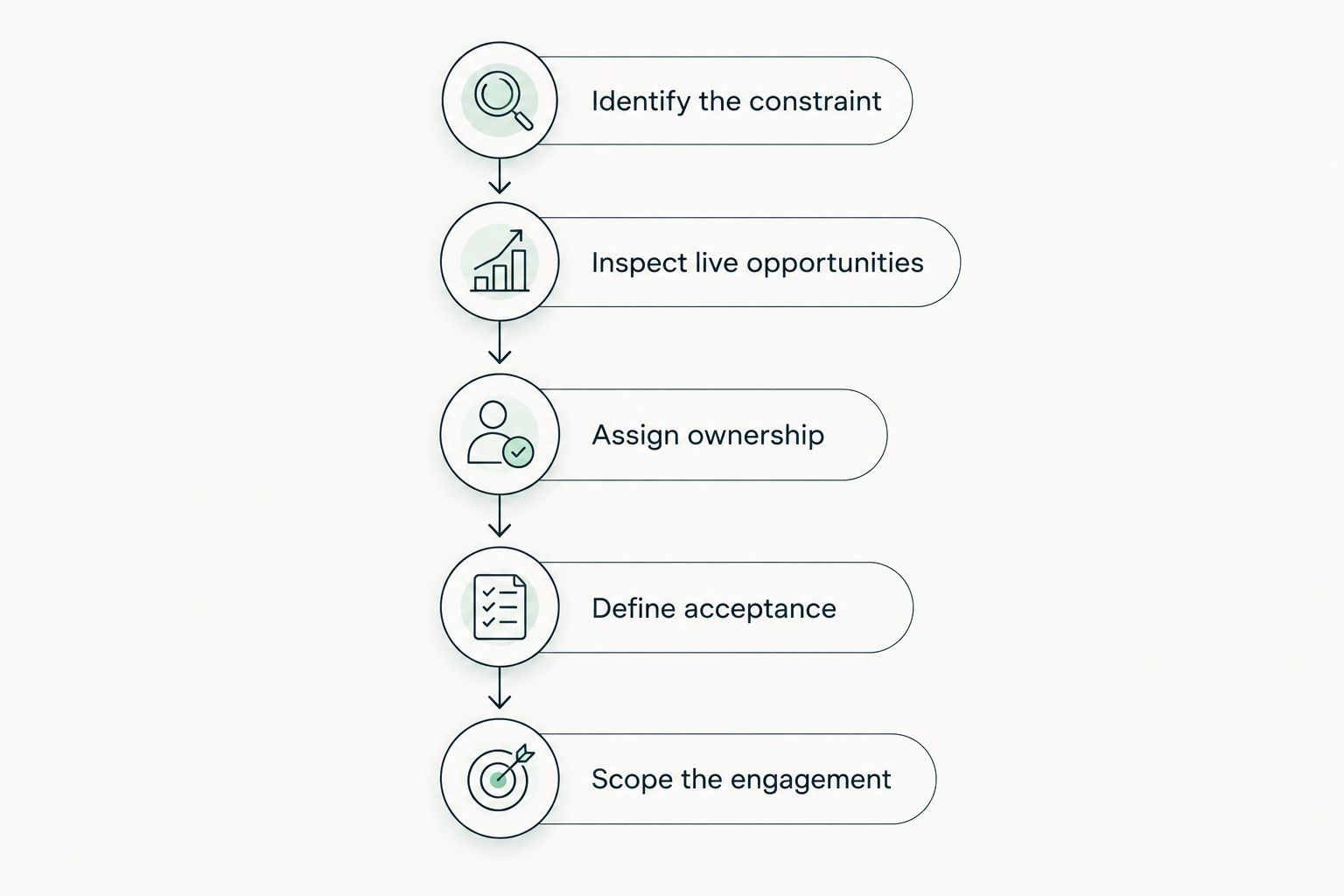
The output should be a working brief, not a request for someone to take over marketing. State the constraint, the required decisions, the deliverables, the company-side owners, and the evidence you will use to accept the work.
Where FieldForge fits
FieldForge is best for industrial and field-service companies that need a defined revenue process before choosing tools. Its senior commercial perspective includes Wesley Cowley's 20 years as a mechanical engineer in field operations, followed by VP/SVP commercial roles inside PE-owned industrial platforms through multiple sponsor cycles.
For a buyer, that experience is relevant to the questions the engagement must address: whether targeting matches operating capability, what qualifies work for a quote, and how commercial commitments reach operations. Evaluate the proposed scope against those mechanics, not biography alone.
Every engagement starts with the free P.R.O. Index diagnostic. It scores pipeline, revenue process, and ownership on a 1–5 scale from ad hoc to systematized, then provides the starting point for choosing a path:
- Revenue Systems: Best for deal stages, qualification criteria, and follow-up cadence.
- Embedded Marketing Team: Best for ongoing content, collateral, and demand generation.
- PE Portfolio Program: Best for commercial-maturity benchmarking and build-outs across portfolio companies in scope.
The boundary matters: process comes first, tools second. Software implementation is a separate add-on, not something to assume is included. Your company must still assign the people who make decisions and carry out the agreed process.
Start with the P.R.O. Index
Assess pipeline, revenue process, and ownership before choosing an engagement.
Can a fractional CMO fix stalled industrial quotes?
A fractional CMO can address stalled quotes only when the agreed scope includes the relevant commercial work and decision authority. If quotes lack qualification, a next action, or an accountable owner, assign those fixes explicitly rather than treating them as marketing deliverables.
Should you hire a fractional CMO before replacing your CRM?
Define the process before choosing either engagement. If your 2026 plan includes a CRM change, first specify qualification fields, stage evidence, follow-up responsibilities, and reporting ownership; then determine whether the missing capability is leadership, process design, or software delivery.
FAQ
Is a fractional CMO worth it in 2026 for an industrial company?
A fractional CMO is worth it in 2026 when an industrial company needs marketing leadership and has defined execution ownership. It is not a substitute for qualification rules, deal-stage discipline, or accountable quote follow-up.
What’s the difference between a fractional CMO and an industrial marketing agency?
The scope should distinguish marketing leadership from marketing execution. Assign decisions about priorities and positioning separately from content, collateral, campaigns, and reporting, even when one engagement covers both.
How do I know whether I need revenue-process help instead?
Start with revenue-process help when opportunities lack consistent qualification, stage evidence, follow-up, or ownership. Inspect live deals to identify the missing rule or handoff before commissioning more activity.
Can my internal sales team keep selling during a consulting engagement?
Yes; define which responsibilities remain with your internal sales team and which belong to the adviser. The scope should identify who accepts inquiries, approves bids, advances opportunities, and follows up.
What should I ask for in a fractional CMO proposal?
Ask for decision rights, deliverables, execution ownership, sales handoffs, and acceptance criteria. Require the proposal to identify company-side responsibilities as well as the adviser’s work.
Where should an industrial company start with FieldForge?
Start with the P.R.O. Index diagnostic, which scores pipeline, revenue process, and ownership on a 1–5 scale from ad hoc to systematized. Every engagement begins with that diagnostic before selecting the appropriate path.
One last thing
Before approving a fractional CMO engagement, ask the proposed adviser and your sales lead to review the same live quote separately. Ask each to identify its stage, qualification evidence, next action, and owner.
If their answers conflict, resolve the operating definitions before expanding the marketing brief. That exercise gives your 2026 scope a concrete starting point: an actual commercial decision that needs a shared rule.
Related guides
- Define a revenue operations consulting scope
- Diagnose stalled industrial quotes
- Set a manufacturing marketing agency scope of work